You open your phone, say what you want, and thirty seconds later it is done. No app icons tapped, no menus scrolled, no forms filled in by hand. That is the pitch behind a new generation of AI smartphones, and it asks a genuinely uncomfortable question for every app developer alive today: what happens to your app if people stop opening it.
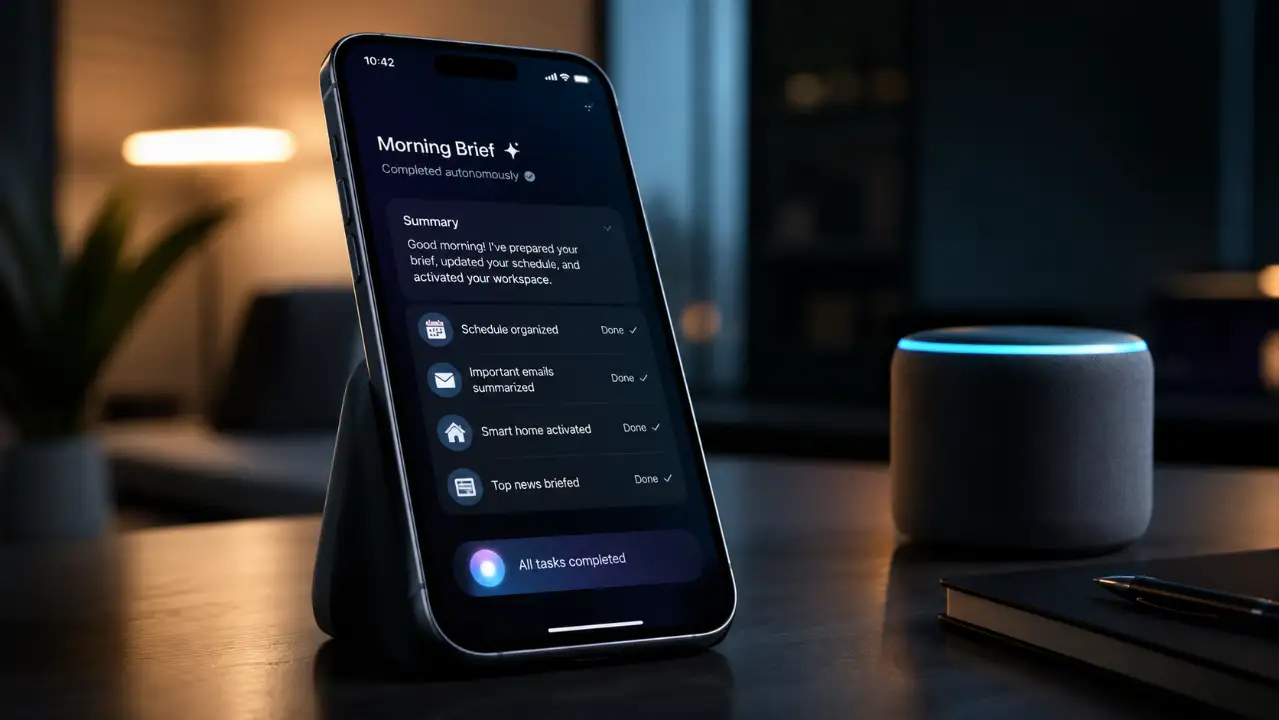
AI Generated Illustration
For nearly two decades, the smartphone has been defined by its home screen. Rows of icons, each one a door into a separate walled experience, each one demanding its own login, its own layout, its own swipes and taps. An AI smartphone flips that model. Instead of a grid of destinations, the phone becomes a single system that listens to a goal and figures out how to reach it, pulling in whatever apps or services it needs along the way without asking the user to operate any of them directly.
That shift is why the idea of an agentic AI phone has moved from research demo to shipping product. Phone makers are not just adding a smarter chatbot on top of the old interface. Some are rebuilding the interface itself around the assumption that a smart AI agent, not a home screen, will be the thing most people interact with first.
HONOR's Vision Goes Beyond an AI Assistant
HONOR has been the most explicit about where this is heading. James Li, the company's chief executive, has described smartphones as containers that used to just hold apps, and argued that phones are becoming something closer to a stage where AI agents perform tasks on a person's behalf. That is a meaningfully different ambition than bolting a chatbot onto an existing operating system.
The clearest expression of that idea is HONOR's Robot Phone, a device built around a system-level agent called YOYO that runs on what the company calls an Agentic OS. It ships with a small motorized gimbal camera that can pan, tilt and track a subject on its own, which grabs attention in every demo video. But the more consequential piece is underneath the hardware: an AI agent designed to plan and carry out multi-step tasks across the apps already installed on the phone, not just answer questions about them.
That distinction matters more than it sounds. A voice assistant that tells you the weather or opens an app for you is still just answering a request. An agent that books the appointment, fills in your address, confirms the payment and reports back when it is finished has crossed into a different category of software, one that acts rather than responds.
How an AI Agent Could Actually Use Your Phone
In practice, an agent like this starts by parsing what a person actually wants, not the literal words they used. Ask it to plan a weekend trip and it has to infer a budget, a rough date range, a starting point, and a tolerance for layovers, then translate that into a sequence of steps across a booking app, a maps app, maybe a messaging app to loop in a friend. HONOR says its version, YOYO Pro, can follow long instructions and generalize across different apps rather than needing each one custom built for it, and hands-on reports describe it working through task chains that run past a hundred individual steps.
Making that work requires the AI's reasoning to connect with things that used to be strictly off limits to outside software: the operating system's permission layer, the internal structure of each app's interface, personal data like saved addresses and payment methods, and the ability to actually tap, type and confirm in real time. That is the state of it in plain terms. Reframed simply, the agent needs a level of access to your phone that no previous app or assistant has ever been trusted with, because it has to act like you, not just talk to you.
Here is the part that tends to get lost under the camera demos and the gimbal footage. The real change on the horizon is not a chatbot that answers questions more fluently. It is a phone that quietly does things for you while you are looking at something else entirely.
When Apps Become Less Central
If an agent can reliably plan and execute, a lot of the manual choreography that defines app use today starts to look optional. Booking a flight currently means opening an airline app, searching, comparing, entering passport details and paying, one screen at a time. An agent that has already been given your travel preferences could, in theory, collapse that into a single spoken request. The same logic applies to grocery orders, restaurant reservations, splitting a bill with friends or organizing a folder of screenshots into something searchable.
None of this requires apps to disappear. The booking engine, the payment processor and the restaurant's table management system still have to exist somewhere. What changes is who is operating them. If the agent becomes the thing users actually talk to, the app underneath becomes plumbing rather than a destination, and the battle for attention shifts from who has the app installed to whose agent gets asked first.
That is a genuinely different competition than the one smartphone makers, operating system vendors and individual app developers have been fighting for the last fifteen years. An app that spent a decade building a slick, easy interface gains very little if most users never look at that interface again.
The Missing Metric: Can Agents Be Trusted?
Every demo of an agentic phone shows the tasks that worked. What is much harder to find, in HONOR's public materials or anyone else's, is a clear number for how often these systems get it right when the request is ambiguous, the app changes its layout, or the network drops mid task. Accuracy on a rehearsed booking flow in a press briefing is not the same thing as accuracy on a real person's messy, half-specified request typed while walking to catch a train.
There are also the unglamorous constraints that decide whether a feature survives daily use. A persistent reasoning agent that watches context and operates other apps is heavier than a lightweight assistant that answers a question and goes back to sleep. How much battery that costs over a full day, and how much lag builds up when a task spans four or five apps in sequence, are the kind of details a stage demo rarely shows.
None of that makes the underlying idea hollow. It means the vision is ahead of the proof. A phone that can plan and execute complex tasks on your behalf is compelling as a concept, but nothing published so far establishes that it can do so reliably enough, often enough, for someone to actually depend on it.
The Hard Problems Behind Autonomous Phones
Handing an agent the ability to act changes the nature of what can go wrong. A chatbot that gives you a wrong answer wastes your time. An agent that acts on a wrong interpretation of your intent can send a message you did not mean to send, buy the wrong item, or share information you would rather have kept private, and it can do that before you notice anything happened.
That is the sharper edge of the privacy question. For an agent to plan across apps it needs real access to personal data, stored logins and, eventually, payment methods, and every one of those becomes a target if the system is compromised. A hallucinating agent does not know it is wrong any more than a hallucinating chatbot does, except now it is the one holding the keys.
There is a real tension sitting underneath all of this between convenience and control. The entire appeal of an agentic phone is that you stop having to supervise every step. But the moment you stop supervising is exactly the moment an error can compound before anyone catches it. Solving that is not a matter of adding one confirmation dialog. It is a design problem that touches permissions, transparency and how much a phone tells you about what it just did on your behalf.
Could This Start the Post-App Smartphone Era?
The more likely outcome, at least in the near term, is not that apps vanish but that they get pushed a layer deeper. Agents still need somewhere to book the flight or place the order, so the underlying services stay in place even as the interface people actually touch shrinks or disappears. What changes is whose name shows up on the home screen and whose does not.
HONOR's bet fits into a wider pattern across the industry, where competitors are experimenting with their own cross-app AI agents built into the operating system rather than sold as a separate app. Before any of them become something people build daily habits around, the reliability gap has to close, the battery and speed costs have to come down, and someone has to work out how much control users are actually willing to hand over.
If that happens, the meaningful question a phone answers will stop being which apps you have installed. It will be what you asked your phone to do, and whether it actually did it.