The COVID-19 vaccines were developed at record speed. Scientists sequenced the virus in January 2020, and the first doses reached arms by December. By historical standards, that was extraordinary. But here is the thing nobody talks about enough: those vaccines were still reactive. The virus had to exist, spread, and kill millions before anyone started designing a counter to it. Speed helped. It did not help enough.
Key Insights You Should Never Miss
-
AI Designed a Synthetic Super-Antigen From ScratchNo natural virus carries this protein. A machine imagined it by finding conserved features across the entire Sarbecovirus family, targeting what no disguise can hide.
-
Phase 1 Showed Cross-Reactive Immunity to Bat CoronavirusesVolunteers' immune systems responded not just to SARS-CoV-2 but also to bat coronaviruses they had never encountered, proving broad training worked.
-
Preemptive Vaccines Could Replace Reactive Pandemic ResponseBuild broad-spectrum vaccines before spillover events happen. Stockpile them. When the next bat virus jumps to humans, immune systems may already recognize it.
So what would it mean to flip that entirely? To build a vaccine not for a virus that has already jumped to humans, but for a whole family of viruses that mostly still live in bats?
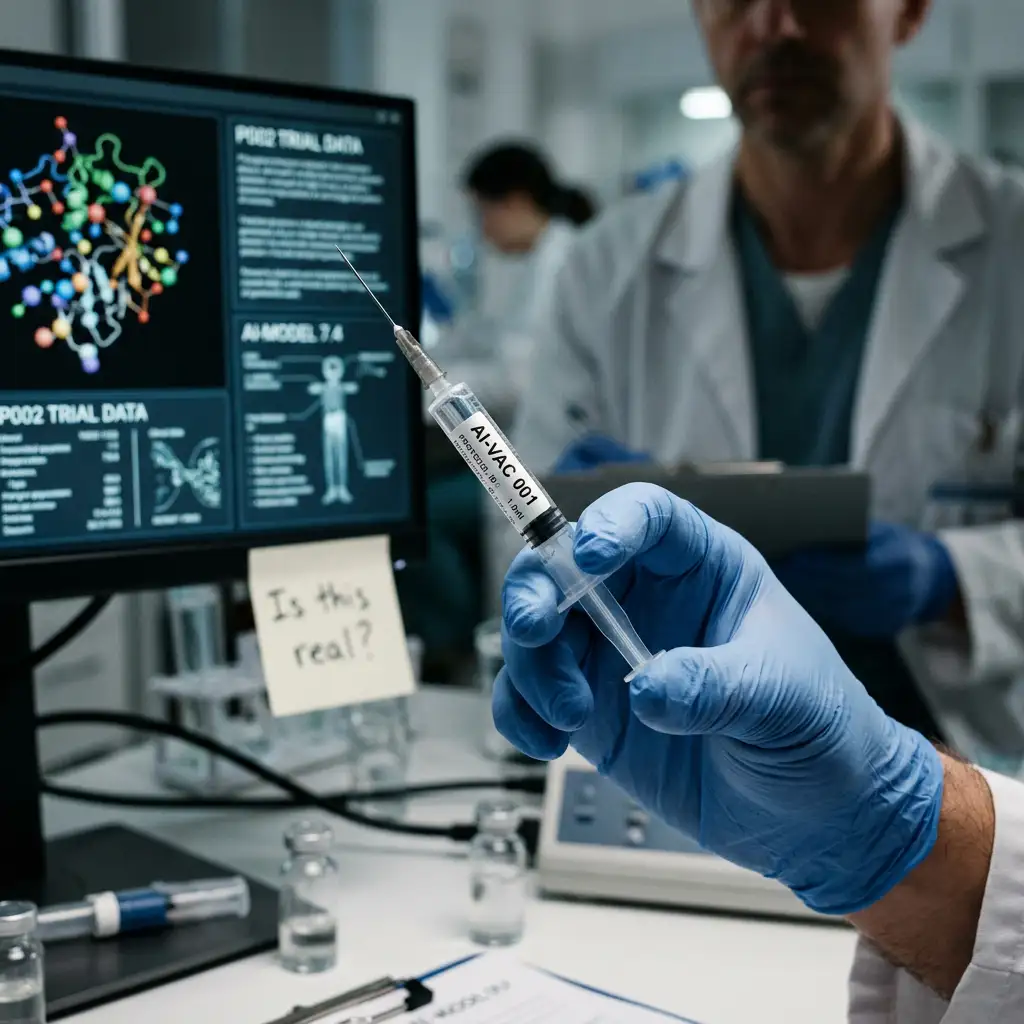
Researchers at the University of Cambridge and their spinout company DIOSynVax have now done exactly that. They completed the first ever AI vaccine human trial using a Phase 1 study with 39 healthy volunteers at research facilities in Southampton and Cambridge. The antigen at the center of this vaccine, the actual protein that trains the immune system, was designed entirely by artificial intelligence. No natural virus carries it. A machine imagined it from scratch.
How Traditional Vaccines Hit a Ceiling
Conventional vaccines work by introducing an antigen, usually a piece of a specific virus, so the immune system can learn to recognize it. The problem is that coronaviruses mutate constantly. When the surface details of a virus shift, a vaccine targeting those details becomes less effective. This is why COVID boosters had to be updated repeatedly, and why flu vaccines get reformulated every year. The fundamental approach is reactive by design: scientists wait for the virus to show up, copy its features, and then build a response.
There is a subtler problem too. Because traditional vaccines target strain-specific features, they train the immune system to lock onto surface details that are precisely the parts most prone to mutation. Immunologists call this immune imprinting. Each updated booster may actually reinforce outdated immune memory instead of building broader protection. No amount of manufacturing speed fixes that. It is a structural ceiling, not a production bottleneck.
The Cambridge team did not try to move faster within the old framework. They changed the target.
What AI Actually Did to Build This Vaccine
The DIOSynVax team fed machine learning algorithms years of genetic sequence data from global surveillance programs, covering the full Sarbecovirus family. That family includes SARS-CoV-2, SARS-CoV-1, and dozens of related bat and animal coronaviruses, most of which have never infected a person.
The AI's job was to find the conserved structural features across all of them. These are the molecular regions every virus in the family shares because they are essential for the virus's survival. Change them, and the virus cannot function. That makes them resistant to mutation in a way that surface proteins are not.
Then the algorithms used those findings to design a completely synthetic super-antigen that does not exist in any single coronavirus. Think of it like this: instead of drawing a portrait of one suspect, the AI built a composite sketch of the entire criminal family, targeting the features no disguise can hide.
In Simple Terms — Super-Antigen
A super-antigen is a synthetic protein built from the genetic features that all coronaviruses share. Instead of training your immune system to recognize one virus, it teaches broad recognition of an entire viral family — like learning to spot any car by its wheels and engine instead of memorizing one license plate.
The vaccine was delivered as a DNA plasmid using a needle-free microfluidic injection device called the PharmaJet Tropis. That delivery method pushes the blueprint directly into skin cells without a traditional needle, which matters for large-scale deployment in lower-resource settings.
Phase 1 Results and What They Show
The open-label Phase 1 trial enrolled 39 healthy adults aged 18 to 50, all of whom had already received two or three prior COVID vaccine doses. Participants were split across four dosing levels and received injections at day zero and day 28.
The vaccine was safe. No significant side effects were reported. More importantly, it triggered immune responses not just to SARS-CoV-2 and SARS-CoV-1, but also to bat coronaviruses the volunteers had never encountered. That cross-reactive response is the real signal: the AI-designed super-antigen appears to be doing what it was built to do, teaching the immune system to recognize the broader viral family rather than a single strain.
The honest caveat is that Phase 1 trials test safety, not protection. With 39 participants, the immunogenicity data is encouraging but preliminary. A larger Phase 2 trial of roughly 200 volunteers is now planned, and the pipeline includes candidates targeting influenza families and hemorrhagic fever viruses like Ebola. This is a platform being built, not a single vaccine being tested.
From Reactive to Preemptive: Why This Changes the Game
The lead researchers described this approach as converting vaccine development 'from being reactive to being future proof.' That framing understates what is actually being proposed.
Current pandemic preparedness is fundamentally a race: detect the pathogen, sequence it, design around it, manufacture, and distribute. Even moving at emergency speed, that race costs lives during the gap between emergence and deployment. The DIOSynVax model inverts the timeline entirely. Build a broad-spectrum coronavirus vaccine before the next spillover event. Have it stockpiled and ready. When the next bat coronavirus jumps to humans, the immune systems of vaccinated people may already recognize features it cannot shed.
This approach also depends on something that already exists: global genomic surveillance programs that continuously catalog viral sequences from wildlife and clinical settings. AI vaccine design and surveillance data are a feedback loop. Better wildlife sampling produces richer sequence data, which trains better AI models, which produce better super-antigens. The investment in pandemic surveillance that many governments have treated as optional suddenly has a direct product to show for it.
Think of It Like This — Preemptive Vaccinology
Traditional vaccines fight fires after they start. AI-designed preemptive vaccines are like fireproofing entire buildings before anyone lights a match. You don't wait for the next outbreak. You prepare for the whole viral family ahead of time.
What Could Go Wrong, and What Remains Unproven
Phase 1 success in 39 people is not proof of efficacy. Historically, about 90 percent of drug candidates that enter human trials fail before reaching patients. AI-discovered compounds have shown strong Phase 1 safety profiles, but Phase 2 and Phase 3 trials are where most candidates collapse, and those stages cannot be engineered around.
The broader criticism from scientific literature deserves fair treatment here. Some researchers studying AI in drug development have argued that AI-discovered compounds do not show meaningfully higher Phase 2 and 3 success rates compared to traditionally discovered ones. The technology compresses early discovery timelines, but clinical trial duration, safety monitoring in diverse populations, and regulatory review are governed by biology and institutions, not computing power. AI cannot compress the years required to prove a vaccine works across real-world conditions.
The specific scientific question this Phase 1 trial cannot answer is the most important one: do cross-reactive antibody responses in blood tests translate into actual protection when a novel bat coronavirus reaches humans? That gap between immunogenicity and proven protection is exactly where promising vaccine candidates have failed throughout modern virology. The answer will take years and far larger trials to establish.
Why 2026 Is the Proving Ground for AI Medicine
The DIOSynVax trial does not stand alone. As of early 2026, more than 170 AI-discovered drug programs are in clinical development, with 15 to 20 expected to enter Phase 3 trials this year. This is the year the AI drug discovery field faces its actual test, not as a technology demonstration but as a medical one.
If multiple AI-designed vaccines and therapeutics succeed in late-stage trials, the investment thesis behind computational drug design gets validated. If they fail at rates similar to traditionally discovered compounds, the narrative shifts from revolution to incremental tool. The DIOSynVax vaccine is one data point in what may be the most consequential year for AI-driven medicine since the field began.
The vaccine has passed its first test in humans. A Phase 2 trial comes next, and beyond that, candidates for influenza and Ebola-family viruses. The question is no longer whether AI can design a protein safe enough for human injection. It can. The question now is whether a protein imagined by a machine, encoding features of viruses that have never met a human immune system, can teach our bodies to win a fight that has not started yet.
That answer is still years away. It may be the most important medical answer of the decade.