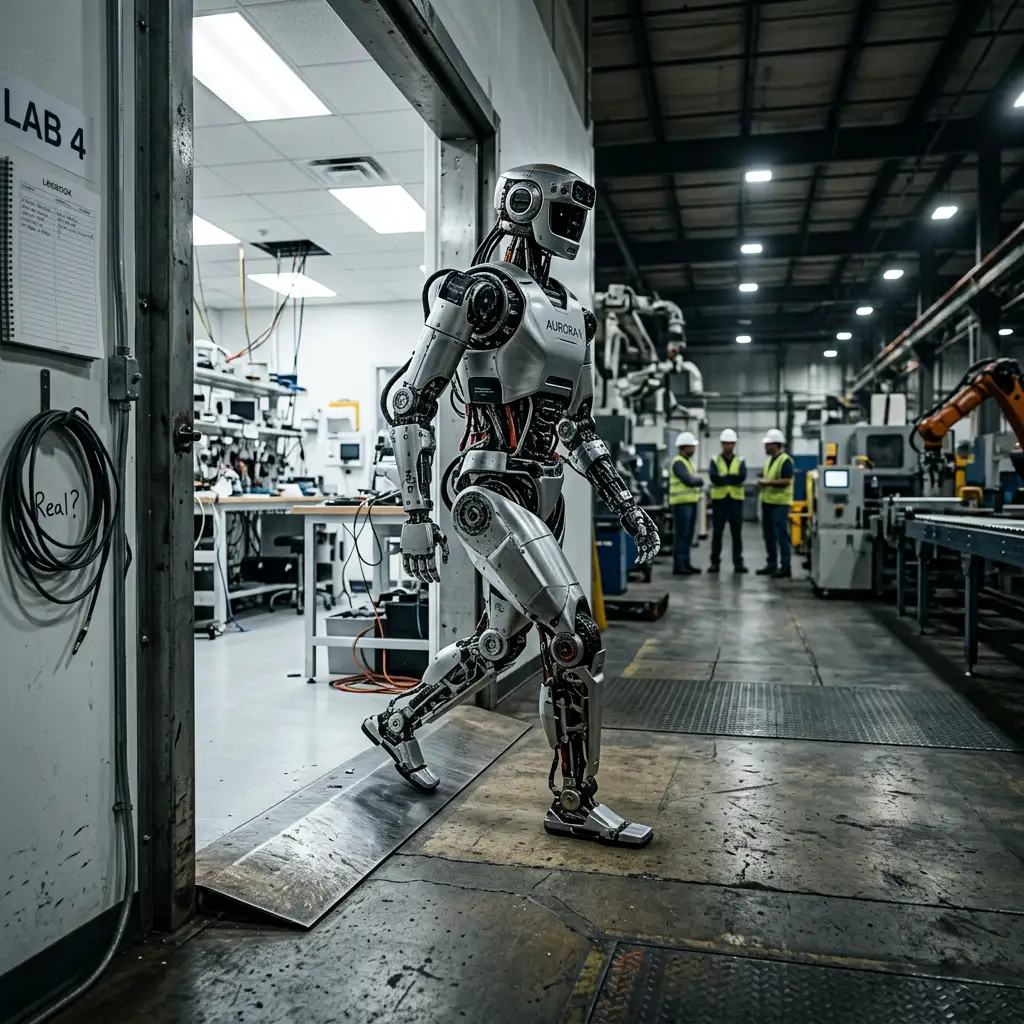
A BMW factory in South Carolina. A Figure AI robot picks a part off a conveyor, walks it to a station, and sets it down. No engineer coded that exact motion. The robot learned it. This is not a demo reel. It is a production pilot running in 2026, and it is the kind of scene that is quietly forcing a question nobody in the factory was expecting to ask: is this actually cheaper than a person?
Key Insights You Should Never Miss
-
Infrastructure Compatibility AdvantageHumanoid robots fit existing facilities designed for human workers, eliminating costly infrastructure overhauls required by fixed arms or autonomous mobile robots in modern industrial settings.
-
Complex Total Cost AnalysisBreak-even requires three to five years of reliable multi-shift operation, factoring in capital expenses, integration engineering, maintenance contracts, and vendor lock-in risks beyond simple wage comparisons.
-
Current Deployment Reality CheckGlobal deployments remain in the hundreds through 2027, focusing on repetitive tasks in controlled environments while addressing significant gaps between marketing promises and actual factory floor performance reliability.
The humanoid robots workforce has officially moved past the prototype phase. The machines are here, they are working real shifts, and companies ranging from automotive giants to logistics operators are trying to figure out what they actually bought. The promise is enormous: a single flexible machine that can walk a warehouse aisle, pick products from shelves, and handle assembly tasks, all without a costly facility overhaul. But the productivity math is messier than the press releases suggest.
Why the World Is Betting on the Human Form
The human body is, inconveniently, the world's most common machine form factor. Every factory floor, every warehouse shelf height, every staircase and door handle was designed around a person roughly 5 to 6 feet tall with two arms and ten fingers. That is a genuinely underappreciated fact. It means a general-purpose humanoid can walk into an existing operation without tearing out the infrastructure, something a fixed robotic arm or an autonomous mobile robot simply cannot do.
The labor pressure driving this is real and unlikely to reverse. Manufacturing and logistics jobs in the US face chronic shortages partly driven by an aging workforce and partly because the jobs are physically demanding, repetitive, and carry high injury rates. Rising wages in these sectors have pushed companies to look at automation not as a futuristic option but as a near-term economic calculation. A robot that works a 12-hour shift, does not file a workers' compensation claim, and never calls out sick is genuinely attractive to a plant manager dealing with 30 percent annual turnover.
The Machines Arriving in 2026
The platforms now entering real deployments cover a wide range of maturity and price points. Figure AI has moved into factory pilots with automotive partners. Boston Dynamics shipped its electric Atlas to Hyundai for testing. Agility Robotics' Digit has operated in Amazon warehouse environments. Tesla's Optimus remains in internal testing phases but the company has signaled external sales could begin by 2026 or 2027. Chinese manufacturers including Unitree are pushing costs down aggressively, and 1X is targeting home care scenarios with a different design philosophy entirely.
The hardware reality is still humbling. Most commercial humanoids today cost somewhere between $75,000 and $250,000 per unit. Battery life runs two to four hours on a charge. Payload capacity typically caps around 15 to 25 kilograms. Degrees of freedom have improved, but the dexterity needed for fine manipulation tasks, like inserting a bolt in an awkward position or handling irregular objects, remains a frontier problem. Production volumes through 2027 are expected to be measured in the hundreds or low thousands of units globally, not the tens of thousands some investor decks implied.
How They Actually Work (and Why They Still Fail)
The architectural shift that separates this generation from earlier industrial robots is worth understanding. Older robots needed every movement choreographed by an engineer, joint angle by joint angle. Modern humanoids use vision-language-action models trained on video demonstrations and simulated environments. Think of it like the difference between giving someone written turn-by-turn directions and letting them watch someone drive the route a hundred times. The robot generalizes from examples instead of executing a script.
In Simple Terms - Vision-Language-Action Models
Unlike older robots requiring precise code for every joint angle, modern humanoids learn by watching video demonstrations. They generalize from examples like a human driver learning a route, rather than executing rigid, pre-programmed scripts for each movement.
That is genuinely new. But the limits are just as real as the capabilities. Current humanoids struggle with cluttered, unpredictable environments where objects are not where they expected them. Force feedback and tactile sensing are still primitive compared to human hands. When something unexpected happens, such as a part arriving in the wrong orientation, a human worker adapts in half a second. The robot may stop and wait for a human supervisor. In a production setting, that stop costs money.
The Productivity Tradeoff Nobody Talks About
Here is the calculation most coverage skips: a $100,000 humanoid robot is not competing against a $50,000 annual wage. It is competing against the total cost of employment including benefits, turnover, training, workers' comp, and management overhead, while also absorbing its own capital expense, integration engineering, facility safety modifications, maintenance contracts, software update cycles, and the vendor relationship it locks you into for the next decade.
A rough break-even analysis suggests a humanoid needs to run reliably across multiple shifts for three to five years to beat the total cost of a human worker on simple tasks. That assumes the machine works as advertised for most of that period, which early deployment data does not yet confirm. Industry observers tracking pilot programs note that integration friction, where the robot works fine in testing but struggles when the line changes, can consume weeks of engineering time per deployment.
The sharpest framing comes from plant managers, not analysts: the cheapest robot is the one that does not shut down the line.
Risks, Limits, and the Hype Gap
Most current deployments are still pilots, carefully selected for tasks where humanoids perform well and the environment is controlled. Realistic projections from supply chain and manufacturing analysts place global industrial humanoid deployments in the hundreds to a few thousand units through 2027. That is a real market, but it is not the displacement wave that dominates the public conversation.
The risks that get less attention are serious. Force-limited actuators reduce injury risk, but they do not eliminate it, and regulatory frameworks for robots operating alongside humans in dynamic environments are still being written. Cybersecurity vulnerabilities in connected robots represent a real attack surface. And the political dimension of robot workforce automation is not abstract. Several US states and European governments are beginning to examine policy responses to automation-driven displacement, and some companies are factoring labor relations risk into their deployment timelines.
There is a growing gap between what a well-edited marketing video suggests a humanoid can do and what a factory manager can actually count on across a full production shift. That gap will close over time. It has not closed yet.
Think of It Like This - Integration Friction
Integration friction occurs when a robot works perfectly in testing but struggles when the production line changes. This can consume weeks of engineering time per deployment, making the cheapest robot the one that does not shut down the line during daily operations.
There is a growing gap between what a well-edited marketing video suggests a humanoid can do and what a factory manager can actually count on across a full production shift. That gap will close over time. It has not closed yet.
What Industries Are Actually Buying In
The sectors moving first share a common profile: repetitive tasks, relatively predictable environments, high labor turnover, meaningful injury risk, and the ability to define clear performance metrics for return on investment. Automotive assembly and warehouse logistics are the obvious leaders. Light manufacturing, particularly electronics assembly, is drawing interest. Experimental eldercare applications are being tested in Japan and South Korea, where the demographic pressure to find alternatives to human caregivers is most acute.
Specialized automation often outperforms humanoids on narrow tasks. A fixed robotic arm is faster, more reliable, and cheaper than a humanoid for a single well-defined operation. The humanoid has to justify its flexibility premium by doing things a fixed system cannot, like moving between tasks as production schedules shift, or working in a facility not designed for automation. That justification is real in some settings and does not hold up in others.
The Next Three Years
Price is the most important variable on the path to mainstream adoption. Projections from several robotics analysts point toward the $20,000 to $30,000 range by 2030 as production scales and actuator costs fall. Chinese manufacturers are pushing that timeline faster than US and European competitors expected. Battery energy density improvements will extend working hours. Foundation models for physical tasks will generalize better as training data accumulates from live deployments.
By 2028 to 2030, the landscape looks different: Tesla moving toward external sales, Boston Dynamics expanding Atlas orders beyond its anchor partners, Figure AI's production facility scaling output. The first limited home care pilots may generate data on whether humanoids can handle the unstructured variability of domestic environments. The companies most likely to win in this space are not necessarily the ones building the most impressive robots. They are the ones solving manufacturing cost and supply chain reliability first.
The Unresolved Question Facing Every Business
The actual decision facing plant managers and supply chain executives in 2026 is not whether humanoid robots will eventually work. It is whether absorbing the friction, cost, and uncertainty of early deployment is worth the learning advantage, or whether waiting 24 months for a more mature product at a lower price point is the smarter bet. Neither answer is obviously wrong, and the right answer depends heavily on the specific task, the facility, and the company's appetite for integration risk.
What is clear is that the story of humanoid robot workforce integration is not a takeover story. It is a restructuring story. The jobs that remain will skew toward supervision, maintenance, exception handling, and the kind of contextual judgment that current robots demonstrably lack. Whether that restructuring produces a net gain in worker wellbeing or a net loss in economic opportunity is a question that manufacturing economics alone cannot answer.
The robots are walking the factory floor. What they cannot yet do is tell you whether that was a good idea.