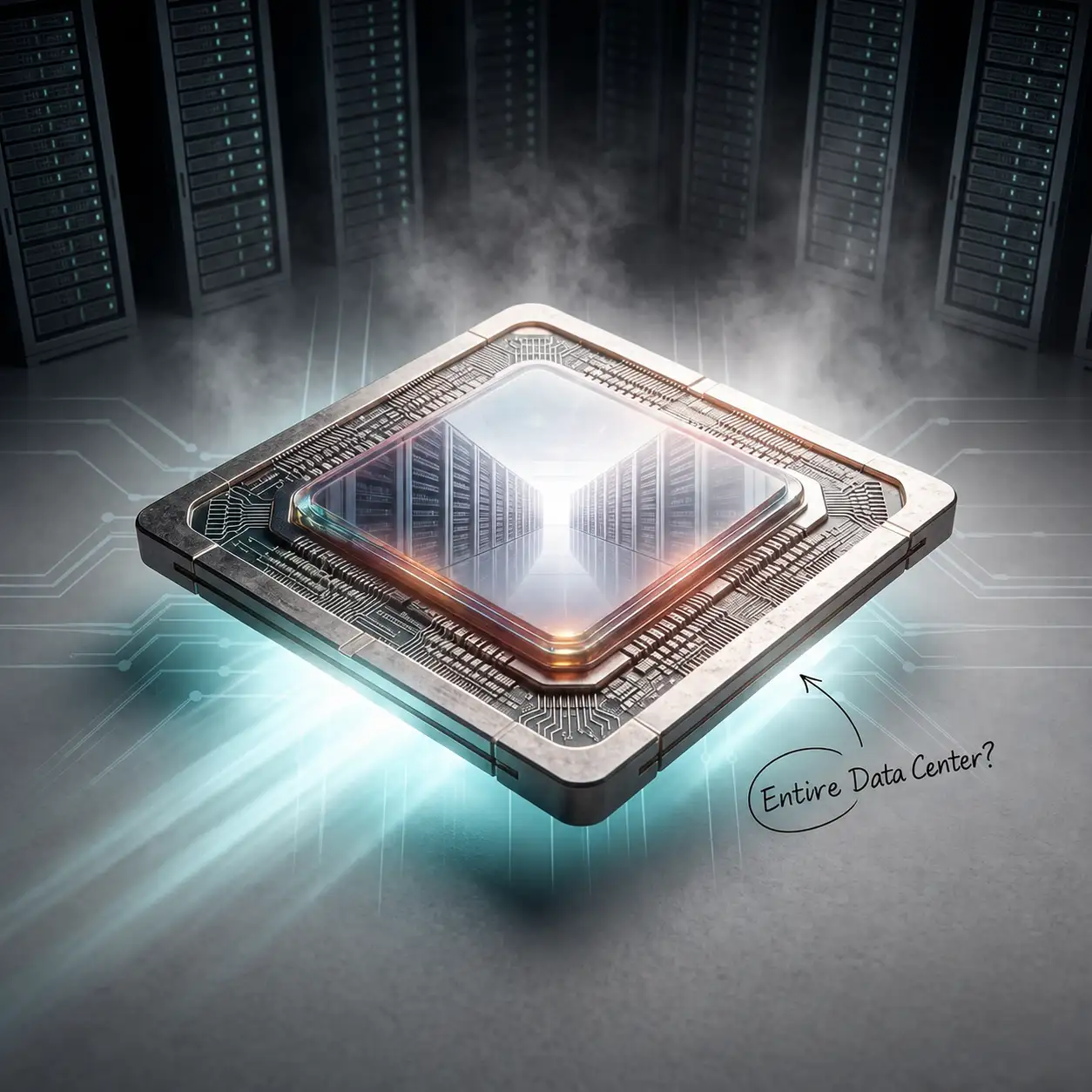
There is a quiet irony at the heart of the AI boom: the most powerful AI systems in the world cannot fit on a desk. They live in warehouses, cooled by industrial chillers, drawing enough electricity to power small towns. Every time you run a language model, you are renting a fraction of someone else's server. That dependency has always felt temporary. With the RTX Spark superchip, NVIDIA and MediaTek may be making it one.
Key Insights You Should Never Miss
-
Unified Superchip Architecture Delivers PerformanceThe RTX Spark combines CPU, GPU, and AI silicon into one package, delivering one petaflop of AI performance locally on Windows on Arm platforms without relying on remote cloud servers.
-
Unified Memory Eliminates Data TransferBy sharing a single high-bandwidth memory pool up to 128GB, the architecture eliminates data copying between components, allowing larger language models to run efficiently with significantly reduced latency and power consumption.
-
Shifting Economics Favor Local HardwareTransitioning from operational cloud expenses to a single capital hardware purchase eliminates per-inference billing, making complex daily AI workflows highly cost-effective for independent researchers, small studios, and solo software developers worldwide.
Announced at Computex 2026 by Jensen Huang, the RTX Spark is NVIDIA's push into the AI PC category through a unified superchip architecture that combines CPU, GPU, and dedicated AI silicon into a single tightly integrated package. The device targets agentic AI workloads running locally on Windows on Arm platforms, reaching up to one petaflop of AI performance and supporting up to 128GB of unified memory. It is not just a faster laptop chip. It is a structural argument that the data center model of AI delivery has real competition.
Beyond the Cloud Bottleneck
The case against cloud AI is not ideological. It is practical. Latency is the first problem. Any workflow that requires a real-time response, from a design application adjusting to cursor movement to a medical tool flagging anomalies during a live procedure, cannot afford a round trip to a remote server. Network delays that feel invisible during casual use become genuine friction when the stakes or speed requirements are higher.
Data privacy is the second constraint. Companies in healthcare, finance, and legal services increasingly find that sending proprietary information to third-party cloud infrastructure creates compliance exposure they cannot accept. Local AI processing sidesteps that problem entirely: the data never leaves the device.
The economics also shift in favor of local hardware over time. Cloud AI usage runs on an operational expense model, meaning costs scale with every query. A local AI PC superchip flips that to a capital expense, a single purchase that runs indefinitely without per-inference billing. For small studios, independent research labs, and solo developers running complex models daily, that math matters more than benchmark sheets.
Anatomy of a Unified Superchip
The architecture that makes the RTX Spark possible is unified memory design. In a conventional PC, the CPU and GPU are separate chips with separate memory pools. When an AI task moves between general computation and neural inference, the system copies data back and forth across a shared bus. That copying adds latency, burns power, and caps the size of models you can run efficiently.
A unified memory architecture eliminates that transfer. CPU, GPU, and the dedicated AI cores all draw from the same high-bandwidth memory pool simultaneously. Think of the difference between two workers passing a document back and forth versus both reading the same whiteboard at once. The whiteboard approach is not just faster, it also scales better when the document gets longer.
The 128GB ceiling matters specifically here. Most current consumer AI hardware tops out far below that figure, which is why running large language models locally has required heavy quantization that degrades output quality. With sufficient unified memory, a local AI PC can run models closer to their full parameter counts, narrowing the quality gap with cloud inference without any network dependency.
The Thermal and Power Paradox
Here is the honest friction point. Data center GPUs are large, expensive, and power-hungry precisely because sustained AI inference generates substantial heat. Moving that compute into a compact desktop form factor does not eliminate those physics, it just compresses them into a smaller space with fewer cooling options.
NVIDIA's Blackwell GPU architecture, which underpins the RTX Spark, was designed for efficiency gains, but the question of thermal headroom under sustained workloads has not been fully answered in public testing. A chip that delivers one petaflop of AI performance in a burst benchmark may throttle significantly during hour-long inference sessions where heat has nowhere to go. For professionals running continuous model inference or scientific simulations, this is not a footnote, it is the central performance variable.
What remains unclear is whether the miniaturization ultimately compromises throughput at the kind of sustained loads enterprises actually care about. The next-gen AI laptop 2026 narrative sells cleanly on peak specs. Real-world performance under thermal pressure is a different conversation, and one the industry tends to delay until after launch.
In Simple Terms — Unified Memory Architecture
Instead of the CPU and GPU having their own separate memory and constantly copying data back and forth, they share one giant pool. This is like multiple people reading the same whiteboard at once instead of passing a single piece of paper around, making everything much faster.
Disrupting the Enterprise and Creator Markets
The categories most immediately affected are not the ones that get the most press. Visual effects studios, architectural firms, and scientific research groups have historically maintained expensive on-premise GPU clusters for rendering and simulation work that cannot tolerate network latency. A single AI PC superchip workstation capable of replacing a small server rack reduces both capital costs and IT overhead for those teams.
Independent researchers present a more interesting shift. Access to large-scale compute has quietly determined which research questions are affordable to ask. A computational biology lab with no cloud budget either pays per experiment or goes without. Local AI computing changes that calculus, making previously cloud-dependent workflows available to teams with a single hardware purchase.
The pressure on cloud providers is real but slower to materialize than hardware announcements suggest. According to analysis from semiconductor research groups, edge inference and cloud training will coexist for years, with cloud platforms retaining dominance in large-scale model training while local devices absorb inference workloads. The threat is not replacement but erosion, a gradual reduction in the proportion of queries that ever reach a remote server.
The Software Ecosystem Challenge
Hardware without optimized software is just expensive potential. The RTX Spark's unified memory architecture only delivers its full advantage when applications are built to use it as a single memory pool rather than treating CPU and GPU memory as separate allocations. Most current AI software was written for discrete GPU setups, which means it either underutilizes unified memory or actively works against it.
The developer tooling gap is not trivial. Rewriting or restructuring AI applications to exploit a new memory model requires time and engineering resources that many software teams, particularly smaller ones, do not have available at launch. There is a reasonable historical parallel in the early Apple Silicon transition, where performance headroom existed in the hardware months before software was ready to use it fully.
Driver stability and ecosystem fragmentation are the quieter risks. Windows on Arm has improved substantially, but it still carries a legacy of compatibility edge cases that discrete x86 GPU setups do not. Users moving from a traditional Dell or Lenovo AI laptop to an ARM-based superchip platform may encounter software that simply does not work as expected, and the support infrastructure for diagnosing those failures is thinner than it is for conventional Windows hardware.
The Road to Consumer Accessibility
The RTX Spark, as announced, is positioned for professional and enterprise users. The price point will reflect that. What the announcement actually signals for mainstream computing is a roadmap, a demonstration that the technical architecture works, which tends to precede broader availability by two to three product generations.
Silicon yield and manufacturing cost reductions follow predictably from volume production. If the unified memory and AI accelerator design proves reliable in professional deployments, versions of that architecture will appear in mid-range hardware within three to five years. The pattern is consistent: workstation-grade features migrate to consumer hardware once yields improve and the software ecosystem matures enough to justify the integration.
The longer-term consumer implication is not about benchmarks. It is about behavior. When a device can run a capable AI model entirely offline, the relationship between a user and their personal AI assistant changes. It stops being a remote service you query and starts being something closer to a local capability you own. The data stays on the device. The model stays on the device. The compute bill disappears.
A New Era of Personal Compute
The tension between centralized cloud infrastructure and local edge computing is not new, but the RTX Spark superchip makes it more concrete than it has been before. Cloud platforms built their dominance on a hardware gap: personal devices simply could not run serious AI workloads. That gap is closing faster than most infrastructure investments were designed to accommodate.
The shift is not going to happen in a single product cycle. Enterprise cloud contracts are long, software ecosystems take years to migrate, and the thermal and power questions raised by workstation-grade AI in compact form factors deserve more rigorous public answers than benchmark sheets provide. But the direction is clear enough.
The more interesting question is what it means when AI stops being a remote capability you access and becomes a local one you possess. Personal devices have spent the last decade becoming increasingly dependent on centralized infrastructure for intelligence. If that trend reverses, even partially, the implications reach well past hardware specs, into questions about data ownership, compute equity, and what it actually means to have an AI that is yours.
Think of It Like This — Edge Inference
Edge inference means running the AI's "thinking" process directly on your local device instead of sending your data to a distant server farm. It is like having a brilliant assistant sitting right next to you, answering instantly without waiting for an internet connection.