A jet crosses the sky at Mach 1.4, faster than the speed of sound. But the people on the ground below do not hear a window-rattling crack. They hear something closer to a distant thump — like a car door slamming a few blocks away. That is what NASA is attempting to prove is possible with its X-59 research aircraft, and the program just cleared a major checkpoint.
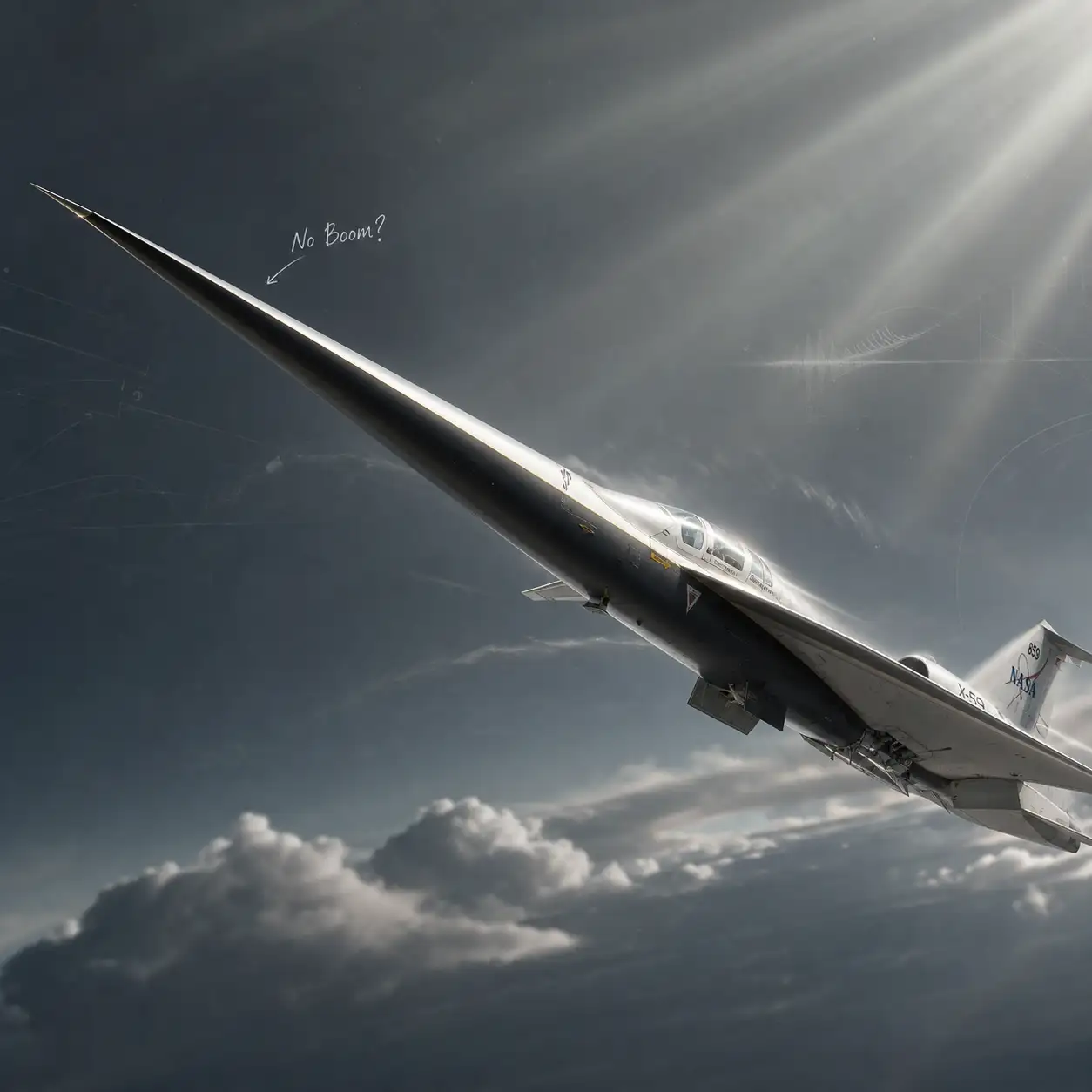
- Quiet Supersonic Flight Target AchievedThe X-59 research aircraft successfully reached Mach one point four at fifty-five thousand feet, confirming it operates within the precise performance envelope required for upcoming community noise testing phases and certification.
- Shockwave Management Reduces Sonic BoomBy utilizing a long needle-like nose and carefully shaped fuselage, engineers intentionally spread pressure waves apart so they reach the ground as a gentle thump rather than a disruptive crack.
- Public Acceptance Drives Regulatory ChangesActual neighborhood survey responses will determine if quieter supersonic flights prove socially acceptable, providing crucial real-world data that could finally persuade aviation regulators to lift longstanding overland commercial flight bans.
Key Insights You Should Never Miss
-
Quiet Supersonic Flight Target AchievedThe X-59 research aircraft successfully reached Mach one point four at fifty-five thousand feet, confirming it operates within the precise performance envelope required for upcoming community noise testing phases and certification.
-
Shockwave Management Reduces Sonic BoomBy utilizing a long needle-like nose and carefully shaped fuselage, engineers intentionally spread pressure waves apart so they reach the ground as a gentle thump rather than a disruptive crack.
-
Public Acceptance Drives Regulatory ChangesActual neighborhood survey responses will determine if quieter supersonic flights prove socially acceptable, providing crucial real-world data that could finally persuade aviation regulators to lift longstanding overland commercial flight bans.
The X-59 has reached its planned mission condition: roughly Mach 1.4 at approximately 55,000 feet. For the Quesst mission, this is not a speed record. It is the specific performance envelope NASA needs to run community noise tests, the phase that will ultimately decide whether quiet supersonic flight has any future in regulated airspace. The aircraft is where it needs to be to do its real job.
What makes this genuinely interesting is not the speed. It is what the speed represents. The X-59 is not trying to fly faster than anyone else. It is trying to prove that flying faster than sound can become socially acceptable again, over populated land, under rules that have kept supersonic travel boxed in for decades.
Why Sonic Booms Grounded Supersonic Dreams
Concorde flew from 1976 to 2003 and could cross the Atlantic in about three and a half hours. It was technically extraordinary and commercially marginal. But the deeper problem was not the ticket price or the fuel burn. It was the shockwave.
When an aircraft exceeds the speed of sound, pressure waves build up around the airframe and merge into a sharp cone of compressed air that travels with the plane. Wherever that cone intersects the ground, people hear a sudden crack, the sonic boom. For communities under a flight path, that crack is not a curiosity. It is a disruption. The United States banned routine overland supersonic flight in 1973, and most of the developed world followed with similar restrictions. Concorde was limited to ocean routes as a direct result.
In Simple Terms - Sonic Boom Shockwaves
A sonic boom occurs when an aircraft travels faster than sound, compressing air molecules into a continuous shockwave cone. When this invisible cone sweeps across the ground, it creates a sudden, explosive pressure change that human ears perceive as a loud, startling crack.
That regulatory wall did more damage to supersonic aviation than any engineering challenge. Companies could build fast planes. They could not build the political tolerance for what those fast planes did to neighborhoods. That is the problem the X-59 was built to solve.
What NASA Proved With This Milestone
Reaching the planned operating speed and altitude confirms the aircraft can actually perform the mission it was designed for. That sounds obvious, but it is not trivial. Research aircraft frequently hit technical delays, structural limitations, or performance gaps that push milestones back. The X-59 hitting its target envelope means the program can move into the next phase.
The technical achievement here is real. The speed and altitude are confirmed. But the metric that actually matters to regulators and the public has not been demonstrated yet. How loud is the thump on the ground? Under what conditions? How does it feel to people who live beneath the flight path? Those questions remain open.
Chase aircraft used during performance testing introduce their own acoustic variables. Measuring sound in a controlled flight test is different from measuring the human experience of that sound in a neighborhood. The X-59 has proven it can fly where it needs to fly. Whether it sounds the way NASA intends is the next chapter.
How X-59 Turns A Boom Into A Thump
The core engineering idea is about shockwave management. When a supersonic aircraft passes through the air, pressure waves radiate from different parts of the airframe and eventually merge together. That merging is what creates the explosive, concentrated boom at the surface.
The X-59 is designed with a needle-like nose roughly 38 feet long and a carefully shaped fuselage that forces those pressure waves to stay separated. Think of it like routing several streams of water so they flow parallel rather than converging into a single heavy current. The individual waves still reach the ground, but they arrive spread out in time and intensity, perceived as a softer, lower-energy thump instead of a sharp crack.
Think of It Like This - Aerodynamic Shockwave Management
Instead of letting sound waves combine into one massive pressure spike, the aircraft’s elongated shape deliberately separates them. Imagine water flowing through multiple narrow channels instead of merging into one heavy flood, resulting in a softer impact when the waves finally touch down.
The X-59 is not breaking the sound barrier so much as negotiating with it. The aircraft shapes the physics rather than muscling through them, which is a meaningfully different engineering philosophy than what the Concorde era attempted.
Why This Could Rewrite Air Travel
If community noise tests validate the acoustic signature, and if regulatory bodies respond by updating the standards for overland supersonic flight, the implications reach well beyond one NASA research plane.
The first routes to benefit would probably not be mass-market flights. New York to Los Angeles in under two hours would initially attract business travelers and time-sensitive cargo, not budget passengers. The economics of supersonic travel favor high-value seats, and that is where any commercial revival would start. According to NASA's mission documentation, the agency is explicitly building a data case for future aircraft certification, not developing an airliner itself.
The real change would be what happens in the aerospace industry once the regulatory barrier softens. Companies have been sitting on supersonic commercial concepts for years, held back partly by engineering challenges and partly by the knowledge that overland restrictions make the business case almost unworkable. Updated noise standards could shift that calculation quickly.
The Big Catch: Quiet Is Not Proven Yet
There is a version of this story where reaching Mach 1.4 is the breakthrough, and the rest is details. That version is wrong.
The decisive test has nothing to do with airspeed or altitude. It happens when the X-59 flies over communities and researchers ask the people below to describe what they heard. Sound annoyance is not purely a decibel problem. It is a perception problem. A thump that seems tolerable once, during a test flight people know is coming, may register very differently as a routine event several times a day. Frequency and repetition change how humans experience sound in ways that acoustic models do not fully capture.
There are also broader constraints that noise reduction alone cannot fix. Supersonic aircraft burn significantly more fuel per passenger than subsonic jets. Emissions from high-altitude flight are under growing regulatory scrutiny. Airport noise during takeoff and landing follows entirely separate rules. And the cost to certify a new aircraft category, design it for commercial scale, and manufacture it economically would be substantial. Even if the boom problem improves, none of those obstacles disappear.
Why Aviation Is Watching Closely
For aerospace companies, the X-59 matters primarily as a regulatory instrument. The technical barriers to building a quiet supersonic aircraft are real, but solvable given sufficient resources. The barrier that has been genuinely immovable is the regulatory framework built around the assumption that supersonic overland flight produces intolerable noise. If that assumption gets challenged with credible public data, the entire business logic of supersonic aviation changes.
This is a rare situation where a single research program could influence law, investment strategy, aircraft design, and public expectations at the same time. NASA is essentially running a scientific experiment whose subject is not just an airplane but the regulatory infrastructure built around a problem that may be partially solvable.
What Happens Next In The X-59 Mission
The next phase involves more flight testing, acoustic measurement, and shockwave validation before any community overflights begin. Those overflights, when they happen, will be conducted over selected locations in the United States. Residents will be surveyed about what they heard and how they felt about it. That survey data, aggregated and analyzed, is what NASA will present to the FAA and international aviation regulators.
The scientific importance of community overflights is that they cannot be simulated adequately. Computer models can predict decibel levels. They cannot predict how a retired teacher in Oklahoma describes a sound she heard while gardening, or whether a neighborhood in Texas decides it is something they could accept twice a day. Human annoyance data has legal and regulatory weight that engineering calculations alone do not.
The X-59's biggest job is not flying fast. It is building an evidence file that could give regulators a reason to write new rules.
The Future May Be Faster, But Not Automatically
The X-59 does not prove that supersonic passenger jets are returning soon. What it shows is that the central obstacle is being tested seriously, with real aircraft, real flight conditions, and eventually real communities.
The aircraft has reached its speed and altitude target. That is a meaningful step. But the deeper question has not been answered yet. Society has not decided whether quieter supersonic flight is quiet enough. And if history offers any guidance, the answer will depend less on what engineers can build and more on what people living beneath the flight paths are willing to accept.
That question is not an engineering one. It never was.