A solar panel in orbit collects sunlight around the clock. No clouds. No night. No atmosphere filtering out the good stuff. At geostationary altitude, the energy density is roughly eight times what reaches a rooftop panel in Germany on a clear day. The physics have been obvious since the 1970s. What has never been obvious is how anyone builds this at scale, gets it into orbit, and delivers the power back to Earth without the whole enterprise costing more than it could ever produce.
Key Insights You Should Never Miss
-
China Industrializes Orbital Solar Strategy.New alliances link space solar to existing photovoltaic manufacturing giants, treating orbital energy as a natural product line extension rather than just a standalone scientific space program.
-
Perovskite Cells Enable Lighter Satellite Arrays.Advanced perovskite tandem modules offer higher efficiency and lower weight than traditional cells, potentially solving the critical mass and cost barriers for building massive orbital power stations.
-
Geopolitical Leverage Shifts To Space Energy.Whoever controls orbital energy infrastructure first could hold significant geopolitical leverage over global energy access, paralleling how oil pipeline control shaped twentieth-century international political dynamics.
In June 2026, at the SNEC photovoltaic exhibition in Shanghai, two new industry alliances announced their intent to do exactly that. The announcements drew relatively little international attention. That might be a mistake.
Why the Energy World Is Looking Up
Global electricity demand is accelerating faster than most projections expected. AI data centers, industrial electrification, and expanding urban populations are straining grids that were designed for different conditions. Terrestrial solar and wind have scaled impressively, but they share a fundamental constraint: they stop working when the sun sets and the wind drops. Battery storage helps, but it does not fully close the gap for continuous industrial power.
Space-based solar power has existed as a theoretical solution since aerospace engineer Peter Glaser first proposed it in 1968. The concept is straightforward: solar arrays in geostationary orbit capture unfiltered sunlight continuously, convert it to electricity, beam that energy to Earth via microwave or laser, and receive it at a ground station. The reason it has never moved past theory is that the engineering is extraordinarily hard. Launching enough hardware to generate meaningful power costs vastly more than the electricity would ever be worth, at least with the rockets and materials available until recently.
China's Academy of Space Technology has been building toward a serious attempt since the early 2000s, with a published roadmap targeting a 10-kilowatt test satellite in low Earth orbit by 2028, a 1-megawatt station in geostationary orbit by 2030, and scaling to 2 gigawatts by 2050. The Bishan testing facility in Chongqing has been operational as ground-based preparation for years. What changed in 2026 was not the roadmap. It was the industrial machinery assembled to execute it.
Two Alliances, One Industrial Strategy
The first of the two new groups, the Space Energy Development Alliance, brings together solar manufacturers, energy storage companies, hydrogen producers, computing infrastructure providers, and aerospace operators. Founding members include GalaxySpace, a commercial satellite operator with over 40 satellites already in orbit, GCL Photovoltaic Materials, and the Yangtze River Delta Solar PV Technology Innovation Center.
The second, the Space Energy Technology Ecosystem Alliance, is led by JA Solar alongside Saiwu Technology, which commercializes luminescent down-shifting films for perovskite tandem solar modules, Jiangsu Jiejiawei in photovoltaic equipment, and CGC Certification Centre.
Most international coverage of space solar power frames it as a competition between national space programs. These alliances reveal something different. China is treating orbital solar not as a standalone space project but as the natural next product line for an industry that already dominates global photovoltaic manufacturing. The companies involved are not space agencies. They are solar manufacturers, materials suppliers, and satellite operators who already know how to build at scale. The strategy is not to win a space race. It is to vertically integrate an entire supply chain from solar cell production to orbital deployment.
How It Would Actually Work
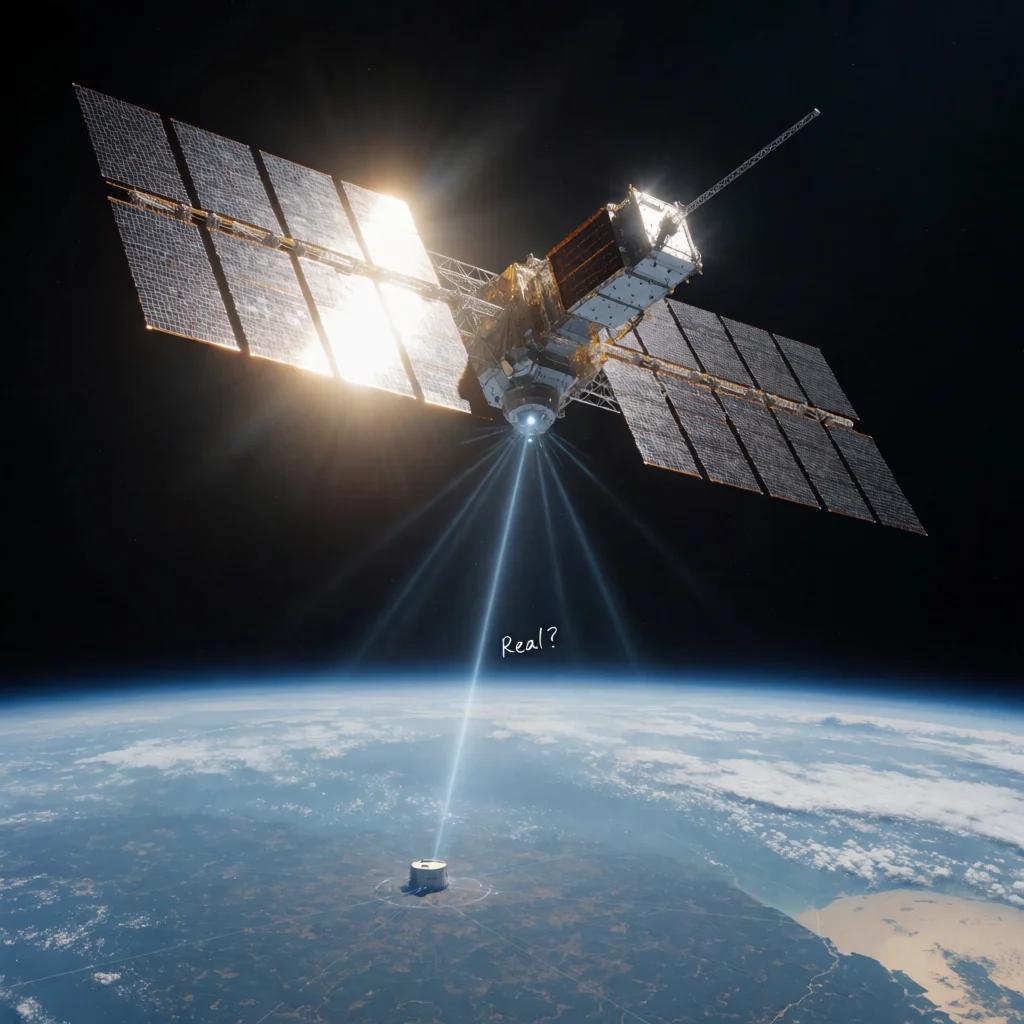
The basic architecture involves solar arrays at geostationary altitude, roughly 36,000 kilometers above the equator, collecting sunlight continuously and converting it into microwaves, typically in the 1 to 10 GHz range. Those microwaves travel down to a ground station called a rectenna, a large antenna array several kilometers across that converts the microwave energy back into usable electricity.
In Simple Terms — Rectenna Technology
A rectenna is a specialized antenna that receives microwave beams from space and converts them directly into direct current electricity. It acts like a giant net catching invisible energy waves, turning them into usable power for the grid without moving parts.
The perovskite angle in these announcements is worth attention. Traditional satellite solar panels use gallium arsenide multi-junction cells, which are efficient but expensive and heavy. Perovskite and tandem solar technologies offer higher theoretical efficiency at significantly lower manufacturing cost and lower weight. For orbital arrays that need to be enormous to generate meaningful power, lighter and cheaper cells could be what makes the economics possible.
The catch is serious. Perovskite cells face harsh conditions in space: proton radiation, thermal cycling between -150 and +120 degrees Celsius, vacuum conditions, and mechanical stress during launch. Research including work from NREL has shown that ultrathin silicon oxide barrier layers can extend perovskite operational lifetime from months to potentially years in orbit, but this remains an active engineering problem, not a solved one. The wireless transmission side has its own unsolved challenges. Hitting a target on the ground from 36,000 kilometers away requires beam pointing accurate to within 0.002 degrees. Miss by slightly more than that, and the beam misses the rectenna entirely. Current demonstrations have achieved modest efficiencies over short distances. Gigawatt-scale transmission from orbit has not been demonstrated anywhere.
What Changes If This Actually Succeeds
A functioning geostationary solar power station would provide continuous baseload electricity independent of weather, geography, or fuel supply chains. A single satellite can see roughly one-quarter of Earth's surface, which means power could theoretically be delivered across international borders faster than any cable or pipeline.
The U.S. Space Force's Future Operating Environment 2040 document explicitly identifies China's space solar ambitions as a strategic technology investment requiring a response. The reasoning is not hard to follow. Whoever controls orbital energy infrastructure in the second half of this century could hold geopolitical leverage over energy access in ways that parallel how oil pipeline control shaped the 20th century. That is a strong claim, but it is the kind of claim serious defense planners take seriously.
The economic ripple effects extend beyond power delivery. If China successfully links space-based solar to its existing solar manufacturing base, it would not just be exporting panels. It would be positioned to export the entire system, from cells to orbital deployment, setting international standards for space energy hardware in the process.
The Problems No One Has Solved
None of this is close to working yet, and the obstacles deserve to be stated plainly.
Every stage of space-based solar power involves energy conversion losses. Sunlight to electricity, electricity to microwaves, microwaves through the atmosphere, microwaves back to electricity at the ground station. Stack all those losses and overall system efficiency likely starts below 10 percent. That means a 2-gigawatt orbital plant has to collect far more energy in space than it actually delivers on the ground. The sheer size of hardware required is staggering.
Think of It Like This — Perovskite Risks
Perovskite cells are like high-performance sports cars: fast and efficient but fragile. In space, they face radiation and extreme temperature swings that can degrade them quickly unless protected by advanced, ultrathin barrier layers.
Getting that hardware into geostationary orbit is the capital problem. Even with launch costs declining significantly, assembling kilometer-scale structures 36,000 kilometers up requires either extremely heavy lift rockets operating at high frequency or autonomous robotic construction in space. Neither exists at commercial scale today. The estimated capital cost for a gigawatt-class system runs into the tens of billions of dollars. The European Space Agency's own 2021 assessment suggested that commercial viability, if it arrives at all, might come in the 2040s at earliest, and only with sustained coordinated investment. Many engineers argue privately that improving terrestrial grid storage offers far better returns for the same capital, with far less technical risk.
The regulatory picture is also entirely uncharted. High-power microwave beams from orbit require international frequency coordination, airspace safety rules, and public acceptance that does not yet exist. Nobody has written these rules because nobody has been close enough to needing them.
The Rest of the World Is Not Standing Still
The U.S. has active efforts, but they are fragmented. Caltech's Space Solar Power Project, funded by over $100 million in private donations, has demonstrated wireless power transmission in orbit on a small scale. The Air Force Research Laboratory's Arachne satellite and DARPA's POWER program are exploring laser-based approaches. Private companies including Space Solar and Star Catcher have raised venture capital. Japan has pursued space solar since 2008 through JAXA, achieving ground demonstrations of wireless power transfer, but has struggled to maintain political and funding continuity. Europe's SOLARIS initiative and the UK's Space Energy Initiative are taking methodical study approaches rather than rapid industrial mobilization.
The critical difference is that no other country has yet tied its space solar ambitions directly to an existing dominant position in terrestrial solar manufacturing. China's alliances connect orbital energy to companies that already manufacture at global scale, already control significant portions of the solar supply chain, and already have commercial satellite operators as partners.
What Happens Next
The 2028 low Earth orbit test of a 10-kilowatt satellite will be the first real indicator of whether microwave power transmission from orbit is achievable at even a small scale. That result will reshape funding confidence and political will across the entire global space solar community, regardless of which country is watching.
The 2030 target for a 1-megawatt geostationary station is four years away. If that timeline holds, it would put the first operational-scale space solar hardware in orbit ahead of essentially every Western projection. If it slips, it will reveal whether the obstacles are harder than the roadmap assumed.
The signals worth tracking are not just launch schedules. Watch which companies are investing in radiation-hardened solar films, in-space robotic assembly systems, and rectenna manufacturing capacity. Industrial groundwork shows up before satellites do.
The Race We Didn't Know We Were Watching
The energy competition of the coming decades may not be decided by who has the most oil, the best batteries, or the largest grid. It might come down to who first industrializes the orbital environment for power generation. China's 2026 alliances are less a space policy announcement than a manufacturing strategy, one that treats geostationary orbit as the next frontier for an industry that already rebuilt global solar energy from the ground up.
The unresolved question is whether space-based solar power will ever make economic sense. Serious engineers disagree. The physics are real, but the engineering distance between now and a commercial gigawatt-class system is enormous. What is harder to dismiss is the possibility that the country which builds the supply chains, masters the materials, and runs the early demonstrations will have already won the next round before the rest of the world decides it was worth entering.
The next energy superpower may not be the country with the most reserves. It may be the one that learns to build power infrastructure that no storm, drought, or political border can touch.