Walk through any major city and the air you breathe carries a quiet chemical record of everything burning nearby. Factories, vehicles, heating systems. The carbon dioxide you inhale on a busy street corner did not originate there. It traveled. And for decades, the planet's forests and oceans have been absorbing that invisible freight with no compensation and no complaints.
Key Insights You Should Never Miss
-
Engineered Systems Capture Atmospheric CarbonArtificial trees use specialized chemical sorbents instead of biological chlorophyll to pull carbon dioxide directly from ambient air, offering a vital technological supplement to rapidly weakening natural global carbon sinks.
-
Natural Sinks Face Severe LimitsGlobal forests and warming oceans are absorbing carbon less efficiently due to deforestation and rising temperatures, creating a massive emissions gap that human activity must address through engineered drawdown solutions.
-
High Energy Costs Hinder ScalingDirect air capture currently requires massive thermal or electrical energy inputs for sorbent regeneration, meaning the technology must dramatically reduce costs and rely entirely on renewable power to become truly viable.
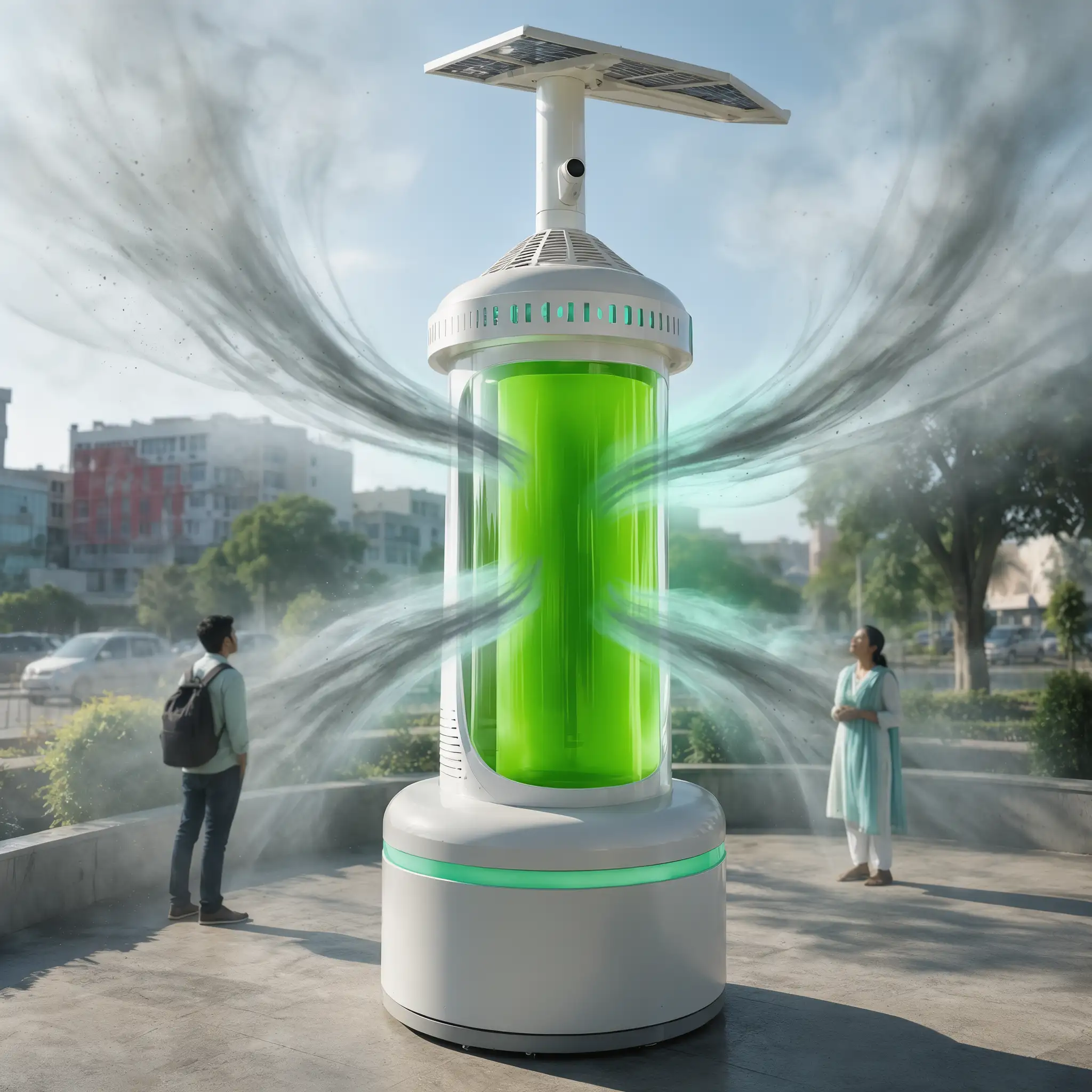
The concept of artificial trees sits at the intersection of climate desperation and engineering ambition. These are not decorative objects. They are systems designed to pull carbon dioxide directly from the air we live in, using chemistry instead of chlorophyll. As natural carbon sinks come under growing stress and global emissions continue to outpace any realistic drawdown scenario, direct air capture technology is moving from speculative research into serious climate planning.
A Future Where Cities Start Cleaning Their Own Air
Most cities are designed to manage the visible consequences of pollution: traffic routing, emission standards, catalytic converters. What they have never been designed to do is actively remove the carbon already diffused into the atmosphere above them. That distinction matters more than it might seem.
The idea behind artificial trees is that urban and industrial environments do not have to remain net producers of CO2. In theory, a city dense enough with engineered carbon capture structures could offset at least a portion of what it generates.
Not by emitting less, but by pulling back what it already released. That is a fundamentally different frame for thinking about climate control. This is no longer a purely academic conversation as governments race toward net-zero targets.
Why Natural Carbon Sinks Are Reaching Their Limits
For most of industrial history, forests, oceans, and soil have absorbed a significant fraction of human carbon emissions. The Amazon rainforest alone has long been described as the lungs of the planet, a description that is accurate in structure if imprecise in scale.
The problem is that they are weakening precisely when they are needed most. Deforestation has reduced forest coverage globally. Warming oceans absorb CO2 less efficiently as surface temperatures rise, a chemical property that has nothing to do with political will and everything to do with physics.
Soil carbon stores are increasingly disrupted by land use changes. According to research published by the Global Carbon Project, natural land sinks absorbed roughly 31 percent of global CO2 emissions in recent decades, but that share has not kept pace with rising emissions volumes.
What Artificial Trees Actually Are
An artificial tree is an engineered direct air capture system, not a machine that looks like a tree but one that functions with the same atmospheric ambition. Where a real tree uses sunlight and water to run photosynthesis, drawing in CO2 and releasing oxygen, an artificial version uses chemical sorbents.
Think of it less like mimicking a tree and more like designing a very specific kind of filter. The 'branches' in most current designs are actually louvered structures or packed-bed contactors that maximize surface area exposure to ambient air.
The modular nature of these systems is part of their appeal. Unlike traditional carbon capture attached to smokestacks at power plants, artificial trees or standalone direct air capture units can, in theory, be deployed anywhere: urban rooftops, highway margins, industrial parks, or remote areas.
In Simple Terms — Direct Air Capture (DAC)
Direct Air Capture is essentially a giant, highly specialized vacuum cleaner for the sky. Instead of sucking up dust, it uses chemical filters to pull invisible carbon dioxide molecules out of the ambient outdoor air.
How CO2 Capture Works in Simple Technical Terms
The core process in most direct air capture systems works in two phases. First, ambient air passes over or through a chemical material, typically a liquid solvent or a solid sorbent, that selectively binds CO2 molecules while allowing nitrogen and oxygen to pass through.
The second phase involves heating the sorbent to release the captured CO2 as a concentrated stream. That concentrated gas can then be stored underground in geological formations or repurposed for industrial use, such as in the production of synthetic fuels or carbonated beverages.
The energy cost of that regeneration step is where the challenge lives. Heating sorbents requires significant thermal or electrical input, and current processes can require between 1,500 and 2,000 kilowatt-hours of energy per ton of CO2 captured.
Why This Idea Is Gaining Serious Attention
Carbon neutrality commitments now cover more than 90 percent of global GDP, according to net-zero tracker data. But most models for reaching net zero show that emissions reductions alone, even aggressive ones, will not be enough.
Some residual emissions from aviation, agriculture, and heavy industry are considered near-impossible to eliminate entirely in the near term. That is the structural reason artificial trees and direct air capture are no longer fringe ideas.
They represent a potential solution to the emissions that cannot be prevented, not just the ones that can be reduced. The logic is simple: if you cannot stop some carbon from entering the atmosphere, you need something that can take it back out.
Think of It Like This — Chemical Sorbents
Chemical sorbents act like microscopic lint rollers designed exclusively for carbon dioxide. When air passes over them, CO2 molecules stick to the surface while harmless gases like oxygen and nitrogen pass right through.
The Big Question: Can It Scale Without Huge Energy Cost?
Here is where honest analysis diverges from optimistic projections. The current cost of direct air capture ranges from roughly $400 to over $1,000 per ton of CO2 removed, depending on the system and location.
The target that would make large-scale deployment economically viable is somewhere around $100 to $150 per ton. That gap is not a minor engineering tweak. It is an order of magnitude problem.
The energy requirement compounds this. If direct air capture systems are powered by fossil fuels, they risk emitting more carbon than they capture, which defeats the purpose. Powering them entirely from renewables means competing with a grid that needs clean energy for everything else.
Climate Tech Competition Is Speeding Everything Up
The carbon removal space has become a competitive arena, and competition has a history of accelerating what seemed impossible. The United States, Canada, Iceland, and the United Kingdom all have active direct air capture programs at various scales.
Companies like Climeworks and Carbon Engineering have moved from pilot plants to commercial operations. Climeworks' Mammoth facility in Iceland, launched in 2024, is designed to capture 36,000 tons of CO2 per year, the largest operational direct air capture plant so far.
That number sounds large until you remember that 36,000 tons is roughly what a handful of commercial aircraft emit in a few months. The scale gap between current capability and what the climate requires is still enormous.
Where Artificial Trees Could Go Next
The most promising near-term path for cost reduction involves pairing direct air capture with low-cost renewable energy. If a capture facility is co-located with a wind or solar farm, the marginal energy cost drops, and the carbon arithmetic starts to work more cleanly.
Some designs are exploring waste heat from industrial processes as an alternative energy source for the sorbent regeneration step, which would cut costs further. Materials science is the other frontier.
New solid sorbents using metal-organic frameworks or moisture-swing materials are showing promise in laboratory settings, with lower energy regeneration requirements than current commercial systems. The gap between lab performance and field performance is historically wide in materials science.
A New Way of Thinking About Climate Control
There is something philosophically uncomfortable about engineering your way out of an engineering problem. The fossil fuel age was itself a triumph of industrial ingenuity that produced consequences nobody fully anticipated.
The idea that more industrial ingenuity will clean up the residue sits uneasily alongside that history. The alternative argument is that waiting for a cleaner solution while emissions accumulate is not neutral. Every year of delay thickens the layer of CO2 that future generations will need to address.
What the next decade may produce is not a replacement for natural carbon sinks but a supplementary system that works alongside them. A hybrid carbon cycle, part biological and part engineered, operating at a scale the planet has never attempted.