A refrigerator-sized robot with three grabbing arms is chasing down a satellite that was never built to be caught. Somewhere over the Pacific, a spacecraft named LINK is closing the distance on the Swift Observatory, a 22-year-old telescope sinking toward Earth's atmosphere faster than anyone expected. If the two never manage to link up, Swift burns. If they do, something in spaceflight changes for good.
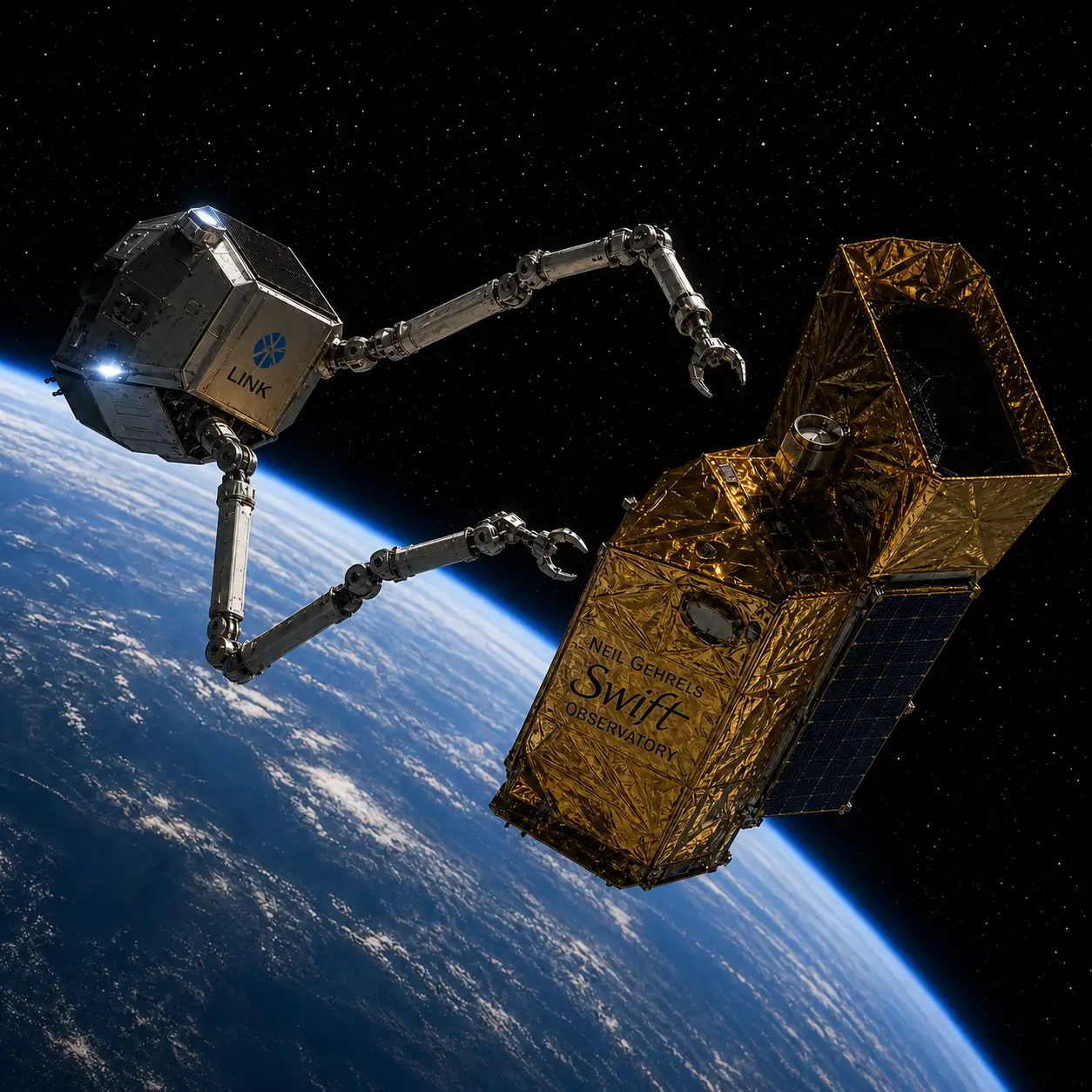
AI Generated Illustration
This is the heart of the nasa telescope rescue now underway, and it is the first attempt by any American company to grab hold of a functioning scientific spacecraft and physically lift it back into a safer orbit. NASA hired the small Arizona startup Katalyst Space Technologies to build the rescue vehicle in under a year, a timeline that would sound reckless for almost any other agency mission. The question hanging over the whole operation is a simple one. Why did it take space agencies more than two decades of satellites quietly dying in orbit before anyone tried something like this?
The answer says less about ambition and more about risk tolerance. Grabbing a tumbling spacecraft that was designed to be launched once and forgotten is a different problem than docking two cooperative vehicles that were built to find each other. Swift has no handholds, no standardized capture ring, and no guarantee that the foil wrapped around its hull will survive being gripped by a mechanical hand. Understanding why this mission matters means looking at both how badly Swift needed saving and why nobody was confident enough to try until now.
What Happened During NASA's Historic Telescope Rescue
Swift launched in 2004 to hunt gamma-ray bursts, the brief and violent flashes given off by dying stars and colliding neutron stars. It has no engine of its own, so its orbit has been shrinking for years as it brushes against the outer edge of Earth's atmosphere. A stronger than expected solar cycle sped that decay up dramatically, and by early 2026 mission controllers had already ordered Swift to stop most of its science work and orient itself to minimize drag, buying time measured in weeks rather than months.
NASA's answer was LINK, launched on June 30 aboard one of the last Pegasus XL rockets ever built, dropped from an aircraft over the Marshall Islands rather than fired from a traditional pad. The mission plan calls for LINK to spend a week or two closing in on Swift, then photograph it from every angle so engineers on the ground can judge exactly how to approach a spacecraft nobody has seen up close in twenty years.
None of this resembles a normal docking. Swift is not transmitting a beacon that says grab me here, and it is tumbling slightly as it falls. LINK has to match that motion precisely before its three robotic arms close around brackets on Swift's frame, a maneuver that has to work essentially on the first real attempt, since there is no dress rehearsal in orbit.
The Robotic Technology That Made It Possible
The capture itself relies on a stack of systems working together: cameras and sensors that build a 3D model of the target, navigation software that predicts where Swift will be a fraction of a second from now, and mechanical arms with grippers that behave less like a claw machine and more like careful hands reading the shape of an object before closing around it. In practical terms, LINK has to fly formation with something that was never asked to cooperate, the orbital equivalent of catching a spinning object without ever slowing it down first.
How tight that navigation has to be is the part nobody outside the program can fully verify. NASA and Katalyst have not published exact tolerances, which makes it hard to compare LINK's precision against other in-space servicing demonstrations that came before it.
The real engineering leap is not the grab itself. It is doing that grab, then spending more than six weeks nudging a spacecraft that was never meant to be pushed, correcting for its mass and shifting center of gravity the entire time, in an environment where a single miscalculated burn could end the mission outright. That combination, not the initial contact, is what has engineers elsewhere in the industry paying close attention.
Why Space Agencies and Industry Are Paying Close Attention
A successful boost could add roughly a decade to Swift's working life for a fraction of what a replacement observatory would cost, at a moment when Swift's rapid-response gamma-ray detection has no real substitute among Hubble, Webb, or the newly completed Roman Space Telescope. That math is hard to ignore for an agency juggling a limited budget against an aging fleet of irreplaceable instruments.
It also signals a shift away from the old model of launch, operate, and let it burn up when the fuel runs out. Commercial operators managing large satellite constellations face the same math on a bigger scale, and a proven repair and reboost capability changes how they might plan replacement cycles going forward.
Push that logic further out and the implications reach beyond Earth orbit entirely. Any future space station or long-duration deep space mission is going to need routine maintenance capability rather than a one-shot design, and this is one of the first real tests of whether robots, not astronauts, can do that work reliably.
The Challenges That Still Stand in the Way
Swift was built in the early 2000s with zero thought given to future servicing, which is true of nearly every satellite currently in orbit. That mismatch does not disappear because one rescue works. Communication delays, limited arm flexibility, and the ever-present risk of creating new debris from a botched capture all remain real constraints for the next mission and the one after that.
What remains unclear is how well this scales. Swift has known, documented hardware. Plenty of aging satellites in orbit right now have designs nobody at the servicing companies has ever seen blueprints for, and a capture method tuned for one spacecraft's geometry will not automatically transfer to the next.
The bigger test is turning a single high-stakes demonstration into something closer to a routine service call, the difference between a proof of concept and an actual industry.
Could This Rescue Give Aging Satellites a Second Life?
It also signals a shift away from the old model of launch, operate, and let it burn up when the fuel runs out. Commercial operators managing large satellite constellations face the same math on a bigger scale, and a proven repair and reboost capability changes how they might plan replacement cycles going forward.
Push that logic further out and the implications reach beyond Earth orbit entirely. Any future space station or long-duration deep space mission is going to need routine maintenance capability rather than a one-shot design, and this is one of the first real tests of whether robots, not astronauts, can do that work reliably.
Could This Rescue Give Aging Satellites a Second Life?
If LINK succeeds, the natural next candidates line up quickly. Hubble is losing altitude the same way Swift did, and Katalyst has already floated a possible boost mission around 2028. Earth observation satellites and commercial communications fleets facing their own slow orbital decay are watching for the same reason.
The more interesting shift may happen upstream, at the design table. Once one company proves that a robot can grab an uncooperative spacecraft and boost it home, engineers building the next generation of satellites have a real incentive to add capture points, standardized fittings, and other small design choices that make future repairs easier rather than accidental.
Saving one gamma-ray telescope was never really the whole story. What is being tested here is whether spacecraft can start getting maintained the way an aircraft gets serviced instead of being written off the moment something goes wrong, and that question will keep mattering long after Swift either survives or doesn't.