In December 2006, a solar flare took down GPS receivers all over the world for roughly ten minutes, long enough to knock out aircraft navigation systems and even disrupt surveying equipment thousands of miles away. From that distance - 93 million miles away - the Sun did something that no one could react to, at least not in the short time. Practically two decades later it is still a matter of the scientists as to whether such an extraordinary event can be forecasted - not just observed - if only we saw it beforehand.
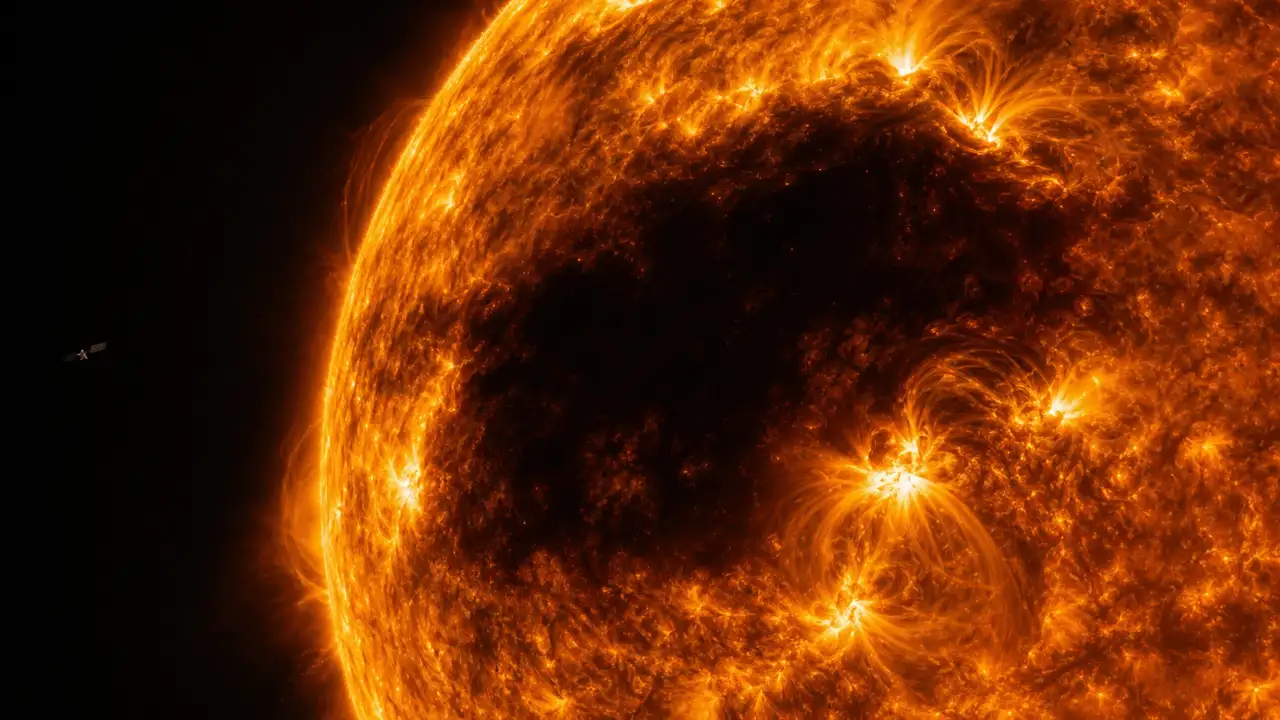
AI Generated Illustration
Behind this issue lie years of inquiry into secret solar cycles, changing solar magnetic fields, and certain researchers' references to some sort of signal buried in centuries of sunspot records which, as them, could mean the end of solar activity. The thought is so quiet, yet so alarming, that our Sun might not be following the regular rhythmic activity described by textbooks and that our solar storms predictions may need to take into account the patterns that we, at present, are not even aware of. With the satellites, power grids and GPS networks becoming more entangled and more vulnerable to whatever the Sun decides to do next, space weather forecast accuracy has regained its urgency.
Unraveling solar activity has been one of the most challenging problems in space science which is not really due to solar mysticism but rather the Sun's fact that it's not just some shining star but a ball of plasma whose magnetic field is never still.
How Solar Cycles Reveal Earth's Future Space Risks
The 11-year rhythm known as the solar cycle of the Sun is actually the slow twisting and reorganizing of its magnetic field. Sunspots, those darker areas on the solar surface, indicate regions where the magnetic field has become strong and tight enough to keep the boiling plasma layer beneath them in check. When those tightly twisted magnetic field lines are snapped by the reconnection, the result is solar flares and coronal mass ejections, which are basically large clouds of charged particles ejected into space. Such occurrences can wreak havoc on the communication systems of Earth's satellite network and also disrupt the geomagnetic field.
Scientists, in tracking the cycles, have the data of over 400 years of historical records of sunspot numbers and more recent satellite instruments that almost continuously monitor the magnetic field of the Sun. Merging the long-term record with current observation, the scientist can compare the present situation with the past ones to find recurring forms in the noise. The current solar cycle, cycle 26 forecast is a result of this work, which is partly pattern recognition, partly physics simulation, and partly guesswork based on experience.
The other aspect of solar storms that people rarely realize is their non-random nature, They do follow structure, i.e. there are cycles within cycles and magnetic patterns that repeat themselves over decades as well as sometimes centuries. The depth of such structure and also whether some of it have been lying in plain sight the whole while is what the scientists still have to figure out.
Inside the Systems Trying to Predict Solar Storms Earlier
Today's solar storm prediction relies on a blend of spacecraft that are located between the sun and our planet (e.g. those satellites), ground-based magnetometers, plus computer models that show the possible behaviors of the solar wind after leaving the Sun. At a gravitational balance point approximately a million miles from Earth, where they are positioned are NOAA's DSCOVR and NASA's ACE satellites which observe particle streams before they arrive. These alerts provide forecasters with a fifteen- to sixty-minute warning period at least for the fastest events which, while helpful, is still not very much time.
Solving a solar flare isn't the hard part - detectors do that within a few seconds. But what forecasters find so challenging is to get a good idea up to a few hours or even days beforehand - whether or not a coronal mass ejection will even make it to our planet, how the impact will be, and where.
Coronal mass ejections are the fastest ones among these solar events that take one to three days to travel the distance from the Sun to the Earth, and the difference between getting an exciting aurora and having a bad time for a grid operator can be due to very small inaccuracies in their starting direction. So the biggest challenge in space weather predicting is not just to follow the Sun's movements, but also to find out what those changes on the Sun will bring to the Earth. That line between merely observing and interpreting is where most of the unsolved problems in the forecasting of space weather remain.
Why Accurate Solar Forecasting Could Transform Technology
If you look at the most intense and long-lasting solar storms, it won't just be the beautiful aurora that is a side effect. These storms, through a different mechanism, can actually disrupt the power grids and other long metallic objects. The example of the storm in 1998, when most of the Quebec population went without electricity for almost a whole day, was one of the main references in a textbook, but the concern nowadays has grown because of many factors, Worth noting the rise of satellites, GPS-based applications, and just-in-time supply chains.
If there were to be a severe geomagnetic storm nowadays, people from different fields would be alerted. Airlines that are considering shifting their polar flight routes are one of them. On the other side, satellite operators are trying to figure out if the most sensitive devices have got to be shut down and power cut during those storm times. Also, grid operators have to protect transformers with special protective devices because of the potential induced current.
It is not only planning after the disaster has happened, but anticipating it, planning a bit ahead. There are many more things involved in space-borne infrastructure at present, which the digital economy that is partly run through space is concerned with, not just as a hobby, but also as an essential part in infrastructure planning. The accuracy of the aurora forecasting and the solar flare prediction are things they are most interested in.
The Limits Behind the Sun's Warning Signals
None of this suggests researchers simply spot a trend and then assert that next year major storm will come by. Signal from the data is not a guarantee, and the scientists who are into research about the sunspot cycle make sure to restate that they always make an allowance for uncertainty. What we have been observing about the Sun during the past four hundred years is a single, long, and rather messy dataset - not some neat and clean experiment in the lab. And it is perfectly possible for us to mistakenly detect a pattern if it is just by chance that things happen to align that way.
The sunspot records of the history are even less reliable as you get older. Early astronomers had very poor-quality instruments, observing schedules were not regular, and there was no accepted way to count the spots consistently. As a result, today's solar activity cycle models rely, in part, on the highly precise modern measurements and, in part, on the ancient "guesswork, " that had been stitched together after the fact. The pattern the researchers find is it a result of that joining-up not a genuine feature they have discovered the Sun? No one is in a position to deny that possibility at this stage.
Getting the predictions right will not just rely on statistical techniques alone as that will probably not be enough. One important issue is to obtain longer, cleaner, and better datasets. The simulations of the processes inside of the Sun have to be developed and improved. Also, monitoring instruments should be made available that can spot and follow the development of the Sun's far side, i.e. of the side that is out of our sight at the moment, where one can potentially discover and study a storm without having seen it before the storm's rotation will bring it into view.
The Future of Space Weather Forecasting Begins With Better Solar Data
Several new missions on the drawing board will help to fill in a lot of missing details. In this case, Solar Orbiter and some of the future heliophysics missions will provide observations of the Sun from vantage points that terrestrial telescopes do never see, including the poles which have been suggested as the most likely place where clues about the magnetic cycle resetting could be found. In addition, it has become clear recently that machine learning models trained with historical data about magnetic fields and particles have been detecting patterns that might remain unseen by the eyes of human researchers, although those models have still a lot to learn before they can be said to comprehend the physics to the level of a human scientist.
What is in fact evolving is not only the hardware but also the attitude. A typical pattern of solar science during about 50 years long space age has been reactive one where people just watch events, and only after that come up with explanation for them. The trend now is to get a step closer to real space weather forecasts, so warnings will be issued far enough in advance to allow satellite operators and grid engineers to effectively utilize them rather than simply documenting what has been damaged.
We have created a civilization that is practically dependent on a star whose behavior we are still far from understanding completely. Still, this kind of a situation, where one party is totally dependent and does not have sufficient knowledge from the other one, will never go away, and if we will be closing the space between those two factors, chances are that it may finally come to be more important than now most of the public seems to imagine.