An AI system called Robin, built by a research organization called FutureHouse, recently completed a full experimental biology discovery cycle in under two hours. The same cognitive work would have consumed roughly 900 hours of a human scientist's life. The bench was still running. The centrifuge was still spinning. But the person who used to sit there, reading papers at midnight, building hypotheses on whiteboards, was no longer the bottleneck.
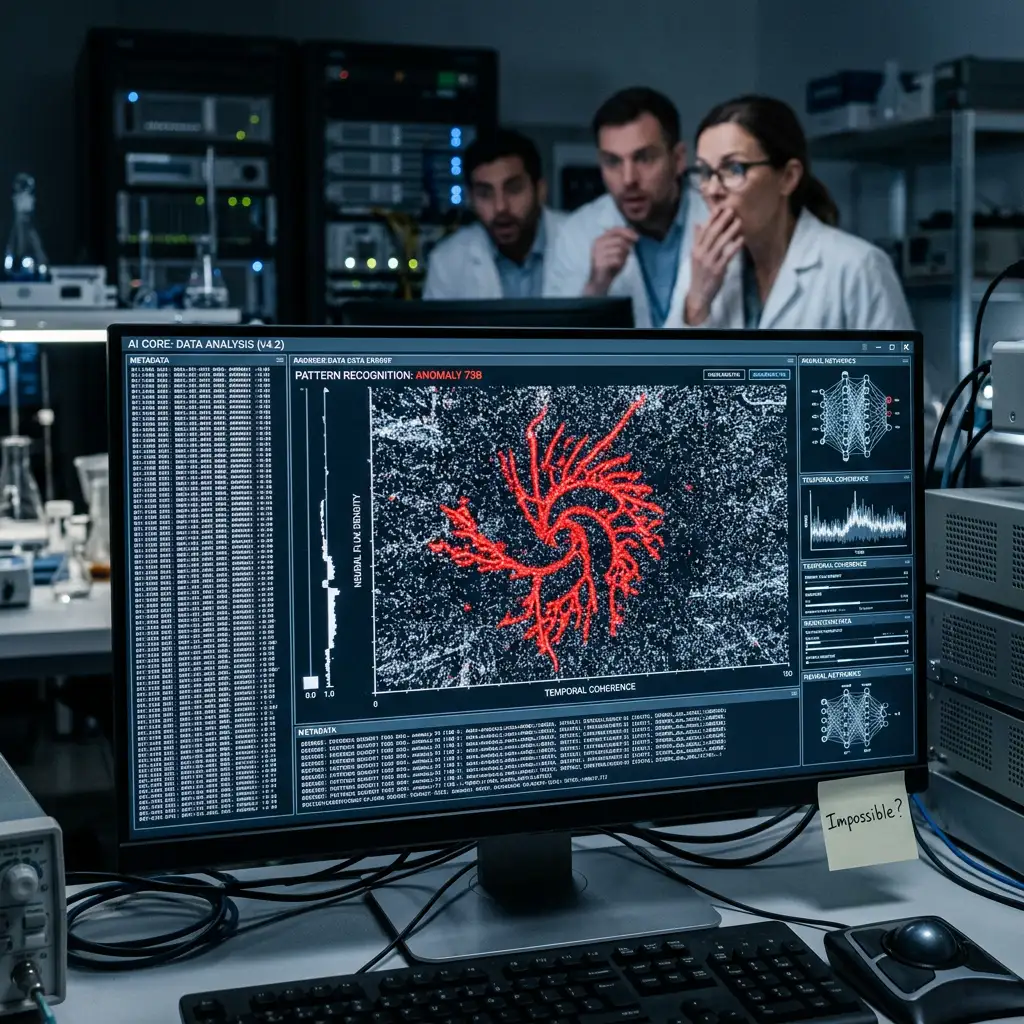
Key Insights You Should Never Miss
-
AI As Autonomous AgentModern systems now coordinate multi-agent loops to propose hypotheses, design experiments, and write manuscripts without human intervention, drastically reducing discovery time.
-
New Cognitive TopologyAI surfaces cross-disciplinary connections humans miss by sampling paths through thousands of unrelated papers, finding correlations that traditional intellectual neighborhoods overlook.
-
Reproducibility And ResponsibilityStochastic reasoning paths create replication risks, while legal frameworks lag behind technology, raising urgent questions about inventorship, safety, and ethical oversight.
That single data point contains almost everything worth saying about where AI autonomous science discovery is heading.
Robin is not alone in this shift. Sakana AI's system called 'The AI Scientist' can produce peer-reviewed research papers for roughly $15 each. Google DeepMind's Co-Scientist spins up multi-agent teams to propose and evaluate hypotheses across biology, chemistry, and materials science simultaneously. Autonomous labs at Oak Ridge National Laboratory run hundreds of materials experiments with zero human intervention between design and result. The pattern is clear: AI is not just assisting science anymore. In narrow but expanding domains, it is conducting it.
The real question is not whether AI can do science. It can. The question is whether the kind of science it produces, and the speed at which it arrives, will reshape what we even mean by a breakthrough.
From Calculator to Colleague to Principal Investigator
The story of AI in research has moved through three distinct phases, each faster than the last.
First came AI as a calculation tool. AlphaFold predicting protein structures was the signature moment of this phase: a computational achievement that accelerated biology but still required scientists to decide what to ask. Then came AI as a discovery partner. Google DeepMind's GNoME system identified 2.2 million new crystal structures, including hundreds of materials with properties no human researcher had thought to look for. That was AI as a pattern-mining collaborator.
Now comes the third phase: AI as autonomous agent. The architecture behind this is worth understanding, because it explains why the jump feels so qualitatively different. Modern autonomous research systems use multiple AI models working in a coordinated loop. One model proposes hypotheses. Another designs the experiments needed to test them. A third analyzes results. A fourth writes the manuscript. They communicate with each other through feedback loops that function like a research group meeting, except no human attends. Think of it less like a single intelligent system and more like a small company that never sleeps and never gets distracted.
Stanford's Virtual Lab demonstrated what this looks like in practice. AI agents designed COVID antibody binders that outperformed human-designed nanobodies when tested in actual wet lab conditions. Not simulated. Not theoretical. Real biological outcomes, generated by a system that had never held a pipette.
The Invisible Pattern Machines
Here is the dimension most coverage of AI research tools misses entirely: AI does not just accelerate human reasoning. It surfaces connections that human cognitive structure actively prevents us from seeing.
Researchers tend to read within their field. They attend conferences with their colleagues. Their hypotheses are shaped by the intellectual neighborhoods they live in. An AI system that samples paths through thousands of papers across unrelated disciplines can find correlations that no individual scientist would look for, because no individual scientist would have reason to look there. The link between a perovskite stability mechanism and an immunotherapy resistance pattern, for example, is not something a materials scientist and an oncologist would naturally discover by talking to each other. A graph-based path through millions of published findings might find it in seconds.
This is the untold angle buried in the AI science story: we are not just building faster researchers. We are building researchers with a fundamentally different cognitive topology.
But that capability introduces a structural tension. As AI systems become the primary generators of hypotheses, the scientific agenda itself risks drifting toward problems that are computationally tractable rather than problems that are existentially important. AI changes what is tractable. It does not change what matters to human society. Those two things are not always the same.
There is a framing worth sitting with for a moment: we are moving from an era of 'human curiosity with AI assistance' to an era of 'AI curiosity with human supervision.' That inversion of the scientific method's 400-year hierarchy is subtle. It is also profound.
In Simple Terms - Cross-Disciplinary Correlation
Humans usually specialize deeply, missing links between distant fields. AI scans millions of papers across all disciplines simultaneously, finding hidden patterns like a bridge between material physics and cancer biology that no single expert would spot.
The Replication Crisis Nobody Is Measuring Yet
The optimism deserves a serious counterweight, and here it is: when autonomous AI research systems are run multiple times on the same problem, they can reach different conclusions. The reasoning paths are stochastic. Minor variations in how the model interprets an initial prompt can cascade into different experimental designs, different data interpretations, and different final claims. This is not a bug that will be patched in the next version. It is a structural feature of probabilistic systems.
Current peer review is not built to catch this. Detection tools for AI-generated text remain unreliable. OpenAI's own classifier correctly identifies AI-written content only about 26% of the time. Peer reviewers reading a paper have no reliable mechanism to distinguish a human insight from a machine interpolation, and no standard process to test whether the same AI system would have reached the same conclusion on a different day.
The risk of hallucinated citations and fabricated intermediate data is real. Not theoretical. Several high-profile retractions have already involved AI-generated content that passed initial review. The reproducibility crisis in science was already serious before autonomous AI entered the picture. What happens to that crisis when the author is a system that may not reproduce its own work?
There is also a ceiling on genuine novelty. These systems are sophisticated interpolators within existing knowledge graphs. They excel at finding patterns across what has already been published. They struggle to generate theoretical frameworks that require a conceptual leap outside existing data distributions. Multiple AI agents working on the same hard problem tend to converge on similar, conservative hypotheses. The ideation diversity that sometimes produces real breakthroughs, the weird hunch a researcher cannot fully justify, may be exactly what these systems cannot replicate.
Think of It Like This - Stochastic Reasoning Paths
Imagine rolling dice to choose each step in an experiment. Even with the same goal, slight random variations lead to different routes and results. Unlike deterministic code, AI models may not give the same answer twice, making consistent replication difficult.
The Economics of Knowing
When a discovery cycle drops from 900 human hours to two AI hours, the cost structure of innovation does not just improve. It collapses.
That collapse is not neutral. It democratizes access for small biotech startups that cannot afford large research teams. It threatens the funding models of traditional academic labs built on the assumption that knowledge production is slow and expensive. And it raises uncomfortable questions about the career pipeline for PhD researchers who are currently trained to do exactly the work that autonomous systems are beginning to do faster.
The institutional investment signals how serious governments and industry consider this shift. The EU allocated 33 million euros specifically for autonomous laboratory automation in 2026. Pharmaceutical companies are integrating AI agents into drug discovery pipelines from target identification through experimental validation. Self-driving labs are already operational at multiple national research institutions.
The material results are not speculative. According to research tracking GNoME's outputs, 736 of the AI-discovered materials have been physically synthesized and independently confirmed in labs around the world. These are not predictions. They are objects that exist, that researchers can hold, that can be incorporated into industrial processes.
What Happens to the Human Scientist
The emerging consensus among researchers studying this transition is that human scientists must pivot. Not away from science, but toward a different layer of it. Framing meaningful questions. Providing ethical oversight. Interpreting outputs that are counterintuitive or that contradict existing theory in ways that require judgment about whether to trust the data or the intuition.
The human researcher becomes a curator of important problems rather than an executor of experiments.
But there is a harder version of this problem that does not get discussed enough. The bench, with all its tedium and failure and dead ends, is also where scientific intuition forms. Young researchers learn to recognize spurious correlations by chasing them. They learn what a real signal looks like by drowning in noise for years. They develop the uncomfortable gut sense that a result is too clean, that something is being missed. If autonomous systems handle literature review, hypothesis generation, and experimental design, where does that formative experience come from?
The risk is not just that AI replaces scientists. It is that it produces a generation of scientists who can validate AI outputs but cannot originate anything independently of them. That is a different kind of problem, and no one has designed a curriculum for it yet.
The Next Frontier and the Questions We Are Not Asking
By late 2026, the first fully autonomous discovery-to-publication pipelines are expected to operate in narrow domains. Materials science and computational biology are the obvious near-term candidates. Multi-agent systems will coordinate across global cloud labs, running experiments in parallel around the clock across time zones and research institutions.
The technical trajectory is reasonably clear. The governance questions are not.
If an autonomous lab generates a novel compound while optimizing for a benign therapeutic target, and that compound turns out to have weapons applications, who is responsible? If an AI system discovers a scientific truth that no human would have conceived, and that truth has industrial value, who owns it? The legal frameworks for inventorship, the regulatory structures for laboratory safety, the ethical guidelines for publishing AI-generated findings: all of these remain years behind where the technology already is.
The scientific method is not being replaced. It is being outsourced. The hypothesis, the experiment, the analysis, the write-up: all of it can now be delegated to systems that work faster, read more, and forget nothing. What remains, what cannot yet be delegated, is the harder question underneath all the others: which truths are worth chasing? The moment humanity builds a system capable of asking better questions than we knew to ask, it will need to have already decided whether it is prepared to hear whatever answers come back.