July 17, 2026 was the day when, after a few minutes in Shanghai, Jinping announced something totally new and no Westerner nor Americans, Nor Japanese people had a piece in writing that document: launching a new international body to determine how AI gets governed without the Western rulebook dominating it. The organization, called the World Artificial Intelligence and Industry Council Organization or WAICO, began with 29 founding countries and with no democratic Western country present.
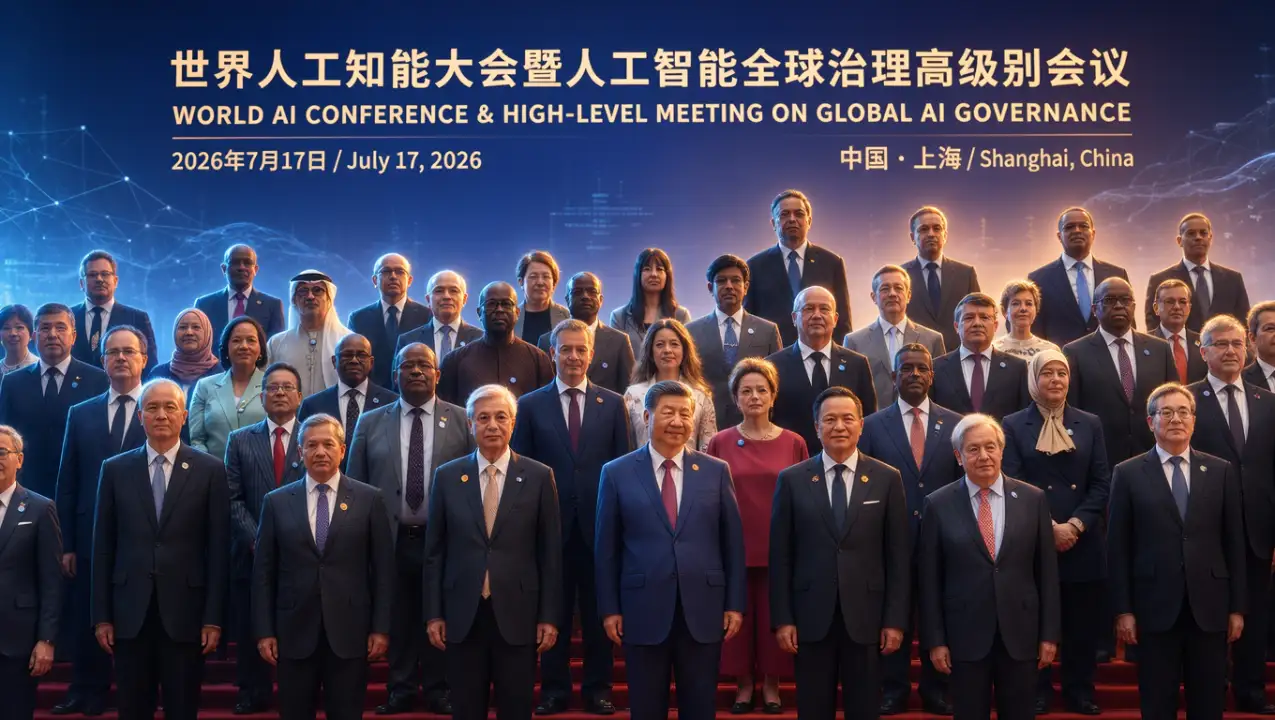
AI Generated Illustration
UN Secretary General, Antonio Guterres though was in attendance. Actually, it was the lack of their presence that became the main part of the message that was given. For about two years now, China has been making preparations to hold this moment, and the resulting AI rules are not really about regulating the use of chatbots in China.It is China's intent that other countries shall be referring to their AI laws while framing their regulations, just the way that privacy regulations are referencing Brussels now.
The only significant difference that this initiative makes compared with the numerous similar governmental papers that other countries published in the last 4 years is that WAICO is a concrete organization with buildings, a charter and a clear vision that its role will not be tied to the political climate of any particular administration. Statements fade away and institutions stay and influence slowly the definition of 'normal'. Right now, it is not the competition of models that gives the better performance on the benchmark that determines the winner, but whose regulation becomes the one by which most of the AI deployments on earth is being governed.
Why AI Rules Have Become a Strategic Technology Race
Governments didn't get into the race against each other to legislate AI because a sudden passion for the inner workings of neural networks caught the lawmakers like that. They began racing because AI models were able to go from research demos to real-world systems that influence elections, personnel choices, and copyright laws, all within around three years. Each of these touchpoints will eventually lead to a group or community of people who will demand regulations So every government wishes to be the one drawing the rules while being the one that merely adopts others' at the same time.
The three major coalitions that are forming around this are really distinct from another. The EU designed the sole comprehensive, non-exempt AI law in the world. This law separates systems into risk categories, and the regulations with enforceable obligations are being implemented gradually from 2025 onwards. The US hasn't introduced a single federal law but has instead put the brakes on through the use of export controls and executive orders. China has now aligned its domestic regulations of algorithms and the generative AI with a product for exporting: WAICO itself that it has made available to any country signing up.
Before, it was usual for the regulators and lawmakers to be late movers, the kind of the cleanup crew. At this time Though they have caught up with or even surpassed technological developments as first-movers' standards will shape quite a lot of AI development in the coming years. This is why signing of the treaty in Shanghai is important to a semiconductor manufacturer in Taiwan or founder of a tech startup in Nairobi Also as to officials at the ministry in Beijing.
At a more fundamental level, one wonders that it is not whether the Chinese model will replace others. It is instead whether the single main structure that rules the globe will come up with an overall system or not?
How the Alliance Could Shape Global AI Standards
The document that led to the creation of WAICO also fails to state something very important: the way AI legislation is actually translated on the ground. Alliances of the kind usually have limited direct control - companies can hardly be controlled at their own - rather, technical standards are being shaped by the influence such groups exert, the certifying bodies, through which safety is determined, and the default options which member states pick instead of writing rules anew.
To give a rough example: think not of a law but of a widely adopted electrical socket plug design. Even though Governments dont compel charging equipment companies to do the work, when one kind of plug is accepted by several countries, the manufacturers will follow. In fact, WAICO hopes that, for a little over half of the 29 countries outside of EU/G7, which are Russia Brazil Indonesia, Pakistan, and Kazakhstan, such agreement may become the default set.
It is Really the case that all that would be necessary is missing. The drafters including the Simon Institute for Longterm Governance who are a group that studies and gives opinions about these sorts of things, have pointed to Really no one revealed the budget, no one set clear criteria that members should comply with or that would be binding, and the first proper meeting has not yet been officially scheduled. It is true that the basic idea has been put forth. But for now, the enforcing powers - the teeth - do seem to be missing. And, in all probability, a headquarters alone cannot justify an organization without the power to enforce its decisions - it would be nothing but a promise - regulation, not a law.
You can get a very refreshing view of things by contemplating this idea: probably the biggest challenge in the area of AI will no longer be the creation of the best model but rather the establishment of the standard that must be followed in every case before a model can perform its tasks. Such a change will mean a complete redefinition of which competitors are the main players.
What This Means for AI Companies and the Global Economy
With WAICO entering the picture, life for a company that builds or deploys AI across borders just got a bit harder, for compliance, not easier. A company building systems to meet the EU AI risk tiers requirements could face the task of completely redesigning those same systems to be lawful on a market aligned with the WAICO structure, since there is no necessity for those two structures to be aligned.
The cloud platforms, hardware manufacturers and the small and midsize tech companies which are all aiming for a global footprint are presented with a dilemma which is pretty much the same ones that data privacy law has given to multinational companies: either create one product worldwide which would comply with the strictest rules everywhere, or develop regional versions of the product and incur the cost of engineering. Generally, regulatory clarity helps drive the adoption of new technologies while the existence of multiple regulatory rules slows the investments down, because no one wants to build an infrastructure that may be obsolete due to regulation change.
On the open-source AI front, the situation is a kind of puzzle. China offers developing countries to access the open models as part of its overall package and also brings the training and technical assistance to countries which get involved. That strategy could help the AI adoption in the Global South in a fast manner and even circumvent the Western export controls, but at the same time, it could enhance the dependence of these countries on the Chinese technical standards that would last the whole year.
Truth is the US is missing from this meeting place not really a minor issue. If that were to be the case, this would be a major consequence that the entire announcement has brought about.
Where Is the United States in This Conversation
Battlefront changed for Washington quite a bit. If rather than signing up to a multilateral treaty body, the US has created its AI blueprint through export limits on cutting-edge chips and Pax Silica, another coalition created in December 2025, whose aim is to safeguard essential minerals, semiconductors, and computing supply chains among the 24 or so allied countries.
This method is quite advantageous. It allows the executive branch to act quickly without waiting for Congress to ratify a treaty and also keeps instruments such as export licensing with the federal agencies. In his Shanghai speech, President Xi went straight for Washington's strategy. He criticized countries whose governments were, in his words, "pushing national security too far" in AI policy, an obvious hint towards chip limits.
The price is coordination. Since the method relies on various executive measures, its implementation can vary with every change in administration. That means, it is a bit of a gamble for other countries to align themselves with US rules when Washington is still not a permanent treaty organization. The advantage that slow-moving centralized units like WAICO have is that, apart from the initial period when they move slower, In reality once established they do not easily change even with the coming and going of different political leaders in any one country, gives them a sense of long-term planning. In this sense whether WAICO will work well for China or not will depend on how much actual power WAICO will have and what decisions will be handed to it by its members.
The Risks, Unknowns, and Questions That Still Need Answers
Essentially, WAICO is simply a name, a city, and a list of 29 signatories, most not fully confirmed publicly when the formalities have stripped away. The group has not revealed how the sanctions are going to be operated, the way funds are going to be shared, and what kind of technological certificates should be issued. There is no mention of the date of their first proper meeting. Whatever is left to say after the creation of WAICO is just what the members hope to achieve in the future.
A serious issue for any person trying to evaluate the extent of change in practice is what these new measures really bring. They argue that international organizations that lack punitive measures typically fail to yield substantive actions as their members merely make statements. Truth is the official launch of WAICO gathered a good number of people hardly is an argument for why it should not be the same. One of the big uncertainties now is whether members with domestic agendas so different from each other, like Russia, Indonesia, and Senegal, agree at least technologically and, if so, how to enforce their joint decisions.
The main purpose, in the eyes of WAICO, is to avoid the creation of new historical injustices in the field of AI access as China is very vocal about it. In principle Yet a Shanghai-based WAICO member means you are to use Chinese-influenced infrastructure and training programs. In practical terms, countries accepting WAICO's training spots are basically gambling on whether they will be the ecosystem of their choice for the decade, whether they admit it at the end or not.
But none of this indicates an abandoned initiative. It only reveals that there is still a long way ahead from announcement to concrete action, and that closing the divide will take many years of hard work, not just catchy headlines.
Why This Moment Could Define the Next Decade of AI
If you step far enough backwards and take an overview of WAICO, it seems more of the beginning of a longer evolution rather than a mere one-off policy announcement.
A regulation on AI is going to expand no matter what. There's no doubt of that since it will happen in Brussels, Washington and now also in Shanghai. Still, the real problem is that which rule system will be seen as the common standard to be followed by governments for regulation without building a whole new system, just the way GDPR was used as a model beyond Europe.
In the future AI history will probably be dominated more by governments that managed to get other countries to adopt their AI regulations than by laboratories that released their most advanced models first.