In 2020, a car accident left Dong Hui paralyzed from the neck down. For years, the simplest acts of agency were gone: picking up a glass, turning a page, signing his own name. Then, after surgeons placed a coin-sized chip against the outer membrane of his brain, his hand moved. Not reflexively. Not with physical therapy. Because he thought about it. The signal traveled from his motor cortex, through a wireless implant, into a soft robotic glove, and into his fingers. He picked up a pen and wrote his name.
Key Insights You Should Never Miss
-
First Commercial BCI ApprovalChina approved NEO, the first invasive brain-computer interface for commercial sale, marking a shift from research labs to actual medical products reaching patients globally.
-
Safer Epidural Implant DesignNEO uses epidural sensors on the dura mater instead of penetrating the cortex, reducing inflammation risks while maintaining high decoding accuracy and wireless power efficiency.
-
Potential Neural Repair MechanismEarly data suggests NEO may help repair neural pathways through plasticity, offering hope for spinal cord injury recovery beyond simple assistive technology applications.
That moment is not a product demonstration. It is the clearest evidence yet that brain-computer interface technology has crossed from the research lab into medicine that actually reaches patients. And what makes it geopolitically charged is where it happened: the implant is called NEO, it was developed in China, and in March 2026 it became the first invasive BCI in history approved for commercial sale beyond clinical trials.
Neuralink did not get there first. Neither did the US programs that have spent decades on this problem. The country that crossed the finish line first did it not by going bolder, but by going wiser.
The Decades-Long Race Stuck in the Lab
Researchers have been studying brain-computer interfaces since the 1970s, and for most of that time, the work stayed almost entirely inside universities and controlled trials. Programs like BrainGate at Brown University produced real results with paralyzed patients, but those results never left the research setting. Decades of papers, and almost no products.
The reason comes down to a single, stubborn tradeoff. Non-invasive BCIs, the kind that sit on the scalp like a cap of electrodes, are perfectly safe but read signals through layers of bone and tissue. The result is blurry, like trying to hear a conversation through a wall. Fully invasive implants that penetrate the brain's cortex pick up sharp, precise signals, but they carry real risks: bleeding during surgery, immune reactions, scarring, and electrodes that gradually lose function as the brain's tissue pushes back against them. Every team in the field has faced the same choice: clarity or safety.
Neuralink bet heavily on penetrating the cortex. So did others like Paradromics. Precision Neuroscience took a gentler approach with thin electrode arrays laid over the brain's surface. But none of these had reached commercial approval. What changed in 2026 was that one team found a third route, and regulators agreed it worked.
What China Actually Approved
China's National Medical Products Administration cleared NEO in March 2026. The device was developed by Shanghai-based Neuracle Technology in collaboration with Hong Bo's team at Tsinghua University, a group that has been working on this specific approach since 2013. Approval is currently limited to adults aged 18 to 60 with paralysis from cervical spinal cord injuries who retain some arm function. Notably, NEO was also assigned a health insurance code almost immediately, which is less a technical footnote than a statement of intent: this is meant to reach patients, not sit in a hospital showcase.
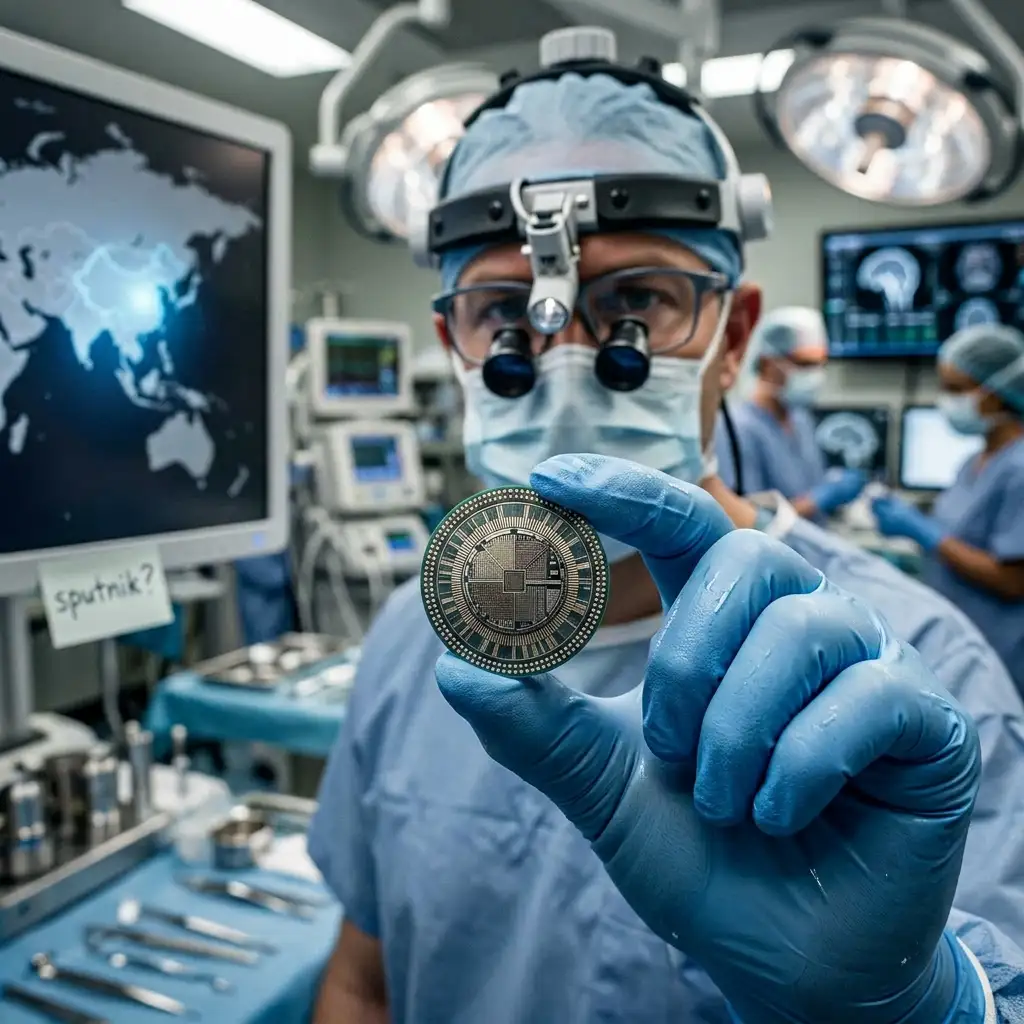
The hardware is deliberately unspectacular. A coin-sized implant, wirelessly powered through near-field energy transfer, with eight sensors that rest on the dura mater rather than inside brain tissue. The dura is the brain's tough outer membrane, the last barrier before neural tissue itself. NEO sits on top of it. The sensors capture electrical signals from the motor cortex, transmit them wirelessly to a processing unit, and that unit drives a soft robotic glove. Users grasp objects by intention alone.
By early 2026, NEO had been implanted in roughly 32 to 36 patients across multiple hospitals. The approval signals readiness for scaled manufacturing and wider clinical rollout. Whether the regulatory timeline elsewhere can keep pace is a different question entirely.
The Quiet Genius of the Middle Path
Here is the decision that made everything else possible. While Neuralink pushed electrodes through the blood-brain barrier to access the cortex directly, Hong's team chose in 2013 to work with epidural signals, those captured just above the brain's surface rather than inside it. The signals are slightly less sharp than cortical recordings. They are also far less likely to trigger the inflammatory response that causes electrodes to fail over time. Think of it like choosing to record a concert from ten feet away rather than standing inside the speaker cabinet. You lose some raw intensity, but you can actually sustain the recording.
In Simple Terms - Epidural vs Intracortical
Epidural implants sit on the brain's protective outer layer, avoiding direct tissue penetration. This reduces surgical risk and long-term immune rejection, though signals are slightly less precise than deep cortical implants.
NEO reports decoding accuracy above 90 percent with millisecond-level response times. The wireless power system eliminates internal batteries entirely, removing the need for replacement surgeries that would otherwise introduce periodic surgical risk. Compare that to a significant setback Neuralink disclosed: in one of its first patients, roughly 85 percent of implanted electrode threads retracted from the cortex, degrading signal quality substantially. The cortex pushed back, as it tends to do.
China did not win the brain-chip race by reaching deeper into the brain. It won by knowing when to stop.
From Assistive Crutch to Possible Healer
Most coverage focuses on the robotic glove, but the more surprising development is what happened without one. Researchers found that over two-thirds of NEO patients showed significant improvement in voluntary hand motor function after six months of use, gains that went beyond what the device itself was providing. Patient Dong reportedly began sweating again after years without sensation in parts of his body.
The tentative explanation involves neural plasticity. By creating a working signal loop between the brain's motor cortex and the body, BCIs may be reinforcing neural pathways that injury had silenced rather than destroyed. The brain, in other words, may use the device not just as a bypass but as a scaffold for its own repair. If that mechanism holds up under longer study, BCIs would shift category entirely: from assistive technology to neurological therapy.
That is a significant 'if.' The patient cohort is small, the follow-up period short, and the mechanism is still not fully understood. Scientists have observed the phenomenon without yet explaining it. But for the tens of millions of people living with spinal cord injuries, ALS, or stroke worldwide, even a preliminary signal of neural repair is the kind of development worth tracking carefully.
The Risks the Headlines Skip
Approval is not the same as availability. NEO currently covers a narrow patient profile, and most clinical data comes from small groups over timeframes too short to reveal what happens to an implant five or ten years in. How the body responds to a permanent foreign object on the brain's surface over a decade is genuinely unknown. Signal stability, long-term material integrity, and failure modes remain open questions that a few dozen patients cannot answer.
The harder concerns go beyond engineering. Brain signals are the most intimate data a device can collect. They are not search queries or location pings. They carry the precursors to intention, thought, emotion. Who owns that data? What happens when insurance companies, employers, or governments want access to neural records? What safeguards prevent a BCI from being updated in ways patients did not anticipate or consent to? These questions do not have settled answers anywhere in the world, and the fact that NEO is now a commercial product with an insurance code means they need answers faster than the academic bioethics literature is currently producing them.
Think of It Like This - Neural Plasticity
Just as physical therapy helps muscles remember movement, BCIs may help damaged brains rebuild connections. The device acts as a temporary bridge, allowing the brain to relearn how to send signals to the body.
The excitement around potential neural repair also runs ahead of the evidence. The mechanism is not understood. The sample size is small. Calling it 'neural repair' before controlled studies confirm it is a choice to let hope drive framing.
A Sputnik Moment for Neurotechnology
What changed on the day NEO received commercial approval was not just the status of one device. It was the classification of the entire technology. BCIs had been research objects. Now one of them was a reimbursable medical product. That reframes investor timelines, regulatory urgency, and competitive pressure for every team working in this space.
The approval also reflects something that cannot be separated from the device itself: China has been treating BCI as a strategic industry at the state level. It designated brain-computer interfaces a future industry in national planning documents, established accelerated regulatory pathways for neurotech, and folded NEO into the insurance system. That is not a startup ecosystem story. It is a coordinated push across government, university, industry, and hospital system that most countries would struggle to replicate even if they wanted to.
That said, 'first to market' is not the same as 'best' or 'safest.' The US still leads in certain deep cortical approaches, and the global BCI field is more competitive now than it has ever been, not less.
What Comes After the First Brain Chip
NEO is a starting line dressed up as a finish. Chinese companies are already pursuing adjacent capabilities: NeuroXess is working on decoding imagined speech into Chinese text, Stairmed is developing ultra-flexible electrode materials, and NeuCyber's Beinao system targets broader motor rehabilitation. The next generation of BCIs will go after language, fuller body control, and implants designed to last decades rather than years.
The strategic stakes extend beyond medicine. Governments increasingly see brain interfaces as a potential control layer for robotics and embodied AI systems, the link between human intention and machine action. That reframes the competition as something closer to infrastructure than healthcare, which intensifies the timeline pressure considerably.
Realistic progress in this field will be incremental and evidence-driven, with tighter regulation following quickly behind commercial expansion. The neurotechnology market in 2026 is not moving at the pace of social media. It is moving at the pace of regulated medicine, which is slower but also more likely to produce things that actually work reliably over time.
When Thought Becomes the Interface
Dong signing his name is the right place to keep returning to, not because it is a satisfying ending, but because it is a precise measurement. The value of this technology is not national bragging rights. It is the restoration of agency to people who lost it. That is what the race is actually for.
But the same technology that read Dong's intention to write can read a great deal more. As brain-machine interfaces enter commercial medicine, society will need to work out who owns neural data, who can afford access to restoration, and where the line sits between healing and enhancement. NEO answered whether this kind of interface was medically viable. What it did not answer, and what no regulatory body has answered yet, is whether we have the frameworks to handle what comes next.
The first commercial brain chip is in a patient's skull. The harder questions are still looking for a home.