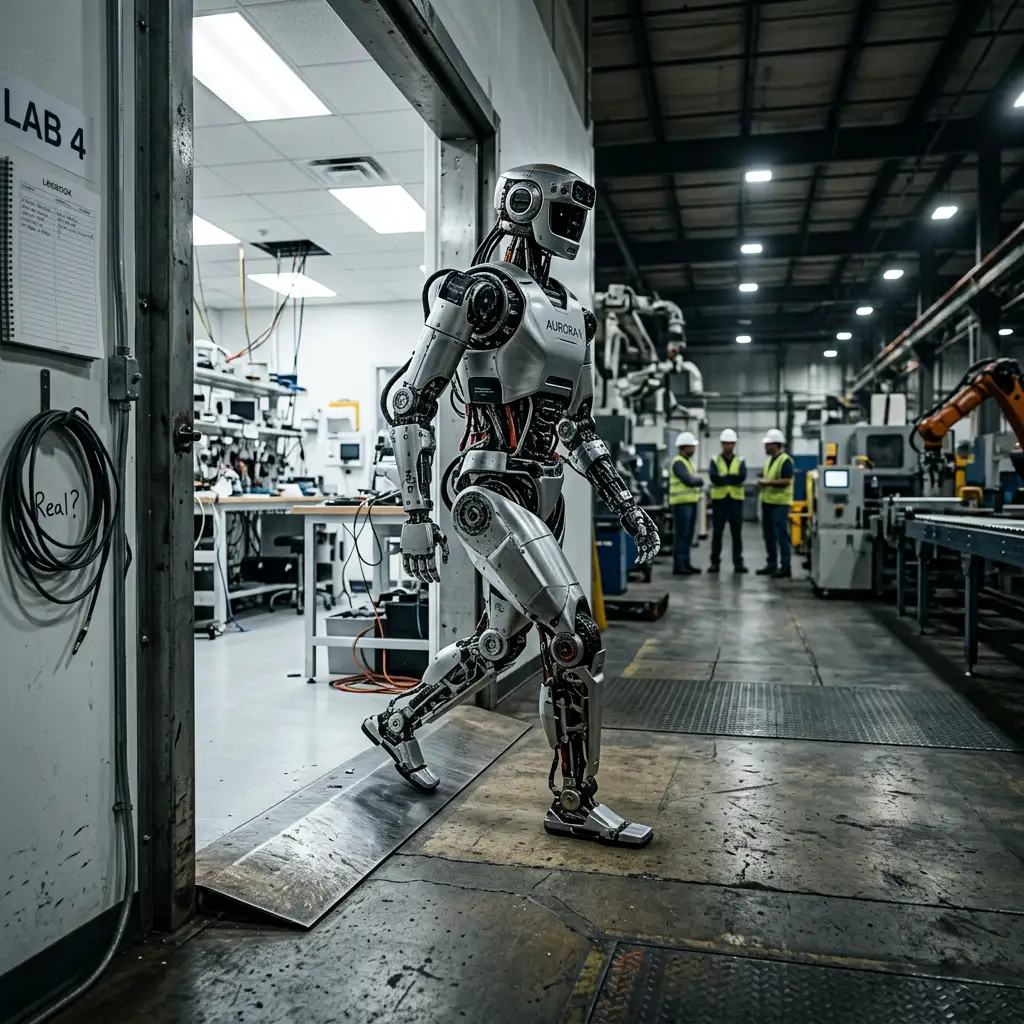
A robot with two arms and a torso works at a workbench in a facility somewhere in the Midwest, putting all the components that are to be assembled in their place over an entire eight hour shift without so much as a break. No cameras are there for it. No press release was issued. And nobody came out with footage of it dancing or opening a beer.
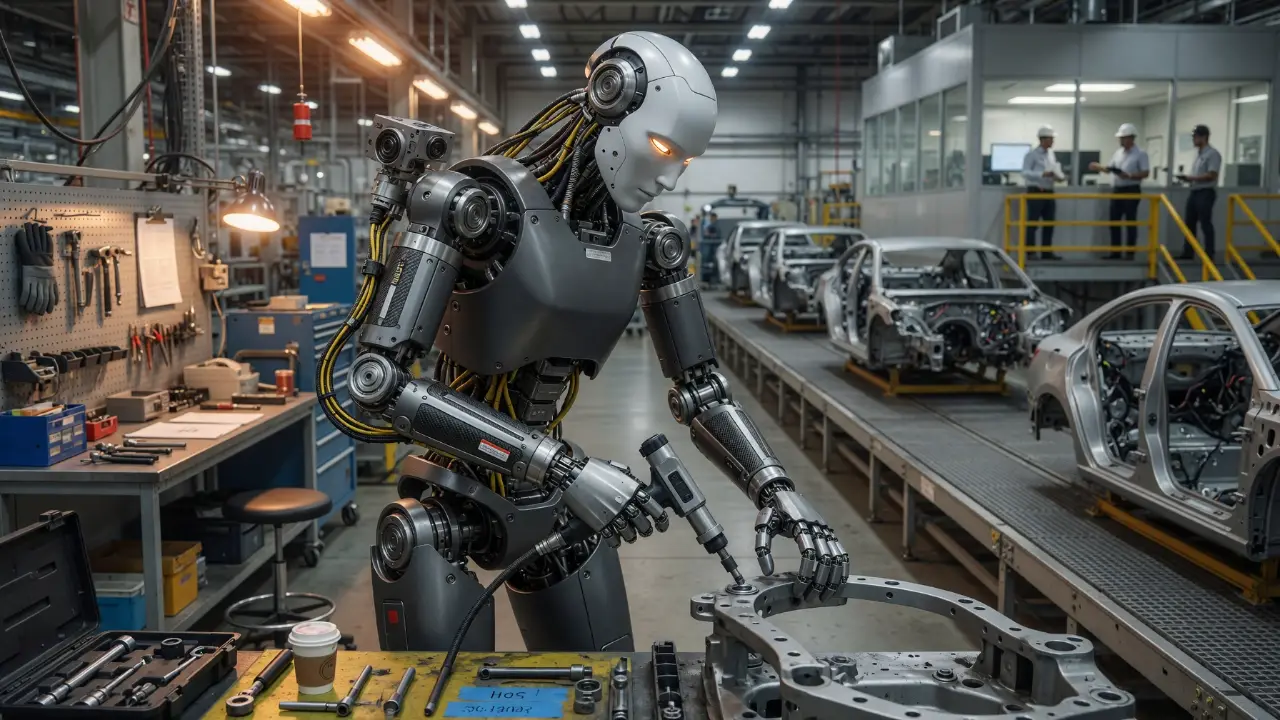
AI Generated Illustration
Definitely not through a press release but a video, neither of the two, and definitely no press conference were the moments that made history for robots that work on humanoid basis, In particular robots that operate and perform the same type of tasks as humanoid beings in real life. So what happens is, while social medial users keep sharing robot video clips showing robots doing backflips or serving coffee, factory bosses of the companies who actually manufacture robots, have passed the stage completely where robots are the theater and only the main event and have been working in the production floors doing actual pilot projects and testing the machines for breakdowns time and they are only interested in a very low-key but much more important robot question like: will the machine be able to do the same task perfectly, exactly ten thousand times in succession?
The race is now being run very quietly and its main concern is, no longer, about finding out which company is capable of building a robot that will be the most convincing, if you like, to look like a human being. It is whether Really humanoid robots can be put to work for a whole shift in a factory setting and won't need a technician all the twenty minutes. With that change of perception, the basis on which this robotic technology is evaluated, funded or adopted, is completely altered. Investors can easily ignore the robot's ability to wink, for example, because what matters to them is the cost per completed task.
We can fully appreciate the significance of the said transition only when we look behind the scenes where these robots are really undergoing the test, rather than in the publicity stunts where viral clips are made.
Why Factories Became the First Real Market for Humanoid Robots
Manufacturing was struggling before this new wave of technology. It has always been a problem finding replacement workers due to an aging manufacturing workforce, repetitive shift work being very demanding, and higher wages are just adding to it. There have been a number of recruitment campaigns and initiatives but there is still a big worker shortage in the manufacturing sector. However, a factory, apart from its other virtues of a good environment for robots, also happens to be one of the few environments where the level of control is sufficient enough for an early robot to be successful.
Factory floors are level, the lighting doesn't fluctuate and all the tasks are similar. A robot working in a house has to deal with different heights, a cat and toys that your toddler leaves spread all over the place so the obvious reason factories won the right to go first is that it was only after all this that it became really practical.
There isn't really any excitement in the jobs these robots can handle as yet. Just, they do things like taking containers from one location to another, operating machines that need to be loaded and unloaded, performing quality checks of assembled products, and picking stuff from stockrooms. Everything in this is quite standard and nothing is trying to be groundbreaking by doing lab demonstrations. These machines are the ones that would be given to temporary workers on the first hand, which is exactly why they are the places one would like to begin. A lot is behind these achievements but the main credit goes to some very specific technical breakthroughs. That's the real story we want to be told.
The Technology That Makes Modern Humanoid Robots Useful
Nowadays, a breakthrough isn't so much about the hardware anymore. Legs and arms have been mechanistically solvable for a while. The change has come down to what's been layered on top of the hardware: for example, computer vision that can identify parts from a cluttered work station, AI models trained with footage in such a way that they can generalize over slightly different objects, and force sensing that enables a robot to grip a part with the right amount of pressure to hold it without crushing it. Stated simply, the last aspect mentioned is known as the application of force feedback control.
Putting it in very layman terms, it acts like human fingers that can recognize the difference between a soft egg and a hard rock as well as how strongly to hold something. The key factors which a factory manager actually considers, to give a clear picture of efficiency, are boring: task completion rate, the frequency of human intervention in robot operations, energy draw per shift, and cost per completed unit of work. Most companies are very secretive about these figures, so you have to work very hard to determine which humanoid robot is best with a high degree of confidence. A vendor promising 95% reliability sounds great until you learn this figure has not been independently checked by a third party.
Even a bit of imperfect statistics reveals that, more and more, industries see such robots as not fixed equipment at all, but rather as phones that are updated with a software and become more advanced. One can imagine that the robot bought in January will perform a wider range of the tasks by June, which will happen not because there was any physical change in it, but because the model underneath has been retrained in some way. A conceptual change in thinking, a hardware buy versus a software subscription, is the reason why this is a game-changer from an economic perspective for the traditional automation industry.
Why Manufacturers See a Long Term Economic Shift
The basic proposition to a factory owner is that a humanoid robot won't get tired and won't miss work. It is a great thing that a humanoid robot, in theory, can change its task from one station to another without having to redesign an entire production line. Still, the real selling point of this flexibility is quite more than just raw speed. Conventional industrial robots are highly specialized to one operation. These robotic devices can do the same motion millions of times with great speed, but it costs a lot to change the product and reconfigure the robots. A humanoid platform will trade off some of the speed in exchange for the robot's being free to move on the production line to work at a new station.
Better than anything is a welding robotic arm on an automated car assembly line in welding jobs. That human-like figure is still by great margin inferior to robotic welding arms for the same kind of work. It is safe to say that humanoid robots will not overtake robotics at work on assembly lines. The main point here is not to substitute traditional automation robots with humanoid ones, but to utilize the potential of humanoid robots to take on jobs which conventional automated machines are simply not built for - irregular, small-volume tasks and working stations where a human is still standing up because a special machine does not make economic sense for such a single job.
This concept which always pops in my mind that a physical work environment whose performance can be augmented every few months via a software update similar to the way one can get a phone upgraded to have a better camera features is very strange to base a whole supply chain on. The answer if this idea can stand up under real-life factory conditions is the question that industry has not yet been able to settle.
What Could Slow the Humanoid Robot Revolution
Battery life remains a significant setback. A robot that has to be recharged every four hours is not replacing an entire shift worker, but more like about half of such shift worker's work, and Apart from that, changing the robot for recharging introduces delays and complications for plant managers and their scheduling. Precision in manipulation is the next big problem. Taking a bolt from a bin seems very simple until you see how a robot robotically fumbles the task because the bolt was lying in an odd position the training data didn't include. Money aspect comes up after all that and yet, no one has a neat solution to it.
A robot that is supposed to work beside human employees takes a thorough understanding of safety certification which varies across different countries. If for example, a robot's arm moves too far because a sensor misinterpreted it only by a few centimeters that wouldn't be merely a hypothetical, it would be a type of event that stops production line, pilot program, and even the rest of the plant from going any further.
A successful pilot at one production plant doesn't mean the same robot will have similar success at a plant with different lighting, different type of floor and a different type of products passing through it. None of these points mean the technology is not progressing but they show rather how the sector is still at a stage where demonstrating reliability carries more weight than another viral demo video production.
What Early Adoption Could Mean for Global Manufacturing
If humanoid robots prove themselves at scale, the impact far-reaching, and ripple effects go beyond just one factory. Countries and companies which successfully use the technology at an early stage to get good at it are the ones that would eventually be able to retain production flexibility advantage. Supply chains that are based on human shifts that can be predicted might change in form when a significant portion of the workforce could work non-stop.
The deployment will not remain confined to car manufacturing plants, as these are now the primary venues for trials. The other industries such as electronics assembly, food processing, pharmaceutical manufacturing, and logistics have very similar types of repetitive tasks, and Because of this, automobile manufacturers were at first the ones to develop and test such technologies, now these are sectors as such, with reduced costs of automation, which will be the next steps in a technological leap for them.
The spreading of automation in these industries would probably occur in a gradual and non-uniform manner, plant by plant, rather than happen simultaneously at the whole industry level, through a sudden switch change. The really important question now is not whether a robot can walk well or talk. The issue is if it is possible for a machine to last an entire production shift without any human interventions for months, i.e. technicians stepping in. These experiments are being tested out in factories, and they will shape more than the physical appearance of robots in the future generation.