Your phone knows where you are. So does the cargo ship crossing the Pacific, the military drone surveying hostile terrain, and the autonomous vehicle merging onto the freeway. Every one of them is quietly dependent on a fragile chain of signals bouncing between Earth and a small constellation of satellites roughly 12,500 miles overhead. That infrastructure works remarkably well, until it doesn't.
Key Insights You Should Never Miss
-
GPS Vulnerabilities Demand BackupCurrent satellite signals are weak and easily jammed, creating critical risks for military, shipping, and autonomous systems that require immediate resilient alternatives.
-
Quantum Sensors Enable Signal-Free NavigationBy measuring atomic changes with extreme precision, these devices calculate position via dead reckoning without needing external satellite signals or internet connectivity.
-
Hybrid Systems Are The Near-Term FutureWhile full replacement faces engineering hurdles like size and cost, quantum sensors will initially augment GPS to maintain accuracy during outages or hostile electronic warfare scenarios.
GPS signals can be jammed with a $30 device bought online, spoofed by hostile actors to make systems believe they're somewhere they're not, and they vanish entirely the moment you go underground, deep underwater, or far enough into space that the satellites are no longer overhead. The entire architecture of modern navigation rests on a system that was never designed to be this important.
So what happens when that system fails? And more urgently: is there a way to navigate that doesn't require listening to satellites at all? That's the question driving a new class of research into quantum sensors as a GPS alternative, and NASA's work aboard the International Space Station is one of the more serious attempts to answer it.
Why Scientists Are Searching for a GPS Alternative
GPS transformed navigation when it went fully operational in the 1990s.Before it, ships used star charts and radio beacons, pilots relied on ground-based transponder networks, and hikers carried paper maps. GPS collapsed those separate systems into a single, global, always-on positioning layer that worked well enough to become invisible infrastructure.
The vulnerabilities were always there, though. GPS signals arrive at Earth's surface at incredibly low power, roughly the equivalent of a car headlight viewed from 12,000 miles away. Jamming them is trivially easy. Electronic warfare operations have already demonstrated spoofing attacks on commercial shipping in the Black Sea and Persian Gulf, with vessels appearing to navigation systems to be miles from their actual position. Underground environments like mines and urban subway systems receive no signal at all, and deep ocean operations face the same blackout.
These aren't hypothetical concerns for a future conflict. They're operational realities that defense planners, shipping companies, and infrastructure operators are already working around. The bigger challenge is that GPS dependency has grown so deep, across so many systems simultaneously, that building a fallback isn't just a navigation problem. It's a systems problem.
Inside NASA's Orbiting Quantum Laboratory
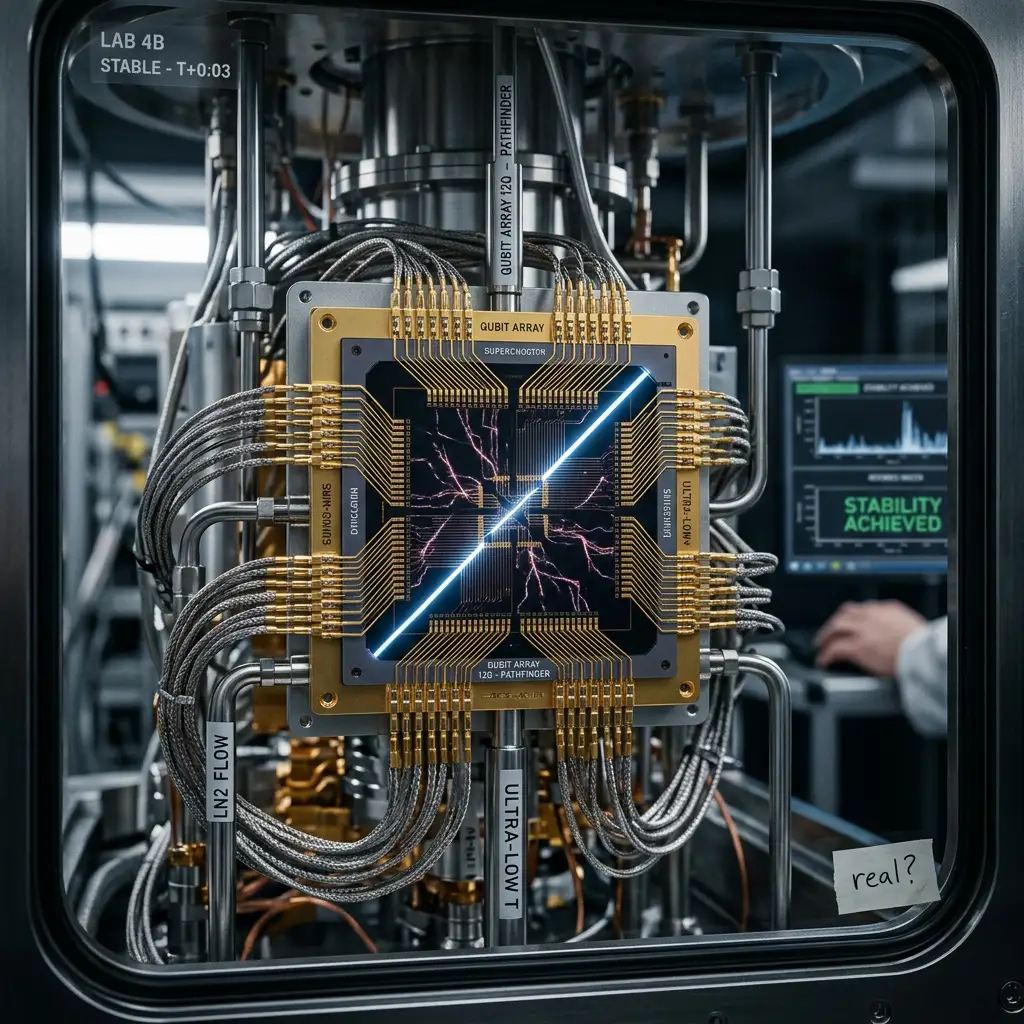
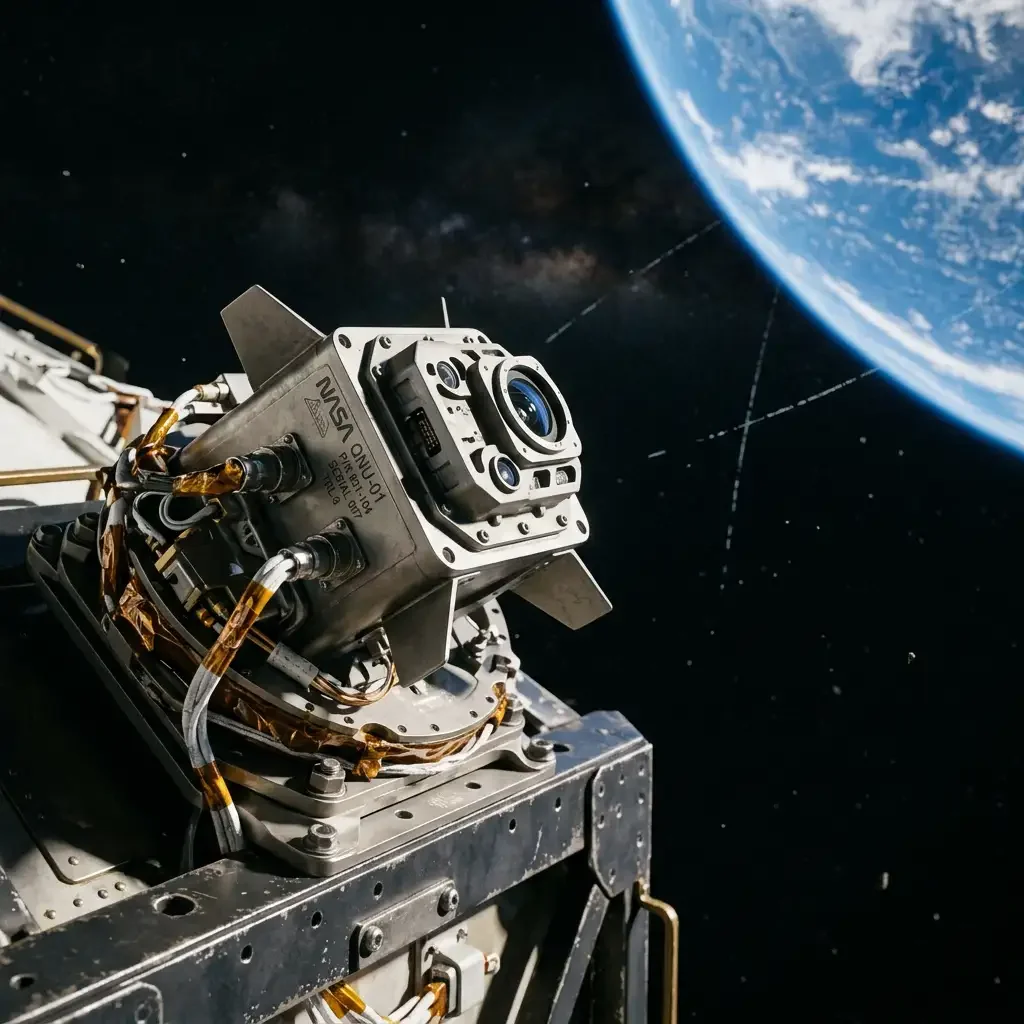
NASA's Cold Atom Lab, operating aboard the International Space Station, exists for a specific reason that isn't immediately obvious: microgravity makes quantum experiments easier. On Earth, atoms that researchers cool to near absolute zero still fall under gravity. They drift, they interact with surfaces, and the window for precise observation closes quickly.
In orbit, those cooled atom clouds float freely. Researchers can observe their quantum behavior for longer periods, and that extended observation window translates directly into more sensitive measurements. The Cold Atom Lab has produced ultracold atomic gas samples and studied quantum phenomena that are difficult or impossible to replicate on the ground for meaningful durations.
The station essentially serves as a quiet laboratory above all the noise. Vibration, seismic interference, and atmospheric effects that complicate ground-based quantum experiments are reduced or eliminated. For research into quantum inertial sensors and quantum navigation systems, this matters enormously because the sensors work by detecting extraordinarily subtle changes in atomic behavior, and any environmental interference corrupts the measurement.
How Quantum Sensors Could Navigate Without Satellites
Here's the core idea, stripped of jargon. Traditional sensors measure forces like acceleration and rotation using mechanical or electronic components that have physical limits on their precision. Quantum sensors use atoms as the measuring tool instead. Atoms of the same type are perfectly identical in ways no manufactured component ever can be, which means the measurement baseline is extraordinarily consistent.
In Simple Terms - Atom Interferometry
Instead of using mechanical parts that wear out, these sensors use identical atoms as perfect tuning forks. By watching how these atoms vibrate in response to motion, the system calculates its exact position through math alone, without needing any outside signal.
When a quantum sensor measures acceleration, it's observing how an atom's quantum state changes in response to motion or gravity. Think of it like this: instead of measuring speed with a needle on a dial, you're watching how a tuning fork vibrates, except the tuning fork is a single atom and its vibration frequency is governed by physics that cannot drift or wear out.
The navigation application follows from this precision. A system that can measure its own acceleration with enough accuracy, continuously, can calculate where it is by integrating those measurements over time. No external signal needed. Starting from a known position, it tracks every movement and arrives at a current position through math alone. This is what navigation engineers call dead reckoning, taken to a level of precision that current electronics cannot reach. The key insight: a quantum positioning system doesn't ask where it is. It calculates where it must be based on everything it has felt since the last known point.
The Performance Question Scientists Are Still Trying to Answer
Every inertial navigation system, quantum or conventional, has the same fundamental problem: errors accumulate. Each tiny measurement imprecision adds to the previous one. Over short timescales, this is manageable. Over hours or days, it can compound into navigational drift significant enough to be operationally useless.
Quantum inertial sensors are dramatically more sensitive than conventional accelerometers, which means the drift rate should be substantially lower. But 'substantially lower' in a laboratory environment isn't the same as 'low enough for practical autonomous navigation.' The research community has demonstrated impressive sensitivity benchmarks, and some results published in journals like Nature Physics and Physical Review Letters suggest atom interferometry can outperform conventional sensors by several orders of magnitude under controlled conditions.
What remains unclear is how these systems perform in real environments, on a moving vehicle, exposed to temperature variation, vibration, and electromagnetic interference, over periods of days rather than hours. The honest answer is that no one has yet demonstrated a quantum navigation system performing at the level needed for practical GPS-free navigation in field conditions. That gap between lab result and deployable technology is where most of the hard engineering work still lives.
Why This Technology Could Matter Far Beyond Navigation
The navigation application gets the most attention, but it's arguably not the most transformative use case.
Submarines already operate without GPS for extended periods, relying on ring-laser gyroscopes and conventional inertial navigation. Quantum inertial sensors could extend their operational range between position fixes. Military aircraft operating in contested environments where GPS spoofing is a real threat could maintain accuracy without broadcasting or receiving any signal at all. Spacecraft on deep space missions, where satellite signals are unavailable by definition, could use quantum sensors to navigate with precision that current technology doesn't approach.
Beyond navigation, quantum acceleration sensors can detect gravitational anomalies with enough sensitivity to map underground geology. Ore deposits, aquifer boundaries, and fault structures all create subtle gravitational signatures. A sensitive enough sensor could read those signatures from the surface. Disaster response operations that currently depend on GPS and surface access could potentially map buried infrastructure or locate survivors using gravitational sensing alone. The biggest breakthrough may not be replacing GPS, but creating measurement capability that satellite signals could never provide in the first place.
Think of It Like This - Sensor Drift
Every navigation system accumulates tiny errors over time, like a watch gaining seconds each day. Quantum sensors are so precise that this "drift" is drastically reduced, allowing vehicles to know their location accurately for much longer without checking in with satellites.
The Challenges Standing Between Research and Reality
The technical hurdles here deserve a direct look, not a passing acknowledgment before returning to optimism.
Current quantum sensor systems require ultracold atoms, which require complex laser cooling setups, magnetic field coils, and vacuum chambers. The Cold Atom Lab aboard the ISS is a sophisticated piece of hardware that took years to develop and required the controlled environment of the station to function. Miniaturizing that technology to something that could fit in an aircraft, submarine, or vehicle, while maintaining the precision that makes it useful, is an open engineering problem.
Temperature sensitivity is a real constraint. The quantum states being measured are fragile. Vibration, electromagnetic fields, and thermal fluctuations all introduce noise that can wash out the signal being measured. Managing these interference sources in a controlled laboratory is challenging. Managing them on a platform moving through variable environments is a different category of problem.
Cost is a consideration that doesn't disappear. Even if the technology matures, the manufacturing infrastructure for ultracold quantum systems doesn't yet exist at the scale needed for broad deployment. The path from scientific instrument to commercial product has historically taken decades and often requires breakthroughs in manufacturing that aren't obvious from the science alone.
Why Governments and Industry Are Paying Attention
The strategic case for GPS-independent navigation is straightforward: any military capability that depends entirely on a single external signal source is a vulnerability. GPS jamming and spoofing have already been used in active conflict zones. The next serious peer conflict would almost certainly involve coordinated attacks on satellite navigation infrastructure.
Defense agencies in the United States, United Kingdom, Europe, and China are all funding quantum sensing research with explicit interest in navigation applications. The US Department of Defense has listed GPS resilience as a priority, and several programs under DARPA have specifically targeted quantum inertial navigation as a target capability. This isn't basic science funding looking for eventual applications. It's applied research with a specific operational gap to fill.
Commercial aviation, autonomous vehicles, and infrastructure timing systems face a lower-stakes but still meaningful version of the same problem. GPS outages, even brief ones, cause enough disruption that multiple backup systems already exist. Quantum sensing could become one layer in a defense-in-depth approach to navigation resilience rather than a wholesale replacement.
Could Navigation Enter a Post-GPS Era?
The most likely near-term path isn't GPS replacement. It's GPS augmentation. Hybrid systems that use quantum inertial sensors to maintain accuracy during GPS outages, spoofing events, or signal-denied environments would be valuable long before a quantum sensor could navigate independently for extended periods. The bar for 'useful' is much lower than the bar for 'complete replacement.'
Improved quantum sensors will come. Miniaturization tends to follow sensitivity gains in this field, and manufacturing methods for atomic physics hardware have improved considerably over the past decade. The Cold Atom Lab's success in orbit demonstrates that quantum sensing hardware can operate reliably in environments far outside the controlled conditions of a ground laboratory.
The more interesting question sits past the navigation problem itself. If a device can track its own movement with atomic-level precision, continuously, without any external reference, what other systems built on the assumption that location requires an external signal start to look differently? The satellites are convenient. They may not be permanent.