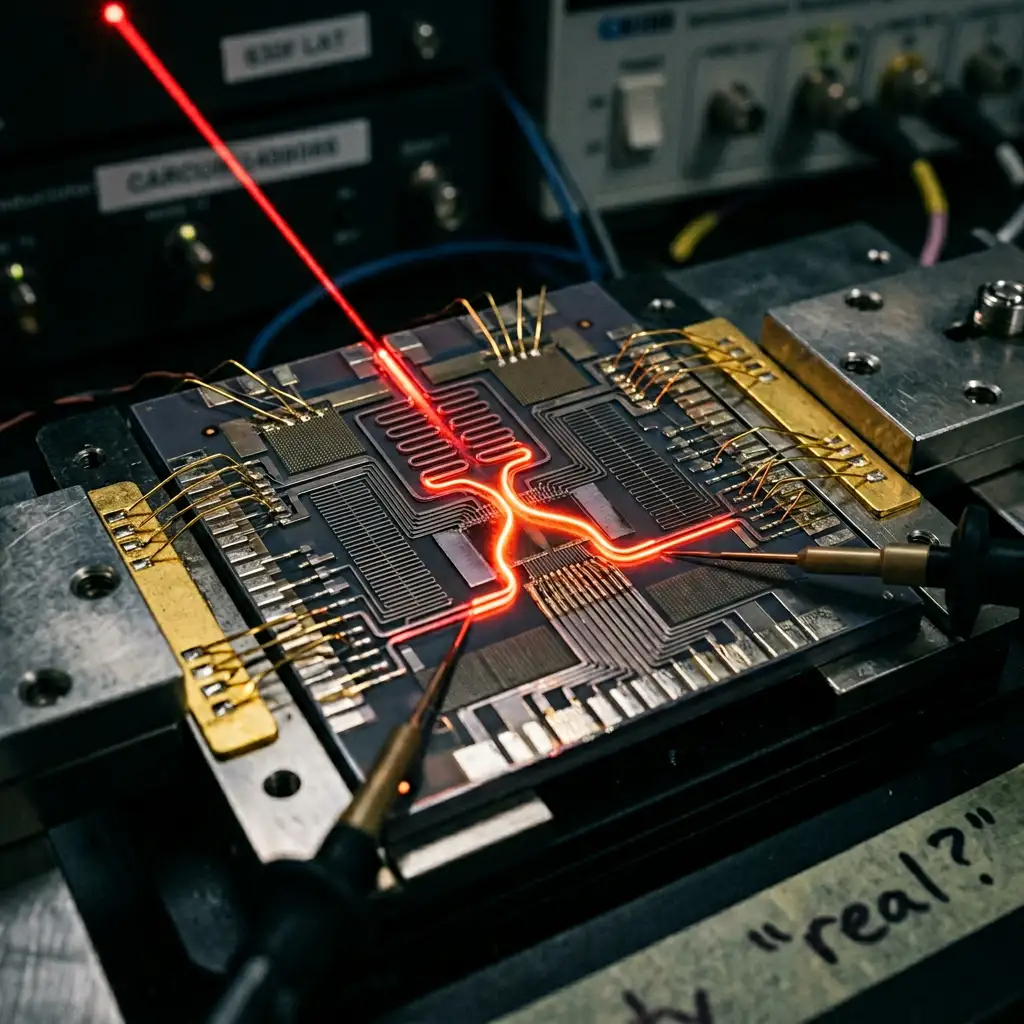
The most powerful quantum computers on Earth share something in common with deep space: temperature. To function, they must be cooled to around 15 millikelvin, roughly -459 degrees Fahrenheit, colder than the vacuum between galaxies. Not as a quirk. As a hard requirement. The entire quantum computing industry has been built around this single, enormously inconvenient fact.
Key Insights You Should Never Miss
-
Stanford Achieves Room Temp Entanglement.Researchers used twisted light and molybdenum diselenide to link photons and electrons at ambient temperatures, bypassing the need for extreme cryogenic cooling systems entirely.
-
Cooling Costs Create Scaling Paradox.Dilution refrigerators cost millions and consume more energy than computation itself. Removing them allows quantum devices to shrink toward chip scale for widespread deployment.
-
Three Paths Converge In Twenty Twenty Six.Independent teams using diamond vacancies, silver nanocrystals, and twisted light all demonstrated room-temperature coherence this year, signaling a major shift in quantum physics engineering.
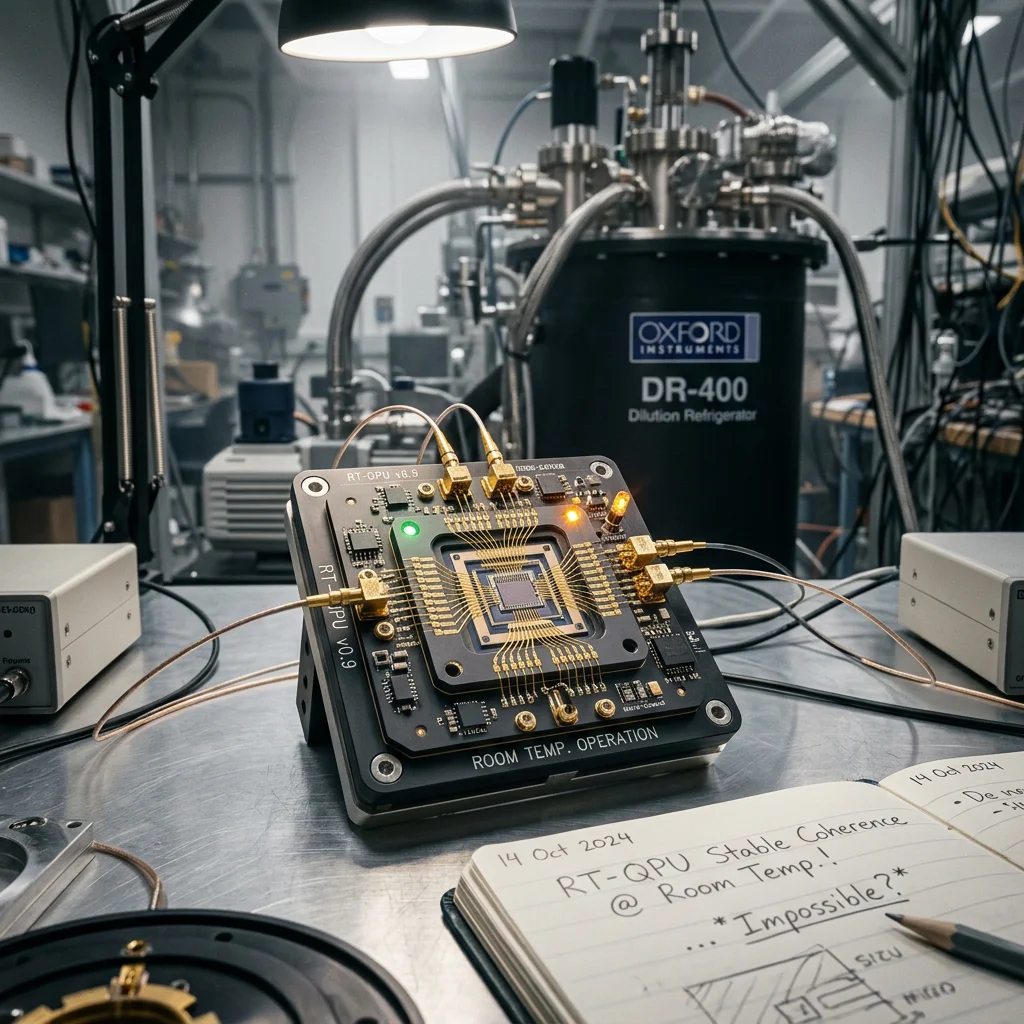
The cost of that inconvenience is real. A single dilution refrigerator runs between $300,000 and $3 million before anyone writes a line of code. Annual operating costs for a full quantum system, including cooling, control electronics, and maintenance, can exceed $10 million. A U.S. Department of Energy analysis found that in quantum data centers, the energy consumed by cooling substantially exceeds the energy consumed by computation itself. That is not an efficiency problem. It is a structural one. Every qubit added to a superconducting system demands more control electronics, which generate more heat, which demand more cooling capacity. The architecture works against itself.
Now, a Stanford University team has built a nanoscale device that performs a fundamental quantum operation at room temperature. And a surprising number of other labs are arriving at the same destination through completely different routes. Room temperature quantum computing, for most of the field's history treated as a distant aspiration, is suddenly a 2026 story.
What Stanford Actually Built and How It Works
The Stanford device is small enough that its complexity is easy to underestimate. Researchers stacked two layers: a patterned silicon chip on the bottom and a single-atom-thin sheet of molybdenum diselenide, a compound semiconductor, on top. The silicon layer was engineered to shape incoming photons into what physicists call 'twisted light,' beams where the light rotates in a corkscrew pattern as it travels, carrying angular momentum like a spinning top.
When those corkscrew photons hit the molybdenum diselenide layer, something precise happens. The photon's rotational spin transfers to electrons in the material. One particle of light and one particle of matter become linked in a shared quantum state. This is entanglement, the phenomenon that makes quantum communication and quantum computation possible at all. The result was published in Nature Communications.
In Simple Terms — Dilution Refrigerator
A dilution refrigerator is a massive, expensive machine that cools quantum chips to near absolute zero. It creates a structural bottleneck because adding more qubits generates more heat, requiring even larger and costlier cooling infrastructure.
The reason this works at room temperature comes down to material choice. Molybdenum diselenide maintains strong spin correlations even when warm because of how its electrons are structured at the atomic level. The silicon nanostructure beneath shapes the light so precisely that the energy transfer remains clean and resistant to thermal noise. The team did not fight the heat. They designed around it.
Why the Freezer Was Quantum Computing's True Bottleneck
This is the part that tends to get buried under announcements about qubit counts and fidelity numbers: the cooling requirement is not just expensive, it is a scaling paradox.
In superconducting quantum systems, every additional qubit requires more control electronics. More electronics generate more heat. More heat requires a larger, more powerful dilution refrigerator. The refrigerator grows as the system grows, and at a certain point the infrastructure surrounding the computer becomes larger than the computer itself. This is why quantum computers have remained laboratory instruments for decades rather than deployable technology.
Removing that constraint changes the geometry of the problem. Without cryogenic systems, quantum devices can shrink toward chip scale. They can be placed in data centers, hospitals, satellites, and edge computing nodes without needing a dedicated cold infrastructure. Jennifer Dionne, the Stanford team's senior author, has described miniaturization as the end goal, with the long-term possibility of quantum components embedded in everyday devices. One Stanford release mentioned the prospect of quantum capability in a cell phone. That may be a decade away, but it is no longer physically absurd.
Think of It Like This — Quantum Coherence
Quantum coherence is the fragile state where particles act as waves. Heat usually destroys it instantly. New materials like molybdenum diselenide or diamond defects protect this state at room temperature, allowing quantum operations without freezing.
Stanford Is Not Alone. A Convergent Wave Is Building
Three completely independent approaches to room temperature quantum computing have surfaced in the same year, and that convergence matters.
Quantum Brilliance, an Australian startup that came out of the Australian National University, has already deployed room-temperature quantum hardware at Oak Ridge National Laboratory and Fraunhofer IAF in Germany. Their method uses nitrogen-vacancy centers in synthetic diamond, tiny defects in the carbon lattice where quantum states can survive at ambient temperatures because diamond's atomic structure is rigid enough to shield qubits from thermal disruption. No refrigerator. No liquid helium. Running hardware, in real facilities, today.
In late May 2026, a research team from Brown University and the University of Michigan published a paper in Science describing a third path: silver nanocrystals, custom-shaped and self-assembled into structures with emergent quantum optical properties that do not exist in any individual particle. The researchers described this phase of matter as a potential route toward room-temperature quantum computing. Twisted light, diamond vacancies, nanoparticle self-assembly, three fundamentally different physical mechanisms, all converging on the same objective within months of each other.
The United Nations designated 2026 the International Year of Quantum Science and Technology before any of these results landed. That designation looks more prescient now than it did when it was announced.
What This Device Cannot Do Yet
It is worth being direct here. The Stanford device is not a quantum computer. It demonstrates valley-selective emission and photon-electron entanglement at room temperature, which is a genuine physics achievement, but the distance between that and a functional quantum computing system is large and uncharted.
Performing multi-qubit logic gates, executing quantum algorithms, implementing error correction, scaling to useful qubit counts, none of these have been demonstrated. Even Quantum Brilliance, which has deployed working hardware, frames fault-tolerant room-temperature systems with useful qubit counts as a late-decade or early 2030s target. Companies building cryogenic systems are not standing still. IBM has committed over $10 billion toward large-scale fault-tolerant quantum computing by 2029, using supercooled architecture. If a 1,000-qubit cryogenic processor demonstrates quantum advantage at scale, the practical relevance of a 50-qubit room-temperature device becomes a real strategic question, not a trivial one.
The Stanford result also lacks published performance benchmarks. Key figures like qubit fidelity, gate speed, and coherence time for this specific device have not been publicly disclosed. Without those numbers, the device's position relative to competing platforms cannot be precisely evaluated. The physics is solid. The engineering road ahead is genuinely long.
Where Room-Temperature Quantum Technology Goes From Here
The Stanford team has stated they are refining the device to improve performance and working toward miniaturization. Quantum Brilliance's roadmap targets application-specific quantum systems with useful qubit counts toward the end of this decade and compact, fault-tolerant systems with roughly 50 to 60 logical qubits in the mid-2030s.
The more interesting scenario may be one where neither approach defeats the other. Cryogenic systems, with their enormous qubit counts and centralized infrastructure, could dominate cloud-accessed quantum computing for large-scale problems. Room-temperature devices could fill an entirely different niche: portable, deployable, edge-located processors for quantum sensing, secure communications, and specialized embedded applications. These are not the same use cases competing for the same market. They are different products solving different problems.
What changed in 2026 is not that the freezer became optional for serious quantum computation. It is that multiple independent teams proved quantum coherence can survive at the temperatures where people actually live and machines actually operate. Whether that proof gets engineered into systems that matter is still unresolved. But physics is no longer the obstacle it was. That is a different kind of progress than another qubit count milestone, and it is quieter, harder to market, and probably more consequential.