Two kids sit in the same classroom, same teacher, same homework. One breezes through fractions but stumbles over a paragraph. The other reads circles around her classmates and still dreads long division. Teachers have chalked this up to effort, motivation, or learning style for decades. Stanford researchers now have evidence pointing somewhere else entirely: brain chemistry learning differences that show up before a single test score does.
AI Generated Illustration
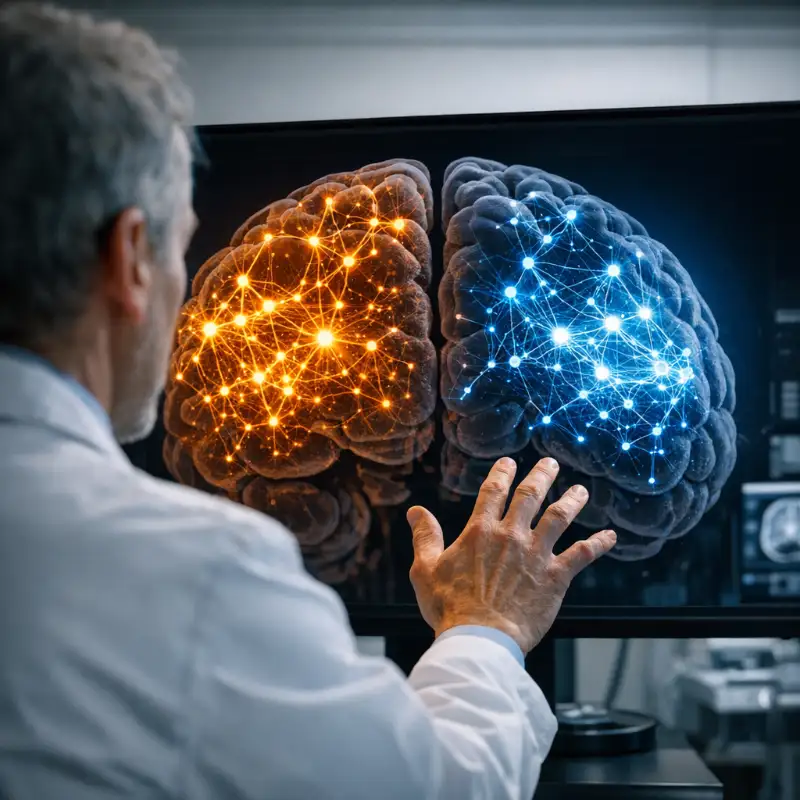
The new work, from Stanford's Cognitive and Systems Neuroscience Laboratory, focuses on glutamate, the brain's dominant excitatory neurotransmitter. Using brain imaging that can detect chemical activity rather than just structure, the team found that math ability and reading ability line up with separate glutamate signaling patterns in the brain. This is not a study about who is smarter. It is a study about how two different mental skills seem to run on two different chemical circuits.
If math and reading depend on distinct chemical pathways instead of one general learning system, that raises real questions for how schools screen struggling students and how researchers think about learning disabilities going forward.
How Stanford Mapped the Brain's Learning Chemistry
Using brain imaging that can detect chemical activity rather than just structure, the team found that math ability and reading ability line up with separate glutamate signaling patterns in the brain. This is not a study about who is smarter. It is a study about how two different mental skills seem to run on two different chemical circuits.
Most brain research on learning relies on structural imaging, essentially photographing the brain's wiring. That tells you where regions sit and how big they are, but not what is happening chemically while someone actually solves a problem. To get at that, the Stanford team paired magnetic resonance spectroscopy, a scanning method that can detect specific chemicals inside brain tissue, with cognitive testing in the same children.
Think of it as the difference between mapping a city's road network and measuring the actual traffic flowing through it at rush hour. That distinction matters because chemistry is harder to pin down than anatomy. Neurotransmitter levels shift by the minute, vary between brain regions, and require far more sensitive equipment to detect reliably. Getting a clean, replicable signal across multiple groups of children, which the researchers did through a multicohort design, is a meaningful technical step on its own.
Why Glutamate Matters More Than Most People Realize
What they found was not a single learning hub lighting up for both subjects. Math performance tracked with glutamate activity in one set of regions, while reading performance tracked with a separate pattern. Different brain regions appeared to specialize by task rather than sharing one general processing center. That finding pushes the conversation about brain chemistry learning away from where thinking happens and toward how neurons talk to each other while it happens.
Glutamate does the unglamorous work of keeping the brain talking to itself. It is the primary excitatory neurotransmitter, meaning it is the chemical that pushes signals from one neuron to the next across billions of connections every second. Without efficient glutamate signaling, the process of building and strengthening neural pathways, known as synaptic plasticity, would grind to a crawl.
This is the same mechanism believed to underlie how memories form and how skills get reinforced with practice. When glutamate signaling runs efficiently, the brain adapts faster, retains information better, and handles novel problems with less friction. But this is not a case of more being better across the board. Both unusually high and unusually low glutamate activity have been linked to disruptions in normal brain function, which suggests there is a working range rather than a simple dial to turn up.
What This Could Mean for Education and Learning Disorders
Here is the part worth sitting with: the brain is not a hard drive that stores facts in fixed locations. It is closer to a city that keeps repaving its own roads based on which routes get used, and glutamate is the material doing the repaving. That reframes what learning actually is at a biological level, and it sets up the harder question of what any of this means once you leave the scanner and walk into a classroom.
If math and reading genuinely run on separate chemical tracks, that has implications for how teachers think about a student who excels at one and struggles with the other. It stops looking like inconsistency and starts looking like biology working exactly as expected, just unevenly across two different systems. That framing matters most for dyslexia and dyscalculia research, the reading and math specific learning differences that affect a meaningful share of school age children.
This study does not hand educators a treatment or a screening test. What it offers is a biological foothold for future work asking whether these conditions trace back to differences in glutamate signaling in the relevant circuits, which is a far more specific question than researchers could ask before this kind of imaging existed. That specificity feeds into a broader shift already underway in education, where neuroscience is increasingly treated as a tool that can inform teaching strategy rather than something confined to a research paper.
What Experts Still Do Not Know
A finding like this does not replace a good teacher's judgment. It gives that judgment a sturdier foundation to stand on. The honest caveat here is that association is not causation. The study connects glutamate patterns to math and reading performance, but it does not prove that glutamate levels are the reason some kids perform better than others.
Genetics, environment, prior instruction, sleep, nutrition and a long list of other factors all shape academic performance, and none of those variables disappear because a chemical correlation showed up on a scan. There is also a harder unresolved question sitting underneath this one: even if glutamate signaling shapes learning capacity, nobody yet knows how much it moves the needle relative to everything else, or whether these chemical patterns could be safely influenced without risking side effects nobody wants in a developing brain.
Turning up excitatory signaling in a young nervous system is not something researchers would attempt casually, and for good reason. Before any of this reaches a classroom or a clinic, it will need replication in larger, more demographically varied groups of children, along with long-term tracking to see whether these chemical signatures hold steady or shift as kids grow. That is slow, unglamorous work, and it is also the only way findings like this earn their way into practice.
Why This Research Could Shape the Future of Brain Science
The bigger story here may be the tool, not just the finding. As imaging techniques get precise enough to track specific neurotransmitters in living brains, scientists gain the ability to build genuinely chemical maps of learning and memory, not just structural ones. That kind of resolution could speed up research into a wide range of neurological and developmental conditions well beyond math and reading.
The ripple effects extend past neuroscience departments. Education researchers, clinicians building personalized interventions, and even AI researchers modeling how learning systems adapt over time all have reason to pay attention to how biological brains manage this problem, since much of machine learning architecture was inspired by rough analogies to neural signaling in the first place.
The real takeaway is not that one neurotransmitter explains who is good at math. It is that learning looks less like a single switch and more like several interacting biological systems running in parallel, each doing part of the job. Once you accept that, the question stops being which chemical matters most and becomes how many more of these systems are still waiting to be mapped.