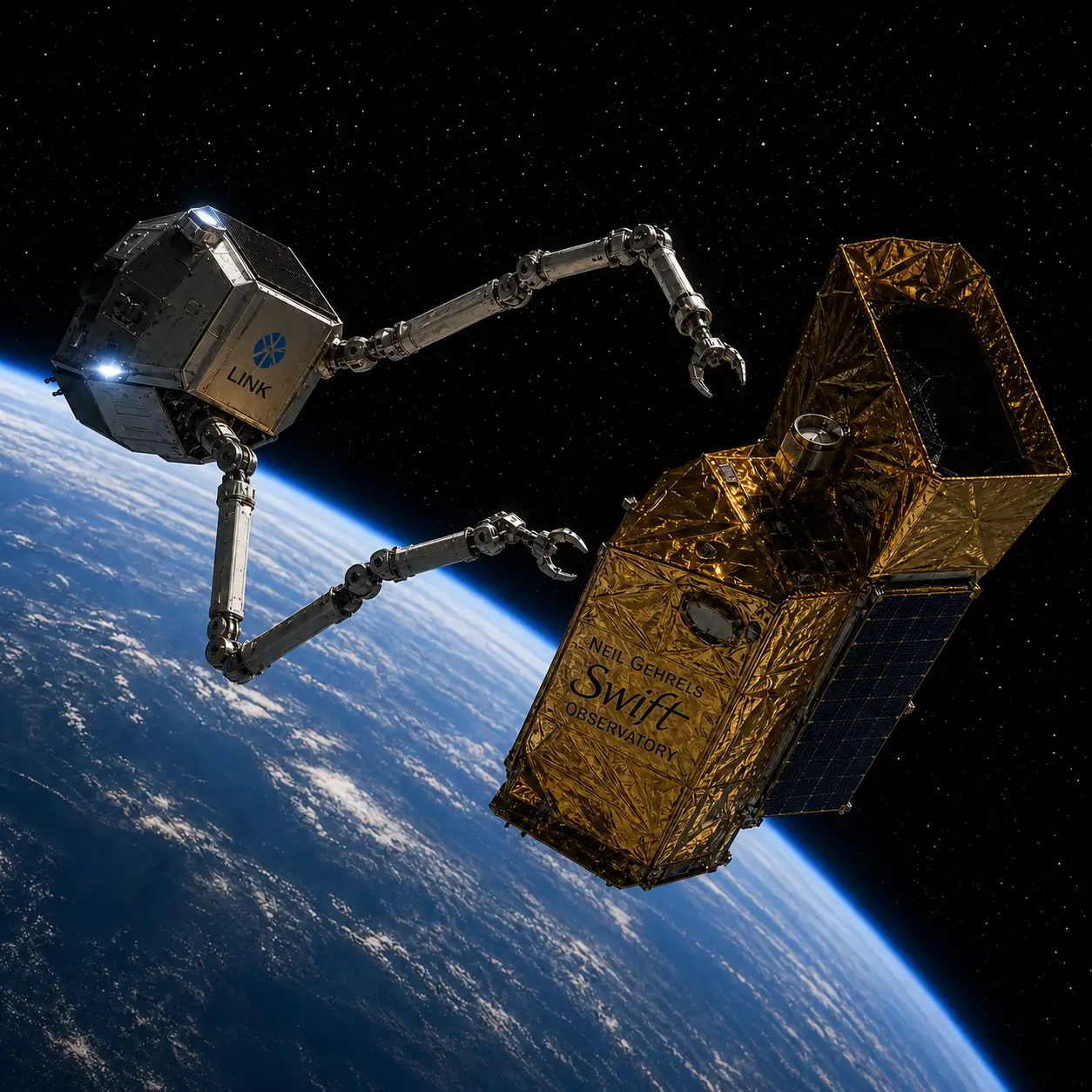
On July 2, Tianwen-2 sent back a single image from 20 kilometers away, and that image immediately clashed with years of assumptions. The rock in the picture, a quasi-satellite called Kamoʻoalewa, measured about 20 meters across. Ground telescopes had pegged it at 40 to 100 meters. Before the spacecraft even attempted to collect a sample, it had already forced scientists to throw out one number and start questioning a much bigger idea, that this asteroid is a broken off chunk of our own Moon.
AI Generated Illustration
China's asteroid probe reached Kamoʻoalewa in early July 2026, roughly 13 months after launching from the Xichang Satellite Launch Center. Tianwen-2 is the China National Space Administration's first attempt at sample return from a near-Earth object, and it picked an unusual target. Kamoʻoalewa, cataloged as 2016 HO3 when Pan-STARRS spotted it in Hawaii a decade ago, is a near-Earth quasi-satellite. It loops around the Sun in step with our planet without technically orbiting it, and researchers have argued over where it actually came from ever since.
Why scientists expected a different story
The lunar origin idea took hold in 2021, when researchers measured Kamoʻoalewa's reflected light with the Large Binocular Telescope and found a reddish, weathered spectrum that closely resembled lunar soil. A few years later, another team pushed the story further, suggesting the object could have been blasted off the Moon by the same impact that carved the Giordano Bruno crater sometime in the last ten million years.
It was a tidy explanation. A crater on the Moon, a chunk of debris, a wandering piece of home hiding near Earth the whole time. The trouble is that spectra measured from telescopes only describe the outer few millimeters of a surface. They cannot tell you what an object is made of underneath, or how it got where it is.
That gap between surface appearance and true origin is exactly why a spacecraft needed to go look up close, and eventually bring material home for lab analysis.
What Tianwen-2's first look actually revealed
The size mismatch was the first blow to the lunar hypothesis. The bigger challenge came from a JWST-based spectroscopy study led by researcher Sharkey, posted as a preprint just before Tianwen-2's arrival and still working through peer review. The study modeled Kamoʻoalewa's albedo, essentially how much sunlight its surface bounces back, and landed on a best fit value around 0.59, with the lowest reasonable estimates still around 0.36.
Think of albedo as a rock's brightness fingerprint. The Moon's surface reflects roughly 12 percent of the sunlight that hits it. Kamoʻoalewa appears to be reflecting somewhere between three and five times more light than that. A lunar fragment should look darker and redder with age from space weathering, not nearly this bright.
That mismatch does not fit lunar highland material or the darker basalt that covers most of the Moon's near side. It fits far more comfortably with an ordinary silicate asteroid that has spent ages bleaching in sunlight.
Why this could rewrite asteroid origin models
None of this closes the case. A preprint is not a settled result, and a spectral reading, even from an instrument as capable as JWST, still describes a surface rather than an object's interior or its collisional history. Kamoʻoalewa is also tiny and spins fast, completing a rotation roughly every 28 minutes, which leaves its surface unusually exposed to solar radiation and micrometeorite impacts. That kind of weathering can change how a rock reflects light in ways researchers are still learning to model.
What remains unclear is whether the high albedo reflects what the asteroid is actually made of, or just an unusually fresh surface layer that hasn't darkened yet. Separate research tracing Kamoʻoalewa's spectral slope and orbital dynamics has proposed a different origin entirely, linking it to the Flora family in the main asteroid belt by way of a well known escape route called the nu-6 resonance. Two competing explanations, both built on remote observations, are now sitting side by side with no clear winner.
What the actual sample return will have to settle
This is where the mission earns its keep. Tianwen-2 is expected to attempt its sampling operation using a touch and go maneuver, briefly contacting the surface before pulling away with whatever regolith it manages to grab. CNSA is targeting a return of somewhere between 20 milligrams and 100 grams of material, arriving back on Earth by 2027.
A physical sample lets scientists run isotope ratios and mineral composition checks that no telescope can replicate from millions of kilometers away. If Kamoʻoalewa really is lunar debris, its isotopic signature should match Apollo era Moon rocks almost exactly. If it is an ordinary asteroid, it won't, regardless of how bright its surface looks from a distance.
Why future space missions are paying attention
The stakes reach beyond one 20 meter rock. Earth has at least seven known quasi-satellites, and understanding how objects like Kamoʻoalewa form and move helps refine planetary defense models, since these small bodies sometimes drift close enough to matter. It also matters for anyone thinking about mining near-Earth asteroids one day, since composition determines whether a rock is worth visiting at all.
For now, the honest answer is that nobody knows yet. Which is precisely why the sample sitting in Tianwen-2's collection chamber, whenever it manages to grab one, will end up worth more than every spectrometer reading that came before it.