The breaking down of a single plastic bottle to a landfill can take centuries of geological time. Thanks to a newly developed catalytic process, one such bottle can now be converted into hydrogen fuel overnight. On the same sustainability issue, plastic waste and a clean hydrogen fuel are at the opposite ends. The one, a material that nobody wants, at all, to have more of. The others are fuels people, in almost all, want more of. With scientists having already showcased an approach for turning discarded plastics into hydrogen fuel directly - rather than recycling it into the lower grade plastic or just incinerating it for waste.
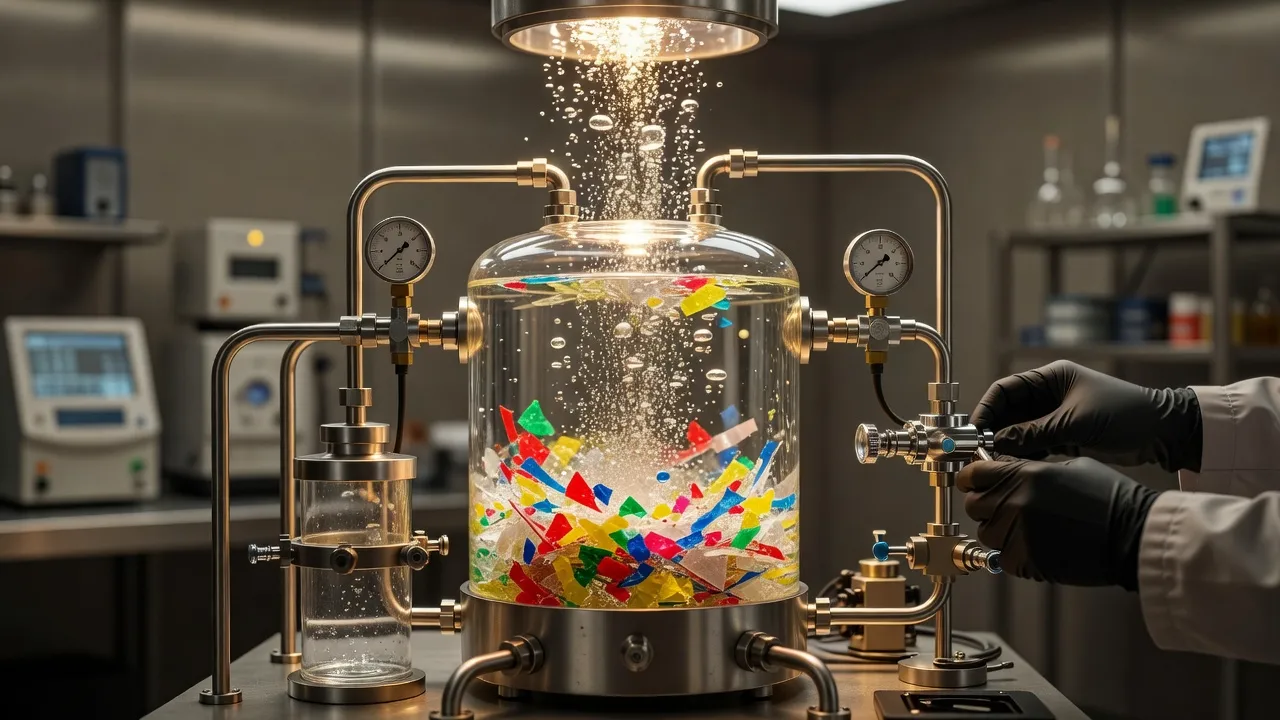
AI Generated Illustration
Making of trash to hydrocarbon fuel has So become more attractive as one way of recycling. The other side to this story is that it is the repositioning of plastic from being the undesirable item into the energy source which has been stored. Making of the plastics - byproducts to chemical energy - is just a small change compared to the recycling method. It involves recognizing plastics more of the chemical stores of energy lying in the wrong container.
The question that many coverage omits to mention is the toughest part. Many lab-scale chemistry reactions look nice on the paper but disappear quietly when they face industrial economical problems. What really makes difference whether the plastic to hydrogen process gets a place in the operation of a city or chemical plant everyday vs. another paper that stays in a journal?
How the Catalytic System Converts Plastic Into Clean Hydrogen
Plastic is, from a chemical point of view, a long chain of repeating carbon and hydrogen units that are tightly bonded chemically. It is quite difficult to break this chain apart without using very high temperatures because any broken fragments usually get back to each other as soot, tar, or a very unpleasant mixture of hydrocarbons, no one wants the stuff. But, the catalyst in this process changes the outcome without getting consumed. The catalyst, which is not a chemical ingredient at all but a very fine pair of scissors that cuts polymer chains at the points most likely to give hydrogen instead of undesirable byproducts.
Let us have a look at what is currently happening. Mechanical recycling gradually degrades recycled plastics and so, it is mostly recycled plastic material that is used as low-grade filler material rather than creating new bottles. Burning plastic gives off some amount of heat but at the same time, releases carbon dioxide which is just the beginning of it because according to the kind of plastic, the process could actually produce some really nasty stuff. Burial of plastics only postpones the problem till the next generation comes around. Catalytic conversion of plastics waste to hydrogen is one of the ways which may be used to gain the energy from exactly that plastics which are hardest to recycle using conventional methods: it is the mixed dirty multi-layer stuff which recycling plants generally reject.
Where to take caution. Most reports on this type of chemistry at this early stage are rather vague when it comes to actual numbers that matter. How many hydrogen molecules per kilogram of plastic are released, or how many times the catalyst lasts before it gets worn out, the overall amount of energy, and the real operating cost per unit of hydrogen produced. Actually these four numbers show the difference between a laboratory finding and a product that an energy company would actually go ahead and build around.
Why Researchers See More Than Just a Recycling Technology
Hydrogen without plastic is a big opportunity that is being rediscovered again and again by researchers. There are certain sectors, like heavy industry and marine transport and long-term energy storage that batteries and direct electrifications are hard to beat and then hydrogen always turns up at the short list. Technology that gets hydrogen from a waste stream that has already been produced in massive quantities will definitely change the initial way hydrogen is made. The point is, the change can't be overstated.
In the circular economy model, plastic is a waste product to be minimized or replaced altogether. Plastic-to-hydrogen conversion is reversing this. If the plastic which is already around like the plastic packaging, plastic film and unsorted mixed waste is used as a raw material then it becomes a valuable asset, instead of an unwanted cost. I imagine a landfill with a plastic bottle being regarded as waste and under our scenario it becomes comparable to an unused battery. Of course, to know if our view of the matter would hold when exposed to actual engineering design is still up in the air, but it is without a doubt a new and different way to view the contents of each recycling bin nationwide.
Could Plastic Waste Become a Future Energy Resource?
If this technology scales well, the first to pick it up will not be small consumers. Instead, the early adopters will be the ones who deal with large quantities of plastic already: the municipal waste collection systems, the companies creating plastics as by-products, the waste processing companies and last but not least, the hydrogen suppliers who are in hunt for low-cost feedstock alternatives to natural gas or electrolysis. There are some obvious economic benefits, for instance a) reducing the quantity of materials dumped at landfills, b) creating a new income source by processing the mixed plastic which at the moment is mostly not resold, and 3) a local (domestic) source of hydrogen that is not going to be affected by fluctuations in the imported natural gas prices These kinds of developments would most definitely be of interest to countries that are fossil fuel import-dependent but do have plenty of plastic waste for recycling Though, that is not going to come as easily as it seems Hydrogen still needs to be transported through pipelines, stored in tanks and the refueling infrastructure is mostly not even built at most of the places yet The plastic waste should still find a way to the conversion plant through the process of cleaning and collection.
The chemical reaction of a catalyst and a plastic is necessary for the process to take place but alone this is not sufficient
The Challenges That Still Stand Between the Lab and Industry
A genuine risk assessment starts by stating that catalysts do wear out. Every catalytic process has been able to operate commercially because those companies were able to come up with solutions to the issue of catalysts losing their activity after many cycles. Plastic waste is In particular dirty feedstock in comparison. When the company is talking about plastic waste at the plant, it means that those plastic items are not just PET ones thrown together. Real world plastic waste is a mix of PET polyethylene polypropylene, and whoever left adhesive, dye, or food residue sticking to it, that person must have thrown the item away. Some of the contaminants that were supposed to have been filtered out in the lab show up in force at an industrial scale, and they really make a catalyst poisoned faster.
There is a carbon calculation problem that gets passed too frequently. In reality the process produces hydrogen from plastic does not mean that the process will be low emission. For example, if the reactor electricity is from a coal-dominated grid or the byproducts require expensive cleanup, the net climate benefit could be smaller than the headlines or even the worst-case scenario of it being negative. The situation is still murky as to whether independent, third-party measurements of the whole energy balance are available instead of figures from the development teams.
This is not a reason for giving up the whole idea. This is why no one can be thinking a commercial plastic-to-hydrogen plant will be open next year. Long-term pilot projects that run at larger than a benchtop reactor and smaller than a commercial scale is the only way to find out if the can work on real waste streams for months hours.
What Comes Next for Plastic to Hydrogen Research
The next phase of the work will focus less on demonstrating that the reaction is feasible chemically and more on ensuring that it can be made to work reliably, inexpensively, and continuously. That is to say, catalyst configurations that do not get poisoned easily by the presence of impurities, process engineering that can withstand a few weeks of running without shutdown, and waste segregating methods capable of delivering the process a feedstock of sufficient consistency and regularity to get the products in consistent volumes.
Of course, none of those things are going to be developed out of nowhere. Universities are very good at demonstrating the working potential of a new kind of reactor by a single researcher using a test tube. Converting it into an actual piece of equipment for the industry will need collaboration with a diverse team of industrial engineers, a waste management company which has the expertise in the logistics industry, and public authorities or politicians who are open to supporting pilot programs that have a higher probability to run into failures.
The key thing about the development of hydrogen from plastic research is that it is not merely a discovery of a creative method to convert garbage into fuel by scientists. It is a sign that certain big waste streams in our society which at present, are being buried at a huge expense of taxpayer are in fact, a potential treasure if only they could be tapped and turned into an alternative energy source instead. It is not known yet But if this potential will still exist and how things will fare when the pilot stage changes to a commercial one.