A reader keys in a question on Google, gets the answer at the very top of the page in full paragraph form and then tabs closed. There is no click, no visit, no ad impression. It is something like one search and one page closed, but imagine it multiplied by millions of different searches happening every day - only then it starts to look like newsrooms and smaller sites can reasonably expect an outcome they fear, something akin to 'death'.
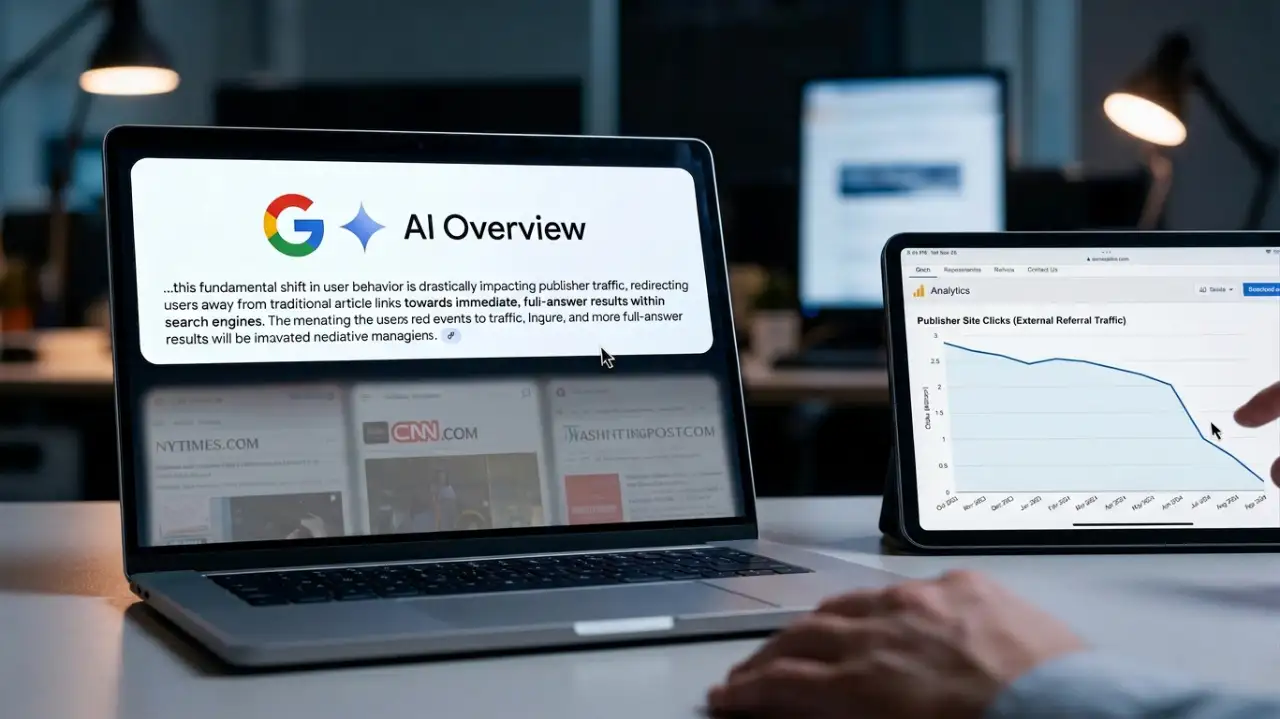
AI Generated Illustration
This, of course, is not merely a small search results screen change, it is basically changing one of the main ways that online publishing has been supported for 20 years. Publisher content has traditionally been a sort of currency that the publisher could get from being sent by Google for people who actually visited the publisher's site, i.e. they could sell ads or subscriptions, use affiliate links, and get brand awareness. A publisher would be happy to produce such content and Google would be happy to get their search traffic.
With AI overview, the publisher gets the deal broken when the answer is given to the user straightaway without sending the user to view any content. This is one of the fundamental reasons all players - from writers and editors to advertisers and casual readers - will want to follow developments as the question at the center of this conflict is ultimately about who should be compensated for sharing information and who can have it read for free without sharing.
If readers start getting their information without going to original articles then logically those companies that depend on reader traffic to keep the websites up (and the content flowing) will lose their income. That means, underneath every article headline about Google AI overview impact on traffic, a single question is always posed: if people stop clicking through to articles, then what will be the fate of the sites publishing those articles that are producing all that?
How AI Search Summaries Replace Traditional Website Visits
AI Overview identifies fragments from multiple web pages and compiles them into a single summary that appears on top of the regular blue links. You can think of AI Overview more as an editor that has already read ten of your chosen articles, typed up the highlights for you without having to ask. And in a significant portion of searching scenarios, that summary is enough for the reader to fulfill their original purpose.
This marks a substantial change from the usual workings of organic search traffic. A typical publisher would be ranked for a question, the reader, in turn, would land on the page, and that visit alone encapsulated the complete business cycle: ad loading, newsletter signup appearing, and perhaps a subscription paywall doing its work. The click was the product, or at least something important of it.
But, by keeping the answer and the question, while completely omitting the intermediate step (when publisher gets paid for making it available to you). It was a very different time when the need for the searcher and the survival of publisher were aligned perfectly. They are no anymore, But, and the gap that is forming between them is the main setting of this story.
Why Falling Clicks Could Reshape the Economics of Online Publishing
Even minor declines in publisher revenue from AI search could still have a significant impact. That's because digital publishing relies heavily on volume. A ten or fifteen percent drop in visits resulting from AI search alone could completely eliminate the tiny profit of say a site that is heavily dependent on advertisements since the costs for writing, editing, and hosting articles and keeping a website up are fixed and will remain the same while traffic is going down. Affiliate income is a lot more vulnerable as it is based solely on clicks from a website or an app to a retailer's site, whereas if AI already offers best options via summary then the click reason is gone completely.
Not everyone is equally vulnerable here. News explainers, product reviews, health advice, how guides, etc. are a few of the main items people search on Google. That means, they are the types of content that could most easily be answered by AI Overview without users having to visit the webpage. If you read an article that is 500 words long explaining that you have got to reset your router or a health-related article explaining your symptom, it is the kind of articles that AI Overview will learn how to digest and never send anyone towards.
One statement to take seriously is - the biggest web money may not be the information itself, but the capability to gain a click. It changes everything once you agree that, the AI Overview debate in the publishing sector turns out not only to be a technical difference of opinion but, in fact, becomes a contest over the only remaining valuable thing publishers might offer.
The Bigger Debate Over Fairness, Attribution, and the Future of Search
Publishers complain that the AI Overview is generated completely from their news and work, and it gives the reader an answer that directly competes with the original article that the content is drawn from In addition, Truth is the search engine company is the same one that decides how much of that news is being extracted and summarized changes the nature of the complaint.
It stopped being just about who gets the money or market share; it got much closer to a question of policy, for example, in various EU countries regulators are currently looking at Google's AI Overview and asking whether summarizing such an amount of content from publisher content amounts to a proper use per copyright laws, or it is nothing more than the company that is riding for free on another ones content. This is a new area though so the complaints are still not completely new.
All the same, it is a fact that in Google's view, the AI overview has been developed to help people find answers to their questions in an efficient manner while at the same time providing source links so that users can find further reading. That has been said, the dispute focuses on the number of times people opt for visiting the source link after they have been provided with the summary, and whether, even in some cases, the traffic that reaches the article is enough for the author to be adequately remunerated for the content that Google took the liberty of summarizing for the users without the readers visiting the article itself Whether the search engine can on one hand continue to support the creators of content as a way of keeping them engaged in the creation of new content and, at the same time But be faster in providing content to people who don't want to make any website visits is the question that, among others, the entire industry is asking itself but still cannot put in words.
What the Numbers Reveal and What Still Remains Uncertain
Publishers and analysts have noticed that zero click researches increase when the AI Overview feature starts appearing wider at the top. Some sites have claimed search referrals decline and the pattern of changes seems to be factual instead of just anecdotal.
Still, the actual size of the impact that AI Overview has on a particular site is much difficult to estimate accurately as it varies by topic, by area, and by Google's decision to replace the normal list search results with a brief summarization.
Largely, the difficulty stems from In reality Google has not released a reliable, universal method that would indicate what effect AI Overview might have on a specific website's traffic. Publishers have to rely on their monthly numbers shown in their dashboards to see the trend, and they are left having to imagine the causes for the changes, which in many cases are quite different even for similar niche sites because of the various factors that neither Google nor the users see fully.
How Publishers Are Adapting to an AI-First Search Landscape
In fact, what newsrooms and individual websites are doing in responding to this development is to start creating the kind of content an AI summary just will not be able to generate easily. Features which require original reporting, are backed up with expert analysis from firsthand experience, and are based on exclusive data, all together require something more than just combining existing pages. Also, newsletters and podcasts, and other content which do not show up well in search, are also being viewed with more favor for similar reasons: they do not require that someone clicking on a blue link find and access them.
What is proving to have real value is an element that is virtually impossible to replicate or condense. The kind of respect and acknowledgment you earn over a long time through your work, a good relationship with a loyal group of readers, and having a truly distinctive and original opinion are all features for a model which can be represented by a single paragraph rather awkwardly compared to a direct factual answer. That, in turn, is less the case of playing an old-fashioned game of search engine optimization than it is about placing a gamble and seeing whose side the machine will finally take away.
It should be stressed, none of that is done to get traffic back from the previous quarter as a kind of quick solution. Generally, this is about the publishing houses themselves admitting that the age of the internet referrals through search engines is coming to a close, and they are Because of this making preparations to move on to a model which will hardly, if at all, require referrals from search engines.
What Happens Next for Google Search and the Open Web
In the coming years, AI-powered search may continue to transform what publishers advertisers search engines, and readers owe each other. The dynamics between all those parties have Definitely changed from their five-year-old state. The classic trade-off, where visibility equals a visit, is being displaced by a more ambiguous setup, visibility might not even lead to a visit.
Whether this scenario works out well for the open web hinges on platforms like Google managing to simultaneously: keep awarding the outlets that produce original research; and delivering answers so swiftly that people who only want the fact and nothing else stay happy. These two aims are not inherent allies, and nothing in the existing environment drives them to collaborate.
We have moved past this being a matter of a single search tool or the revenues of one industry. It is an active problem on how the creation and discovery of knowledge, and its payment, will occur once the simplest way to get a text will not require a publisher at all.