A few years ago, an AI system answered medical licensing exam questions well enough to outscore most human test takers. Headlines followed almost immediately, framing the result as a preview of a faster, smarter, more accurate version of medicine. The assumption underneath that excitement was simple: if a machine can reason through a board exam, surely it can reason through a hospital.
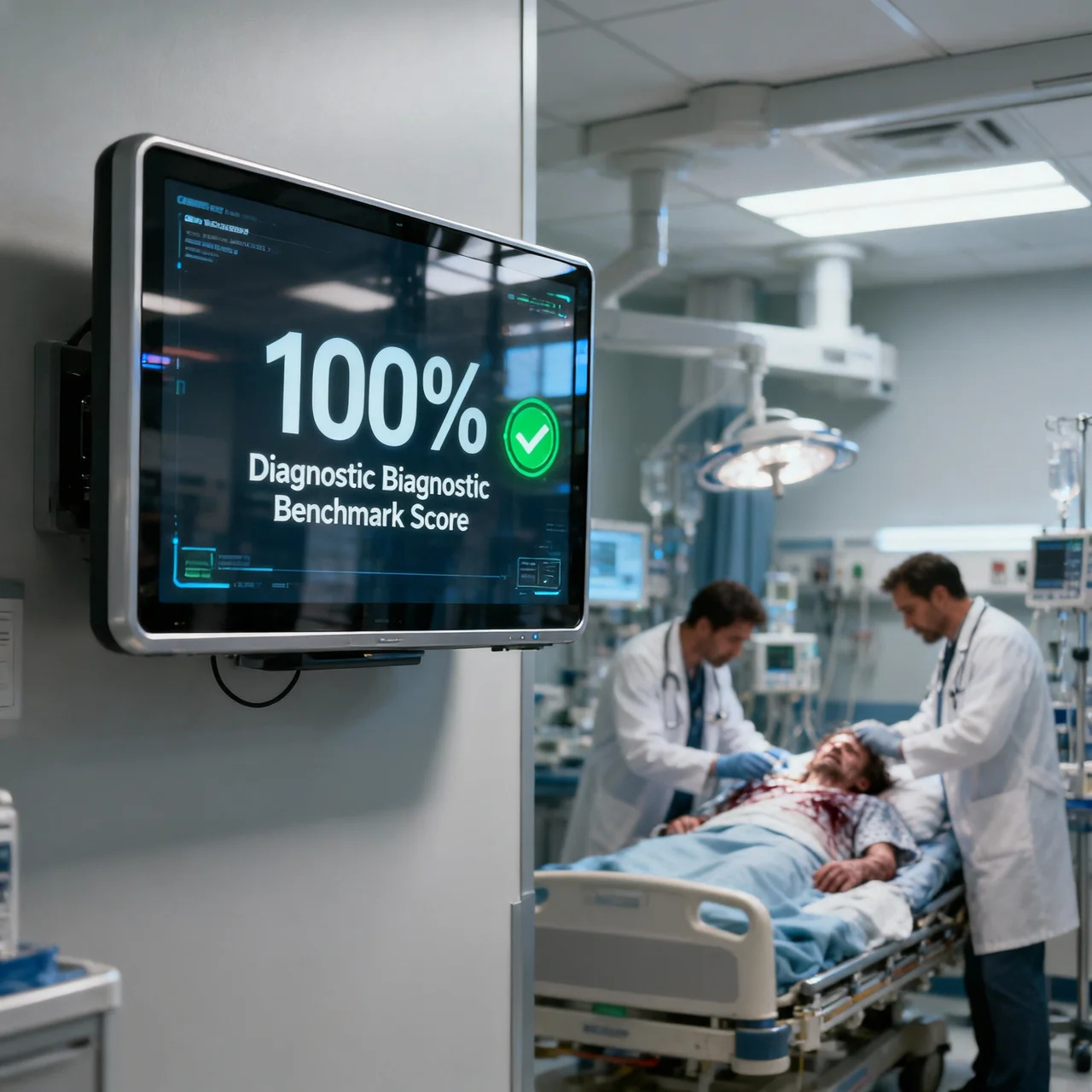
AI Generated Illustration
That assumption has not held up cleanly. Across hospitals and clinical studies, medical ai outcomes have not improved at anywhere near the pace the exam scores suggested they would. Diagnostic accuracy on paper has not consistently translated into shorter recovery times, fewer complications, or measurably better care once these systems entered real clinical settings. The gap between the lab and the ward has turned out to be wider than almost anyone expected.
What Medical AI Benchmarks Actually Measure
Most medical AI systems are evaluated through licensing exams, curated question and answer sets, diagnostic image challenges, and retrospective datasets pulled from past patient records. These tests are useful because they are controlled. They are also, by design, nothing like a hospital floor.
Accuracy on these benchmarks is the number that gets reported, and it is the number that gets cited in press coverage. What rarely gets the same attention is whether that accuracy connects to anything a patient would actually feel: shorter time to diagnosis, fewer missed complications, less strain on an overworked clinical team. Many of the studies behind these headlines simply do not measure that far downstream, which leaves a real gap in what we can honestly claim about clinical ai validation.
Why Real Hospitals Expose AI's Biggest Weaknesses
Clinical care runs on incomplete information. A patient's condition shifts hour to hour, the full history is scattered across systems that do not talk to each other, nurses and physicians are relaying updates verbally between rounds, and somewhere down the hall an actual emergency is unfolding that has nothing to do with the case in front of the screen. None of that resembles a fixed set of exam questions with one correct answer waiting at the end.
An AI recommendation also has to survive contact with the rest of the hospital. It needs to fit into the electronic health record system already in use, match the workflow a physician has built over years of practice, and arrive early enough to change a decision rather than confirm one that was already made. A diagnostic suggestion that is correct but late is functionally the same as one that never arrived.
The Hidden Barriers That Benchmarks Never Reveal
Underneath the workflow problem sits a longer list of structural ones. Training data quality varies wildly between institutions. Datasets can carry biases baked in from whichever patient population happened to generate them. Clinicians facing constant algorithmic alerts start tuning them out, a documented problem known as alert fatigue that quietly erodes the value of even a well-built ai diagnostic tool. Add inconsistent rollout across departments, regulatory review that moves slower than the software, and the unresolved legal question of who bears responsibility when an AI-assisted call goes wrong, and accuracy starts to look like the easy part of the problem.
There is also the matter of where a model was trained versus where it gets used. A system built on data from one hospital's patient population can behave differently inside a hospital across town with a different mix of patients, equipment, and documentation habits. Generalization across settings remains one of the genuinely hard open problems in healthcare automation, and no amount of exam-style testing reveals it in advance.
What Researchers Are Learning About Measuring Success
That recognition is starting to change how researchers evaluate these tools. The shift is moving away from celebrating a benchmark score and toward something closer to evidence based ai: prospective clinical trials, randomized comparisons against standard care, workflow studies that track what actually happens after a recommendation appears on screen, and longer monitoring windows that follow patients well past the moment of diagnosis.
The questions driving that research have changed too. Does the tool reduce diagnostic errors that would have otherwise been missed. Does it shorten the delay between a symptom and a treatment plan. Does it lower cost or ease the load on an already stretched clinical team without introducing new risk somewhere else. A high score on a held-out test set answers none of those questions, and increasingly, researchers are willing to say so out loud.
What This Means for the Future of Medical AI
The likely near-term future is not an AI that replaces physicians but one that sits beside them as decision support, ideally one that is more transparent about its own uncertainty and continuously checked against outcomes rather than evaluated once and deployed indefinitely. That is a narrower promise than the one implied by exam-beating headlines, but it is also a more honest one.
What remains unclear is how regulators, hospital systems, and developers will agree on a standard for proving that an AI tool helps patients across genuinely different settings, not just the one it happened to be tested in. Accuracy on a benchmark is no longer treated as sufficient evidence of anything beyond accuracy on a benchmark.