A skincare brand's best performing Instagram account belongs to a model who has never opened a single one of its products. She posts rooftop selfies from Barcelona, reviews serums under studio lighting, and pulls in a steady stream of brand deals every month. She was assembled by a small design team, not raised by two parents, and most of her followers know it and stay anyway.
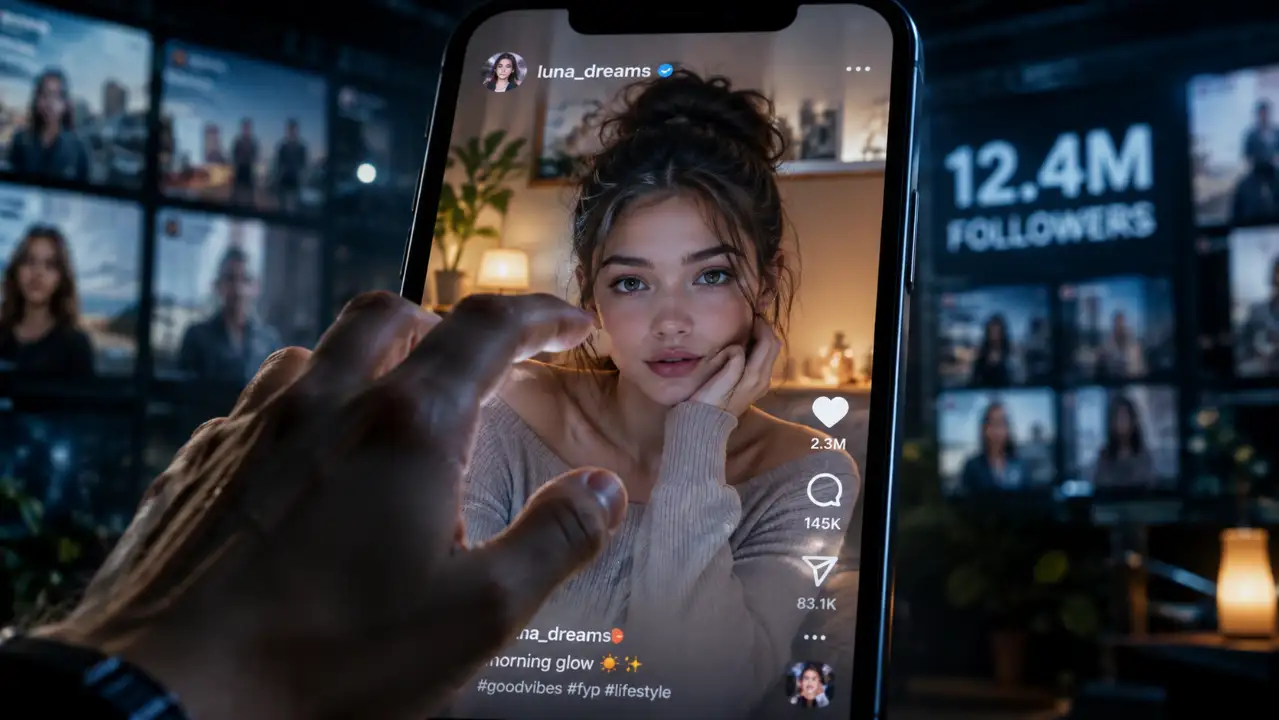
AI Generated Illustration
That is the strange new normal of AI influencers, the industry's shorthand for what most people still call virtual influencers, personas built entirely out of code. A character with no body, no childhood, and no actual opinions can still build a following, sell a product, and post consistently enough to outperform some of the humans competing for the same sponsorship budgets. Brands are no longer treating this as a novelty act in digital marketing. They are treating it as a media property.
The odd part is not that a computer generated face can look convincing under the right lighting. It is that a brand can now design the entire personality behind that face, from her taste in music down to how she responds to a bad comment, and tune all of it to match exactly what the marketing team needs. A human hire never offers that level of control. Getting there took a specific stack of technology maturing all at once.
AI Gives Brands Control Humans Cannot Offer
Generative AI now handles the hard parts of running a persona at scale. One system keeps a face and body consistent across thousands of images. Another writes captions in a fixed voice. A third generates video, and a fourth manages replies to comments so the account never goes quiet. Put together, a small team can run an AI influencer the way a much larger studio once ran an animated mascot, except this one posts daily and never asks for a raise.
The commercial pitch writes itself. An AI influencer does not get tired, does not have a bad week, and does not sign with a competitor. She shows up in a swimsuit campaign on Monday and a tech unboxing on Tuesday without a single scheduling conflict, the kind of reliability that AI social media marketing teams now build entire content calendars around.
What actually sells brands on the idea is not the cost savings. It is the fact that the identity itself becomes something they own outright. Lil Miquela, built by the Los Angeles startup Brud back in 2016, has spent nearly a decade fronting campaigns for Calvin Klein, Prada, and BMW precisely because her creators can pull the brand deal for one campaign and reshape her look for the next without hiring anyone new. That kind of control raises an obvious question. If audiences know the person on their screen is not real, why do so many of them still follow along?
Millions Can Follow Someone Who Never Existed
The mechanics that make AI influencers work are borrowed directly from human ones. There is a backstory, a consistent aesthetic, a set of opinions she shares in the comments, and a feed that looks lived in rather than manufactured. Aitana Lopez, built by the Barcelona agency The Clueless, posts about heartbreak and bad days along with the sponsored content, and that mix is what makes an account feel like a person rather than an ad unit.
Familiarity does most of the heavy lifting here. A face that behaves consistently, reacts to news, and remembers running jokes with its audience reads as a social presence even to people who know full well nothing behind it is alive.
The influencer economy is beginning to separate influence from the existence of an actual person. That line used to be assumed. Now it is optional. Knowing whether that separation actually moves product, and not just impressions, is where the story gets more complicated.
The Real Test Is Engagement, Not Realism
The instinct is to assume a hyperrealistic AI influencer must outperform a human one simply because she never has an off day. The research does not back that up cleanly. A study surveying more than 400 consumers found that credibility, useful content, and how human the persona feels mattered more to engagement and purchase intent than sheer visual realism. A flawless render with nothing to say still underperforms a rougher one with a real point of view.
The evidence stays conditional rather than universal. Results shift depending on the platform, the product category, how the persona was designed, and what the audience already expects from that kind of content. A stylized, cartoonish character like Noonoouri can outsell a photorealistic one in fashion, while the same approach might fall flat selling something functional like software or appliances.
No single number in the current research proves AI influencers reliably beat human creators on return. What shows up instead is a tension baked into the format itself. The more convincingly real a brand makes its synthetic persona look, the more it has to reckon with what happens when the audience finds out, or has to be told.
Trust Becomes the Price of Making AI Look Real
Regulators in the United States and the European Union already require clear labeling when a commercial post is AI generated, so disclosure is not really optional at this point. The harder question is what disclosure does to the numbers once it is there.
Multiple studies point in an uncomfortable direction for brands. Research on AI generated influencer content has found that explicit disclosure can lower perceived authenticity and brand trust, and that people with more digital literacy tend to react more skeptically once they know. Other work on disclosure prominence found the effect depends heavily on context, including how obviously the disclosure is placed and what kind of product is being sold. Familiarity with a persona over time appears to soften the hit, which is part of why brands invest so heavily in long running characters instead of one off campaigns.
None of this makes AI influencers inherently deceptive. It means every gain in realism comes paired with a corresponding trust bill that eventually comes due, either through regulation, audience backlash, or both. Pew Research has found that roughly two-thirds of American shoppers say they are unlikely to buy a product an AI influencer promotes, even when that influencer's engagement numbers look strong. Engagement and conversion, it turns out, are not the same thing at all.
Synthetic Influencers Create New Risks for Brands
Human influencers come with a familiar set of risks. Scandals happen, opinions shift, contracts get messy. AI influencers trade those problems for a different set entirely, ones that center on who actually made this thing and whether the audience was told the truth about what they are looking at.
Provenance is the sticking point. When a virtual persona posts a political opinion or endorses a supplement, it is not obvious to a regulator, let alone a casual scroller, whether that came from the brand, the agency running the account, or an algorithm improvising within loose guardrails. Platform policies and advertising law are still catching up to a category that barely existed five years ago, and enforcement so far has been inconsistent across markets.
None of this means synthetic personas are automatically harmful. A clearly labeled AI influencer selling makeup is a different animal from an unlabeled one quietly shaping opinions on health or politics. The risk lives specifically in the gap between what a persona appears to be and what a brand discloses about it, and that gap is exactly where lawsuits and platform bans tend to start.
The Future May Belong to Both Humans and AI
The likely next phase is not a straight swap of humans for algorithms. Synthetic personas are well suited to the repetitive, always on work, the daily posts, the product placements, the rapid trend chasing that burns out human creators. Actual people keep the advantage where it counts most: lived experience, a real stake in what they are recommending, and the kind of community trust that a script cannot fake no matter how good the render looks.
Brands appear to be settling into treating AI influencers less like replacement talent and more like owned media, a face they control the same way they control a logo or a mascot, deployed as virtual brand ambassadors alongside human creators rather than instead of them.
As synthetic identities get cheaper to build and harder to distinguish from real ones, the harder question stops being whether the face in the feed looks convincing. It becomes whether anyone bothered to check if a person exists behind it at all, and whether that answer still matters to the person scrolling past.