A single data center built today will need an upgrade within a decade, not because the demand for storage stopped growing, but because the hard drives and tape libraries inside it are already running into the limits of physics. AI training runs, satellite imagery, and a planet full of sensors are producing more data than the industry has ever had to archive, and the usual fix of adding more racks is starting to look less like a solution and more like a delay. So what happens when spinning disks and tape simply cannot keep pace with what needs to be saved?
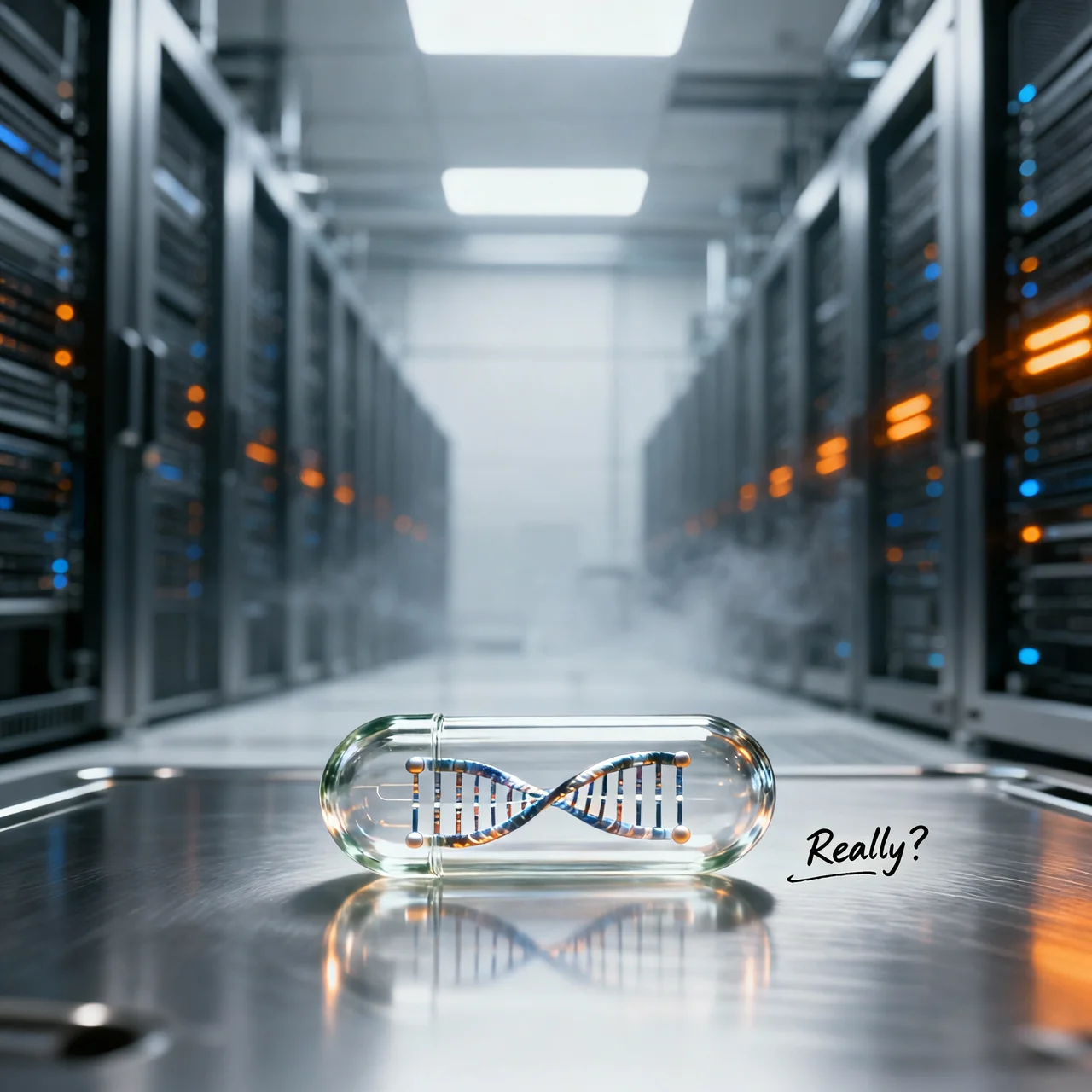
AI Generated Illustration
One answer comes from biology rather than engineering. Scientists are looking at DNA data storage as a way to preserve information using the same molecule that has kept genetic records intact in fossils, seeds, and ancient remains for thousands of years. It already holds a track record longer than any digital format in existence, and that durability is exactly why researchers want to borrow it for archives that are not supposed to disappear.
Understanding why this idea has momentum starts with a simple question. How do you turn a spreadsheet, a photo, or a research dataset into something made of biological material, without ever touching a living cell?
How Can DNA Store Digital Information?
The process works by translating the ones and zeros of digital files into the four letters of the genetic code: A, T, C, and G. A computer file is broken down into binary, and that binary is mapped onto sequences of those four bases. Companies then synthesize physical strands of DNA that match the sequence, essentially writing the data into molecules instead of magnetic particles. Retrieving the file means running the DNA through a sequencer, which reads the order of the bases and converts it back into binary.
It helps to be clear about what this DNA actually is. It is synthetic, built in a lab specifically to hold data, and it has nothing to do with living organisms or genetic engineering. No cells are grown, no organisms are modified, and nothing in a server room is alive. The DNA here functions closer to a chemical hard drive than to anything biological in the traditional sense.
The reason this approach keeps attracting attention is not the novelty of writing data into molecules. It is what that molecule can do once the data is in there.
Why Researchers Believe DNA Could Transform Digital Archives
The density numbers are almost hard to take seriously until you sit with them. A single gram of DNA can theoretically hold around a billion gigabytes of information, according to estimates from researchers studying molecular storage. Compare that to a modern hard drive, which needs an entire physical disk assembly to store a tiny fraction of that amount, and the gap becomes obvious. Tape libraries that fill warehouse-sized rooms could, in theory, be replaced by something closer in volume to a sugar cube.
Density is only half the appeal. DNA can also survive for decades, possibly centuries, without power, climate control, or maintenance, as long as it is kept cool and dry. That is the opposite of how current storage works. Hard drives degrade, tapes need to be re-copied every several years, and everything in a data center depends on a constant supply of electricity just to stay readable.
None of this means DNA is about to replace the drive in your laptop. Its real strength shows up in cold storage, the kind of archive that gets written once and rarely touched again, where density and longevity matter more than speed.
The Untold Challenge That Most Headlines Skip
Here is the part most coverage glosses over. Storage capacity is not the metric that decides whether a technology gets adopted. Cost per byte, synthesis speed, sequencing speed, error correction, and how much of the process can be automated are the numbers that actually matter, and right now they remain the biggest source of uncertainty in the field.
Writing and reading DNA today is slow and expensive compared to flipping bits on a disk. Synthesizing even a modest amount of data can take hours and cost far more than storing the same file on a conventional drive. Sequencing it back out adds more time on top of that. Those numbers are exactly why DNA storage cannot touch the workloads that cloud providers handle every second, things like streaming video or running a database query. Synthetic biology has solved the part everyone finds exciting. It has not yet solved the part that determines whether anyone can afford to use it at scale.
That gap is where the actual research is happening now, less about proving DNA can hold data and more about making the process fast and cheap enough to matter.
Could DNA Replace Cloud Data Centers or Work Alongside Them?
Most researchers in this space are not picturing a future where DNA replaces SSDs or memory chips. The likelier path is DNA sitting alongside existing infrastructure as a dedicated archival layer, something used for data that needs to survive but does not need to be accessed quickly. Fast storage stays fast. Archival storage gets denser and longer lasting.
That distinction matters more as the categories of data needing long-term preservation keep expanding. Genomic research, medical records, government archives, cultural preservation projects, and even data gathered on long-duration space missions all share the same requirement: store enormous amounts of information for a very long time, without needing to touch it constantly. DNA storage is built for exactly that profile.
There is a strange image worth sitting with here. The data center of the future may not vanish, but the part of it holding decades of archived records could eventually fit inside something no bigger than a coffee mug.
What Could This Mean for the Future of Computing?
If the cost and speed problems get solved, even partially, the downstream effects reach further than storage alone. Less physical infrastructure for cold archives means lower long-term energy demand, since DNA does not need to sit on powered racks the way tape and disks do. That alone is enough to keep major tech companies and research labs funding the work despite how far it still has to go.
What remains genuinely unresolved is whether DNA synthesis can scale to industrial volumes without costs staying prohibitively high, whether standards will emerge across competing approaches, and whether the environmental footprint of producing synthetic DNA at scale ends up smaller than the systems it would replace. These are not minor footnotes. They are the questions that will determine whether this stays a lab curiosity or becomes infrastructure.
What is clear is that humanity is running out of places to put everything it wants to remember, and biology, of all things, might be where it finds room. The silicon era is not ending tomorrow, but for the first time, it has a plausible successor waiting in the wings, one built from the same molecule that has been quietly archiving life on Earth since long before anyone thought to build a server.