In December 2021, a Chinese satellite called Shijian-21 crept up on a dead navigation satellite, locked onto it, and towed it hundreds of miles across orbit to a graveyard belt far from anything else in the sky. No missile fired. No explosion. One spacecraft simply reached out, took hold of another, and moved it wherever it wanted.
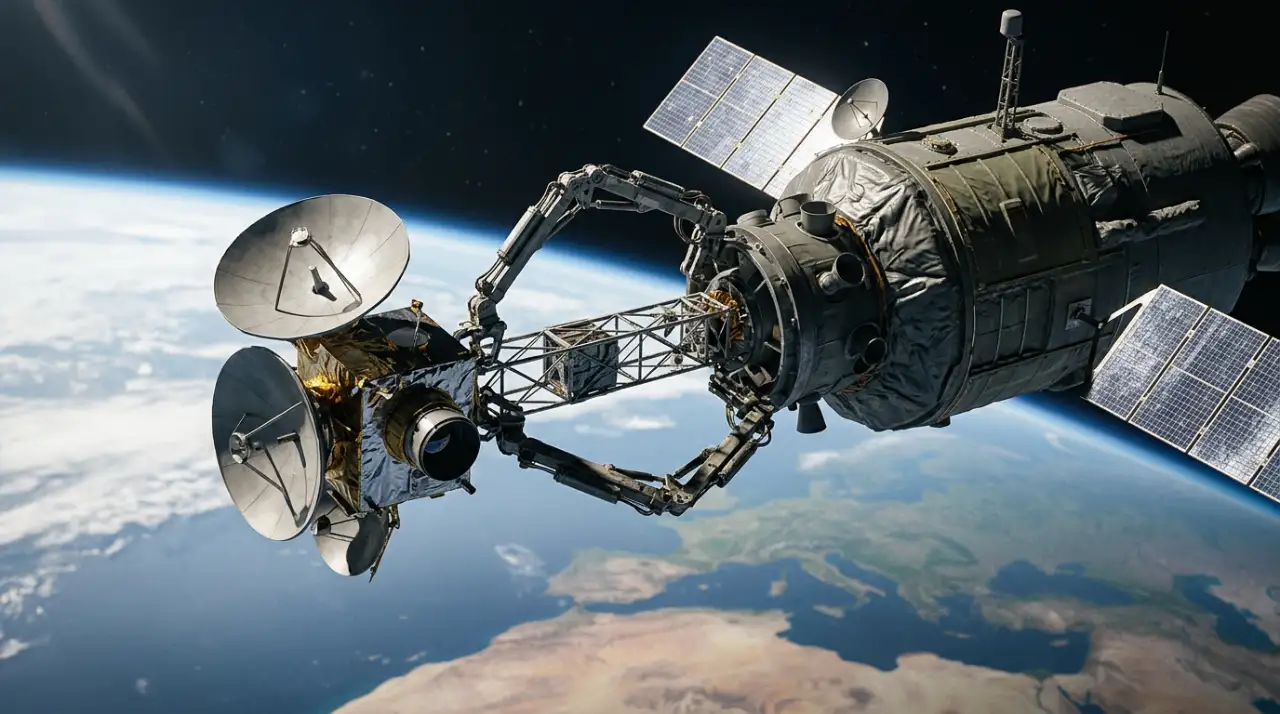
AI Generated Illustration
That kind of control sits at the center of a new round of Pentagon interest in space weapons, and it looks very different from a missile strike. Modern militaries lean on satellites for nearly everything: GPS coordinates for troops on the ground, early warning of missile launches, encrypted communications, and the imagery that tells commanders what an adversary is doing before they do it. Losing that layer of infrastructure, even briefly, would be disorienting in a way few other single points of failure could match.
So the question worth sitting with is this: what changes once an orbital asset can be approached and taken over instead of simply blown apart?
What the Pentagon Is Studying
Reporting on the Pentagon's satellite work has increasingly centered on rendezvous and proximity operations, or RPO, the broad category of activity where one spacecraft deliberately closes in on another. The Space Development Agency and the Defense Innovation Unit have already put money behind part of this picture, awarding preliminary design contracts to commercial firms including Firefly Aerospace, D-Orbit, and Katalyst Space Technologies to build autonomous systems capable of physically grabbing military satellites that were never built with capture in mind.
That distinction matters. A contract to study or demonstrate a capability is not the same as fielding an operational weapon. Preliminary design work tells you a government is curious about whether something is possible and worth pursuing. It does not tell you the system works reliably, or that anyone has decided to use it offensively.
What remains genuinely unclear, and probably will for a while, is the performance envelope. How close does a chaser spacecraft need to get before it can grab something. How much mass can it realistically move. How long does an approach take, and how often does it fail. Those numbers separate a laboratory concept from a fielded satellite capture mission, and none of them are public.
How Capturing a Satellite Could Actually Work
Grabbing a satellite sounds simple until you remember that nothing in orbit sits still. Everything is moving at roughly 17,000 miles per hour, and a chaser spacecraft cannot just point itself at a target and fly over. It has to match the target's position, speed, and direction almost exactly, the orbital equivalent of trying to shake hands with someone while both of you are sprinting in the same direction at the same pace.
The broader sequence runs through several stages: tracking the target from a distance, closing the gap gradually, holding a stable position nearby, making physical contact, and then gaining enough control to move or disable it. Each stage compounds the difficulty of the last. Losing track of a target during approach, or misjudging its tumble rate, can turn a controlled rendezvous into a collision.
Here is the part people usually get backward. Reaching a satellite is the easy half. Matching its exact motion, without smashing into it or being flung off course by its own drift, is where the real engineering problem lives. On-orbit maneuvering of that precision is closer to docking two vehicles in freefall than it is to firing a weapon at a fixed coordinate.
From Space Cleanup to a Potential Weapon
None of this technology started as a weapons program. Companies have spent years developing capture systems for entirely civilian reasons: pulling dead satellites out of crowded orbits, refueling active ones, repairing hardware that would otherwise be scrapped, or nudging a spacecraft into a better position before it runs out of fuel. Orbital debris removal alone has attracted serious commercial investment, because a cluttered low Earth orbit is bad for everyone flying through it.
But a spacecraft that can dock with a defunct satellite to service it can, in principle, dock with an active one to disable it. The hardware does not know the difference between a decommissioned relay and an operational reconnaissance satellite. The intent lives entirely in the mission plan, not the machine.
That ambiguity is the uncomfortable part. A satellite servicing spacecraft closing in on another country's satellite could be doing routine maintenance under a commercial contract, or it could be the opening move of an offensive space capability. From the ground, using existing space domain awareness tools, those two scenarios can look almost identical until the very last moment.
Why Control Could Matter More Than Destruction
Blowing up a satellite with a direct-ascent anti-satellite weapon creates a debris field that can linger in orbit for decades, threatening every other spacecraft that passes through it, including the attacker's own. That collateral risk has made kinetic strikes politically costly and operationally messy.
Capturing or quietly disabling a satellite avoids that problem entirely. Nudge a satellite off its intended orbit, jam its sensors from close range, or simply take physical control of its orientation, and you can knock out surveillance, navigation, missile warning, or communications without leaving a single piece of new debris behind. The damage is functional rather than physical, which makes it both quieter and harder to prove.
The next space weapon may not need to destroy a satellite. It may only need to take control of it.
The Growing Contest for Control of Orbit
The United States, China, and Russia are all expanding their counterspace capabilities, and rendezvous technology is only one piece of a much wider toolkit that already includes jamming, cyberattacks, ground-based lasers, and direct-ascent interceptors. Shijian-21's 2021 tow job was one data point. In 2024, US Space Command flagged a Russian satellite, Cosmos 2576, as a likely counterspace weapon after it deployed into the same orbit as a US government satellite, echoing tactics Russia had used with earlier inspector spacecraft.
Those episodes reframe the defensive problem. For decades, protecting a satellite mostly meant hardening it against missiles fired from the ground. Now operators also have to watch for something that looks, at first glance, like an ordinary object sharing their orbit, then slowly and deliberately starts closing the distance.
That shift toward maneuverable, patient spacecraft is why military space power increasingly depends on tracking behavior over time, not just cataloging objects. A satellite that has done nothing unusual for six months and then begins a slow approach toward a high-value target is a different threat picture than a missile launch, and it demands a different kind of vigilance.
What the Study Still Cannot Tell Us
It is worth being precise about what has actually been demonstrated versus what remains a research concept. Preliminary design contracts, wargame exercises, and public reporting on Pentagon interest in satellite capture are not the same as a deployed, combat-ready system. The gap between a promising design review and something that reliably works against a maneuvering, possibly defended target in a contested environment is enormous.
What is missing, and what would actually settle the debate over how practical this all is, are the performance figures nobody has published: success rates, timelines, and behavior under countermeasures like evasive maneuvering or decoy debris. Until those numbers exist publicly, most of what gets written about space weapons capable of satellite capture is informed speculation built on contract announcements and orbital mechanics, not proof of an operational threat.
Even so, the direction is hard to miss. Weather forecasts, bank transaction timestamps, and military targeting data all increasingly run through orbit. As that dependence grows, the ability to reach out and take control of a satellite may end up mattering just as much as the ability to destroy one.