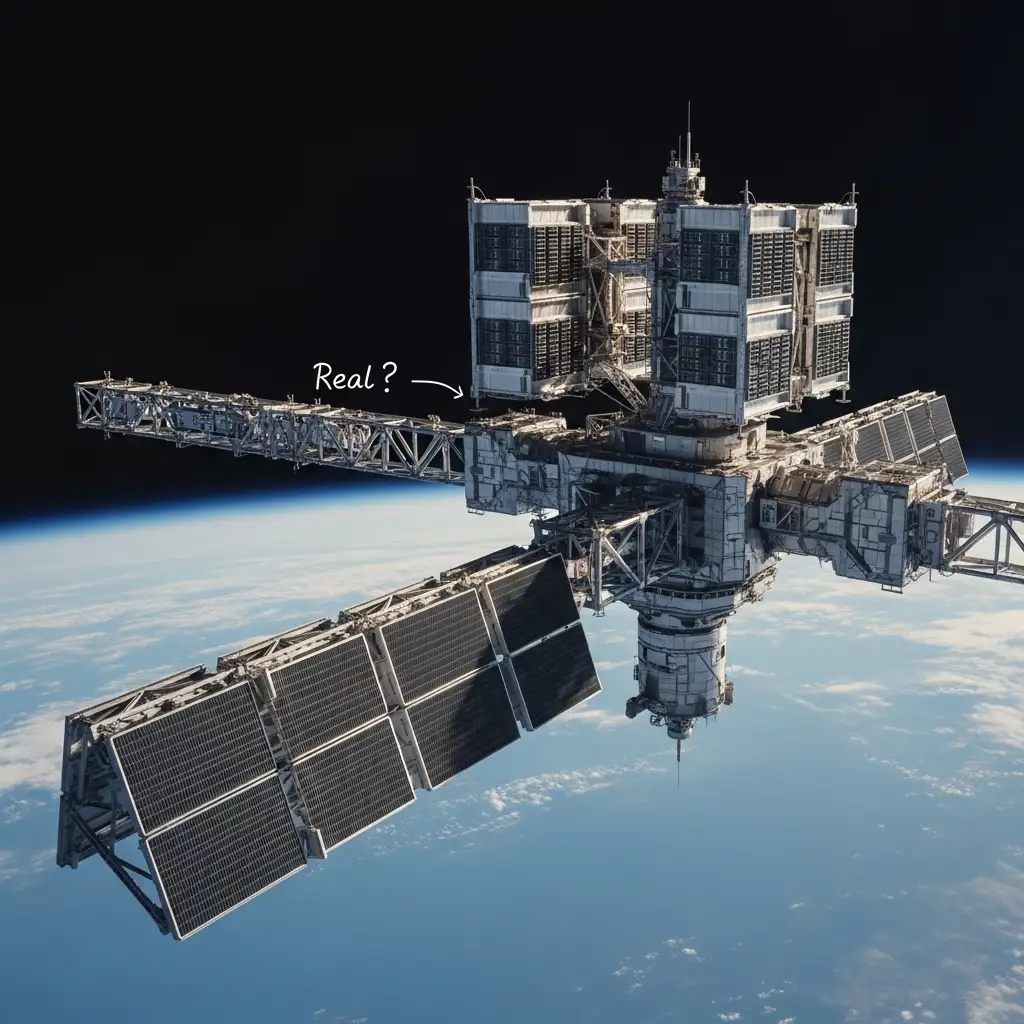
Somewhere over the Pacific tonight, a school bus sized satellite will hit the upper atmosphere at roughly eight kilometers a second and start to come apart. Nobody will notice. That is the point.
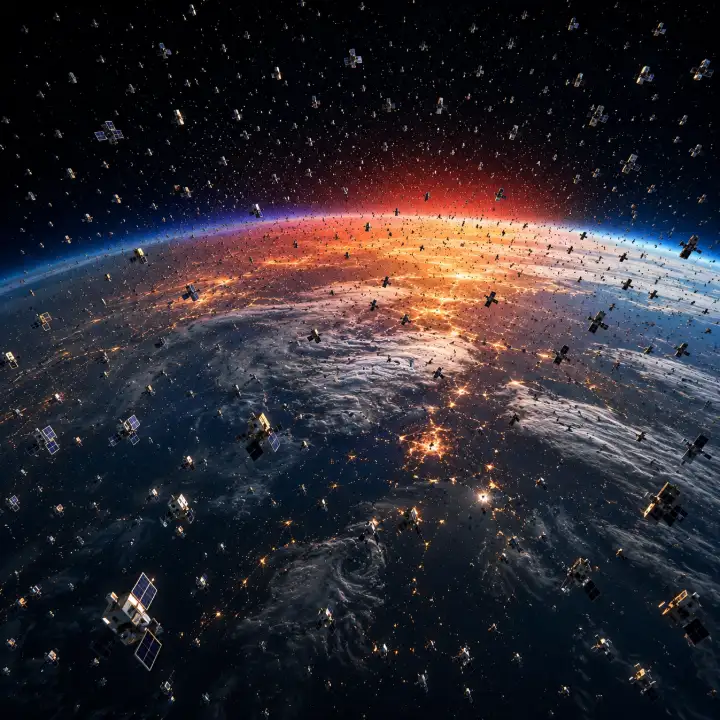
AI Generated Illustration
This happens routinely now, and it is about to happen a lot more. SpaceX has floated a vision of orbital AI data centers, satellite constellations built not to relay phone calls or beam internet, but to run artificial intelligence workloads in space, powered by sunlight that never dims and cooled by the vacuum itself. The scale under discussion, up to a million satellites, would dwarf anything currently in orbit. The AI satellites climate impact question that follows has less to do with collisions or space debris in the traditional sense, and more to do with what all that hardware does to the sky on its way up and its way back down.
Current low Earth orbit satellite fleets, including SpaceX's existing Starlink constellation, number in the thousands. A satellite network built for AI computing would need launches on a different order entirely, and each unit would likely weigh several times more than a typical Starlink satellite, packed with the processors, radiators and power systems space based computing requires. More mass in orbit eventually means more mass burning up, since hardware in space typically lasts only a handful of years before it needs replacing.
The environmental question that matters most here is not what a million satellites do while circling the planet. It is what happens twice: once when rockets punch through the atmosphere to put them there, and again when the satellites themselves eventually fall back through it. That second event, the reentry, is where things get genuinely strange, because the atmospheric layer involved is one science has barely started to study.
The Atmosphere Is the Unexpected Battleground
Ground level pollution is, in a relative sense, a solved problem. Scientists know how to measure it, track it and model its effects with reasonable confidence. The mesosphere and upper stratosphere, the layers roughly 50 to 85 kilometers up, are different. Almost nothing reaches that altitude under normal circumstances. Rockets and reentering spacecraft are among the only things that do.
A rocket launch releases exhaust directly into these upper layers, including black carbon particles from burning fuel, along with aluminum and other metals shed from the vehicle itself. Because so little else happens up there, researchers do not have decades of baseline data to compare against. They are trying to understand a chemistry experiment while it is already running.
The concern is not simply putting a million machines in space. It is putting the material from those machines through Earth's atmosphere, twice, for every satellite, for as long as the constellation keeps replacing itself.
Altitude changes how that material behaves, and nowhere is that clearer than in what happens when a satellite actually burns up on the way home.
What Happens When Satellites Burn Up
When a large satellite reenters, it does not simply vanish the way a shooting star seems to. Friction with the atmosphere heats the structure until it vaporizes and fragments, scattering material across a wide altitude band rather than concentrating it somewhere on the ground, where monitoring and cleanup would at least be possible.
Aluminum draws most of the attention, for a straightforward chemical reason. It combines with oxygen during reentry to form aluminum oxide, a fine particulate that can linger in the stratosphere for years, the way chalk dust drifting in still air takes far longer to settle than a dropped brick. Aluminum oxide is also chemically active in ways that matter for ozone.
Researchers modeling megaconstellation scale reentries have arrived at estimates in the hundreds of metric tons of aluminum oxide compounds released annually under some future scenarios, a volume with no real precedent for artificial material at that altitude.
That is what comes down. What goes up, in a growing number of rocket launches, may turn out to matter just as much.
More Launches Could Mean More Atmospheric Pollution
Starship burns methane and oxygen, a combination that produces less soot than the kerosene based fuels older rockets rely on. That advantage narrows fast once you multiply it by frequency. A cleaner rocket flown a thousand times can put more material into the upper atmosphere than a dirtier rocket flown a dozen times.
Deploying and maintaining a million satellite constellation, replacing hardware every few years as AI chips age out, would require a launch cadence well beyond anything flying today. For context, roughly 324 orbital launches took place worldwide in 2025. No confirmed plan for an AI satellite constellation at that scale exists yet. What exists is a stated ambition, and the launch numbers it implies, if realized, would mark a sharp jump from current totals.
Altitude also changes how long pollution sticks around. Black carbon released near the ground gets rained out or dispersed within days. In the upper atmosphere, where weather as we experience it does not reach, the same particles can persist for months or years, spreading slowly and interacting with sunlight and existing atmospheric chemistry the whole time.
Launches are only half the pollution story. The satellites still have to come back down, and there could eventually be far more of them up there to begin with.
The Satellites Could Create a New Kind of Space Dust
AI focused satellites are not built like communication satellites. Running machine learning workloads in orbit calls for heavier processors, larger radiators to shed heat in a vacuum, and more power generation hardware, all of which adds mass. Estimates for systems like this run into several tonnes per unit, and because AI hardware ages out quickly, operators would likely replace satellites more often than the five to seven year lifespan typical of current constellations.
Multiply a heavier satellite by a shorter replacement cycle and a much larger fleet, and the atmosphere starts receiving reentry material at a pace natural sources cannot match. Micrometeorites, the tiny space rocks that normally supply most of the metal reaching Earth's upper atmosphere, arrive in relatively steady and well understood quantities. Repeated satellite reentries at megaconstellation scale could, in some projections, exceed that natural input, introducing manufactured metal at a volume the atmosphere has never had to process before.
What nobody can say with confidence yet is how these materials behave once they build up. Do they stay put, drift into other atmospheric layers, or interact with existing pollutants and the ozone layer in ways that compound rather than simply add. Those are open questions, not settled ones, and nobody has measured it yet.
Scientists Do Not Know the Tipping Point Yet
Identifying a pollutant is not the same as knowing how much of it triggers a measurable problem. Researchers can point to aluminum oxide and black carbon as substances worth watching in the upper atmosphere without being able to say precisely what threshold would cause noticeable ozone depletion or temperature change.
Some modeling studies have projected ozone and temperature effects under future megaconstellation reentry scenarios, and the results are worth taking seriously. They are modeled outcomes built on assumptions about launch cadence and satellite mass, not measurements of damage already done. That distinction gets lost easily in either direction, dismissed as alarmist or treated as settled fact depending on who is telling the story.
Closing that gap requires more direct atmospheric sampling at altitudes that are expensive and difficult to reach, more laboratory work on how aluminum oxide particles behave under stratospheric conditions, and modeling that keeps pace with how fast launch plans keep changing. None of that happens quickly, and none of it happens for free.
That mismatch, between how fast the technology moves and how slowly the science can confirm its effects, is the governance problem sitting underneath all of this.
The Race to Space Is Moving Faster Than Environmental Science
Orbital infrastructure is being proposed, funded and in some cases built on timelines measured in a couple of years. Atmospheric research on questions this specific typically takes far longer, partly because the instruments and expertise needed are scarce, and partly because a trend usually needs years of data before it becomes distinguishable from noise.
This is not a problem unique to SpaceX. Interest in orbital data centers is spreading across the space and AI industries, and any company that pursues satellite based computing at real scale runs into the same physics. Deploying and eventually replacing large numbers of heavy satellites means launches and reentries regardless of whose logo sits on the hardware.
The deeper question is whether the limits of what the upper atmosphere can absorb should be established before a million satellite space economy gets built, or discovered afterward, the way so many environmental costs have been discovered before: once the damage was already underway, and the industry causing it too large to easily unwind.