Some craters near the Moon's south pole have not felt direct sunlight in longer than complex life has existed on Earth. Their floors sit close to minus 230 degrees Celsius, cold enough to freeze almost anything that drifts across them and never let it go. Scientists have spent two decades chasing signs of lunar water ice inside these permanently shadowed craters, and the evidence keeps pointing at something real without ever settling how much is actually down there.
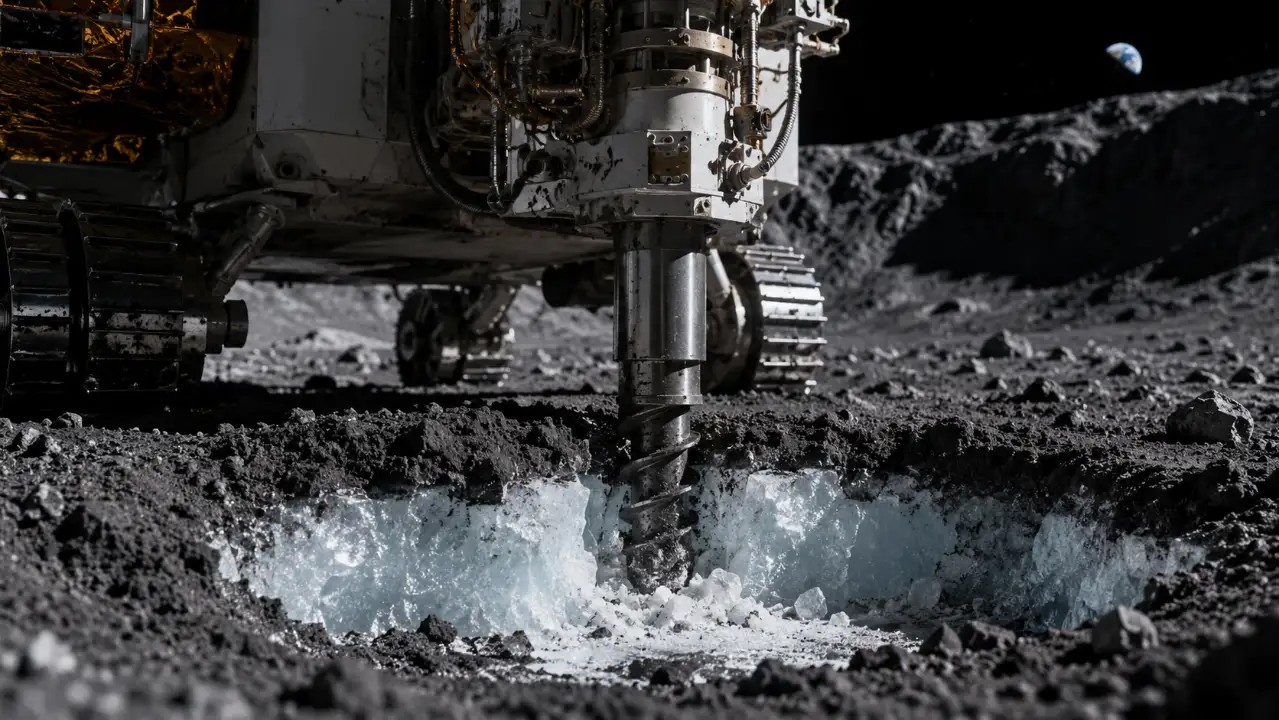
AI Generated Illustration
Earlier missions built the case piece by piece. NASA's Lunar Prospector picked up hints of hydrogen concentrated near both poles back in the late 1990s. In 2009, the LCROSS probe smashed a spent rocket stage into Cabeus crater and kicked up a plume laced with water vapor and ice particles, while India's Chandrayaan-1 mapped hydration signatures across a much wider stretch of the surface that same year. None of it told researchers whether the water sits as solid ice, is bound into minerals, or moves around the pole in ways nobody has modeled correctly yet.
That gap between detecting water and understanding it is where China's Chang'e-7 mission comes in. Bound for the lunar south pole, it is built specifically to stop guessing from orbit and start digging into the ground itself.
Chang'e-7 Will Go Where Sunlight Cannot
Chang'e-7 is aimed squarely at the Moon's south pole, a region that has turned into the most contested piece of real estate in current Moon landing site planning, with craters like Shackleton drawing attention from multiple space programs at once. The mission pairs an orbiter, a lander, and a rover with something unusual: a small flying probe built to hop across the surface instead of rolling over it.
That hopping probe exists because wheels are the wrong tool for this job. Permanently shadowed craters have walls steep enough to strand a rover and floors too treacherous to cross blind, so engineers gave Chang'e-7 a probe that launches itself in short controlled jumps and clears obstacles a set of wheels never could. It behaves less like a car exploring the Moon and more like a scout leapfrogging into terrain a car could never reach.
Surviving inside one of these craters is its own engineering problem. There is no sunlight to recharge solar panels, temperatures cold enough to damage unshielded electronics, unmapped terrain, and a signal path that has to route around crater walls tall enough to block a direct line to Earth or a relay satellite.
All of that hardware exists to answer a question orbiters have never been able to settle on their own: is the water actually there, and if so, in what form.
The Probe Will Drill Into Lunar Soil
The detection plan is fairly direct once the probe reaches its target. It drills into the lunar soil, collects a sample, and seals it inside a chamber. From there, the sample gets heated until anything trapped inside is released as gas, which onboard instruments then capture and analyze.
The instrument doing that analysis is called the Lunar soil Water molecule Analyser, and it is built to do more than confirm water is present. It can measure water molecules directly and read isotopic signatures in the released gas, the kind of detail that tells scientists something about the water's history rather than just its existence.
That distinction matters more than it sounds. Finding a visible chunk of ice would make for a dramatic photograph, but Chang'e-7 is not built to hunt for ice cubes. It is built to measure abundance, concentration, and chemical form inside the soil itself, the numbers that actually determine whether lunar water ice could ever be used for anything.
A visible patch of ice would be good for exactly one headline. Learning how water survives buried inside billions of years of lunar soil is the kind of result that reshapes every mission planned after it.
Answering how the water is stored only opens the next question, which is where it came from in the first place.
The Biggest Mystery Is Where the Water Came From
Two competing explanations have dominated this debate for years. One holds that comets and asteroids delivered water to the Moon through impacts over billions of years, the same bombardment that pockmarked the surface with craters to begin with. The other points to volatiles already present in or near the Moon, slowly migrating toward the poles and settling into the cold traps of permanently shadowed regions.
Hydrogen and its heavier isotope, deuterium, show up in different ratios depending on where water originally formed, so measuring that ratio in a drilled sample can point toward one origin story over the other. It is close to the only fingerprint that ancient lunar water has left behind.
Knowing that water exists is not the same as understanding it. Researchers also need its depth below the surface, how concentrated it is in a given patch of soil, whether it sits as ice crystals or bound into mineral grains, and how that distribution shifts from one shadowed crater to the next. Chang'e-7's in-situ lunar analysis is designed to start filling in those specifics for one location instead of estimating all of them from orbit.
The scientific case for going would be reason enough on its own. What has actually pulled multiple countries toward the same handful of craters is the practical case sitting right behind it.
Lunar Ice Could Change Future Exploration
Water ice locked into lunar soil could, in theory, be processed into resources astronauts cannot easily bring from Earth. Split into hydrogen and oxygen, it becomes breathable air and rocket propellant. Left mostly intact, it becomes drinking water for a crew that would otherwise need every drop shipped nearly 240,000 miles from home.
That possibility is a big part of why the south pole has become the focus of nearly every serious lunar exploration plan on the table, from crewed landings to concepts for a longer-term lunar base. It also feeds a wider interest in space mining potential across the solar system. A dependable source of water changes the math on how long a crew could stay and how much has to launch from Earth just to keep them alive.
None of that makes lunar ice usable simply because it exists. Extracting water from soil sitting below minus 200 degrees Celsius, inside a crater with no sunlight, requires equipment nobody has built and tested at that scale, a power source that can run in permanent darkness, and a way to move processed water or fuel out of terrain machines can barely enter in the first place.
That gap between what looks promising on paper and what Chang'e-7 can actually prove is worth sitting with before anyone starts planning an extraction operation.
Finding Ice Is Not the Same as Mining It
Even the most optimistic estimates of polar water ice come with wide error bars. Scientists do not agree on how much water is actually down there, how concentrated it is in any given crater, how deep it sits below the surface, or whether it exists as solid ice, frost mixed into soil, or water bound into minerals at the molecular level.
Permanently shadowed regions are brutal environments for hardware. The cold can crack materials that work fine elsewhere on the Moon, the terrain is unmapped, and every machine sent in has to operate without sunlight or, often, a direct line of communication back to Earth.
Current evidence does not point to some clean underground reservoir waiting to be tapped like a well. What the data suggests instead is water scattered unevenly through soil in ways that differ from crater to crater, which is a far harder resource to plan around than a single deposit.
That uncertainty is exactly the gap Chang'e-7 is positioned to close, at least for one crater at a time.
Chang'e-7 Could Answer What Orbiters Cannot
Orbiters are good at spotting where hydrogen signatures cluster across the lunar surface, but they cannot say what is happening a few centimeters below the ground. Only a robotic Moon mission sitting on the surface, drilling into actual soil, can answer questions about depth, concentration, and chemical form that remote sensing alone has never resolved.
The bigger contribution here is not confirming that water exists. Multiple missions have already done that in different ways. It is establishing how that water is stored and distributed at ground level, the kind of detail that turns a promising signal into something closer to a resource map.
Whatever Chang'e-7 finds will feed directly into how future missions choose landing sites, how planners think about lunar base resources for a longer human presence, and how scientists refine their models of where the Moon's volatiles came from and how they have moved across billions of years.
The darkest, coldest, most forgotten craters on the Moon are quickly becoming some of the most closely watched real estate in the solar system. What Chang'e-7 pulls out of that soil may end up deciding where humans can actually afford to live once they get there.