In a galaxy so distant its light left home before Earth had settled into anything close to its current shape, three supermassive black holes are locked in a slow gravitational dance. Two of them sit close enough together that astronomers expect them to merge within a few hundred million years. The third drifts thousands of light years out, a straggler whose origin nobody can fully explain yet. Finding one black hole in a galaxy this old is routine work by now. Finding a triple black hole system is not.
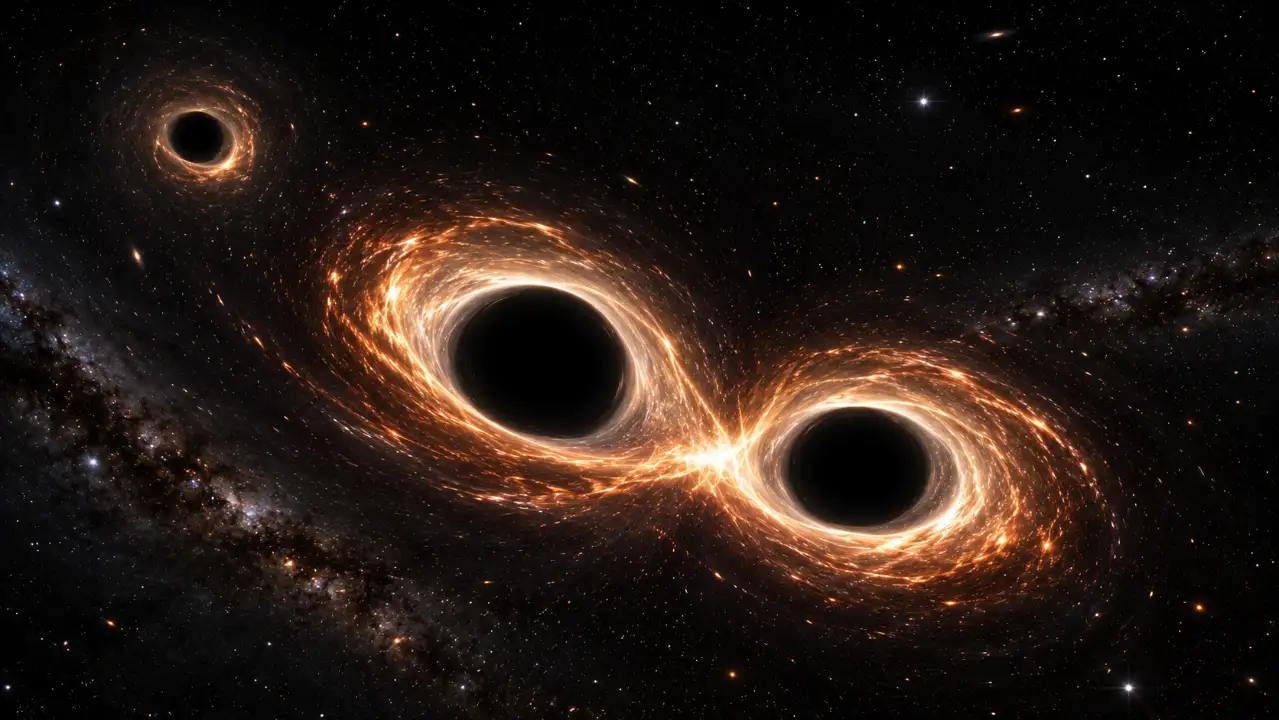
AI Generated Illustration
The galaxy is called J0148-4214, and it sits at a chapter of cosmic history astronomers rarely get to read directly: about 1.2 billion years after the Big Bang, when the universe was still assembling its first large structures. Using the James Webb Space Telescope, an international team led by the Max Planck Institute for Extraterrestrial Physics confirmed what first looked like noise in the data. Three separate sources of hydrogen gas were whipping around at extreme speeds, the telltale signature of matter falling into black holes. It is the first confirmed triple black hole system found in the distant universe, and it hands astronomers something rarer than the black holes themselves: a direct look at how galaxies build their monsters.
The puzzle isn't that black holes exist this early. It's how three of them ended up sharing the same galaxy only a billion years into cosmic time, a period when galaxies were still small and chaotic, barely settling into recognizable shapes.
Two Black Holes Could Be Heading for a Merger
Two of the three black holes sit right at the galaxy's center, separated by roughly 620 light years in projection, which sounds enormous until you remember the distances involved. Astronomers describe this pair as bound to each other by gravity and losing ground with every orbit, on track to collide and merge within the next several hundred million years. That is fast by cosmic standards, barely a moment compared to the universe's roughly 13.8 billion year age.
The reason they're closing in comes down to a slow, grinding process called dynamical friction. As two massive objects orbit close together inside a sea of gas and stars, they stir up everything around them, and that disturbed material drags on them the way a spoon loses momentum pushing through thick batter, bleeding away orbital energy little by little. Over millions of years, that drag tightens the pair's orbit until they eventually spiral together and merge into one larger black hole.
What happens when they do merge matters to more than black hole specialists. An event that massive would send ripples through spacetime itself, gravitational waves in a frequency range no current instrument can detect but that future space-based observatories like LISA are being built to catch. Watching that kind of merger unfold, even indirectly, would give astronomers something they've never confirmed with hard evidence: whether black hole mergers happened often enough in the early universe to explain how galaxies grew their central monsters so quickly.
How Three Black Holes Can Orbit Together
Three supermassive black holes sharing one galaxy sounds like it should end quickly and violently, yet gravity here is patient rather than reckless. Black holes this large, the smallest weighing in at around 600,000 suns and the largest at about 80 million, don't simply fall into each other on contact. They settle into orbits around the galaxy's shared center of mass, the same way planets circle a star without crashing into it, just messier, since there's no single dominant body keeping order.
That mess likely has a clear origin. Galaxies in the early universe merged with each other constantly, and when two galaxies combine, the supermassive black holes at their centers eventually get pulled toward the newly combined core too. Add a third galaxy and its black hole to that mix within a relatively short window, and a tidy pair turns into a three body gravitational tangle instead. That's a plausible read of what happened at J0148-4214, based on where the third black hole sits and how its mass compares with the other two.
The real insight here isn't the number three. It's what that number implies. A triple black hole system is unlikely to be three unrelated black holes that happened to wander into the same galaxy. It reads far more like fossil evidence of repeated galaxy collisions, a pattern written into the orbits of three objects that shouldn't be anywhere near each other unless something large brought them together first.
A Rare Window Into Early Galaxy Growth
Because light takes time to travel, looking at a galaxy 12.5 billion light years away also means looking back in time, to a universe barely a tenth of its current age. Most black hole mergers that astronomers study happen in the nearby, modern universe, where the physics is easier to observe but the history has already played out. A system like J0148-4214 offers something closer to a live recording of the process while it's still underway.
Black holes and their host galaxies appear to grow together, and this system hints at how. The galaxy holds an estimated 1.3 billion solar masses' worth of stars, and its three black holes together account for a notable share of that mass, a fraction too large to chalk up to coincidence. If black holes routinely arrive at the centers of young galaxies through merger after merger, picking up mass along the way, that would help explain a longstanding puzzle: how supermassive black holes got so big so early, faster than steady gas accretion alone seems able to account for.
That's what makes this galaxy useful for more than curiosity's sake. It gives astronomers a natural laboratory for testing whether merging, not just steady feeding, did the heavy lifting in building the earliest generation of monster black holes, a question that has split astrophysicists for years without a clean answer.
What the Discovery Cannot Tell Us Yet
It's worth being precise about what astronomers actually measured versus what they're inferring. What they observed directly is solid: three separate sources of high velocity hydrogen gas, positioned and separated with enough precision to rule out other explanations like supernovae, shocks, or unusually massive stars. What they're inferring, the merger timeline and the eventual fate of the third black hole, rests on models and reasonable extrapolation rather than watching an event unfold in real time.
Plenty stays genuinely open. The few hundred million year merger estimate for the central pair depends on assumptions about the surrounding gas and stars that are hard to pin down at this distance. Nobody knows for certain whether that merger, whenever it happens, will produce gravitational waves strong enough, in the right frequency range, for an instrument like LISA to actually detect. And the third black hole's story is murkier still. It could be a survivor of an earlier merger, flung outward by a gravitational recoil kick, or it could simply be sinking slowly toward the center from the outside, and current data can't fully separate those possibilities.
What ultimately matters to researchers isn't the number of black holes but the harder numbers behind them: the masses, the distances between them, how fast they're moving, and how tightly gravity binds them together. Those values decide whether this system becomes a genuine test case for merger driven growth or an interesting anomaly that never quite fits the models.
What This Black Hole Trio Could Reveal
Follow-up observations, whether from JWST again or from future instruments, could eventually track how the central pair's orbit is evolving and whether the predicted merger timeline holds up. Confirming even the early stages of that process would turn this galaxy from a single interesting data point into a working example of black hole growth caught mid-motion.
The bigger question is whether J0148-4214 is a fluke or a preview. Astronomers found this triple system almost by accident, using a spectroscopy technique precise enough to separate signals that would have blurred into a single black hole with older instruments. That raises an uncomfortable possibility: multiple black hole systems might be more common in the early universe than anyone assumed, simply because nobody had the resolution to see them until now. Finding a second or third example, in a different galaxy at a similar cosmic age, would settle that question one way or another.
If they do turn out to be common, it reframes something bigger than one galaxy. The largest black holes anchoring today's biggest galaxies, including our own, may not have grown through slow, steady feeding so much as through repeated, messy collisions like the one still playing out at J0148-4214. Whether that idea holds will depend on how many more of these systems turn up once astronomers know where to look.