Every living thing on Earth, from a mushroom to a blue whale to the bacteria in your gut, is supposed to trace back to one shared ancestor. That has been the working assumption in biology for decades.
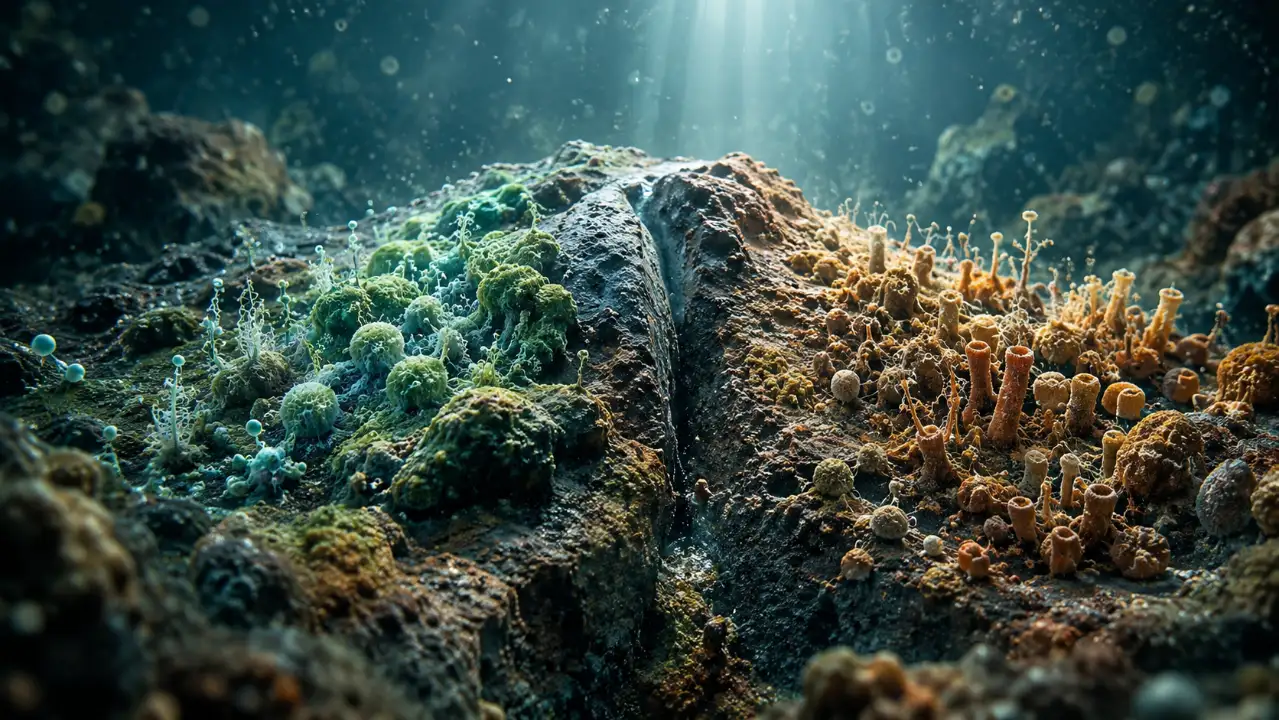
AI Generated Illustration
A new study out of Heinrich Heine University in Düsseldorf is now pulling at that thread, and the argument for two origins of life is more careful than it sounds. It does not claim that lightning struck a puddle twice. It claims something stranger: that the final step separating chemistry from biology may have happened independently, in two different microbial lineages, using two different sets of molecular tools.
The research, published in Science Advances, focuses on bacteria and archaea, the two oldest branches on the tree of life. Both groups are single celled, both are older than anything with a nucleus, and for a long time scientists assumed their shared ancestor already had a fully working metabolism before the two lineages split apart. This new analysis suggests otherwise, and the gap it finds in the story of how did life begin on Earth is exactly where things get interesting.
The Evidence That Makes Life's Origin Stranger
The research team, led by biologist Natalia Mrnjavac, compared the protein structures of core metabolic enzymes across bacterial and archaeal genomes. What they found were several cases where bacteria and archaea perform the exact same essential chemical reaction using enzymes that share no structural resemblance at all. Different shapes, different folds, different evolutionary histories, same job.
This is not a claim that life sparked from nonliving matter twice. It is something more specific and, in some ways, more unsettling for anyone who thought the origin of life theory was mostly settled. The finding concerns machinery that evolved after life already existed in some proto-form, not the initial spark itself. Two lineages independently built the tools to finish becoming fully self-sufficient cells.
Still, the question that lingers is hard to shake. If bacteria and archaea both needed the same functions to survive, why would evolution bother inventing two completely different ways to get there? Redundancy is expensive. Building a new enzyme from scratch takes generations of trial and error. Doing it twice, separately, for the same outcome, is the kind of detail evolutionary biologists tend to notice.
Bacteria and Archaea Took Different Chemical Routes
The team's method involved more than a side by side comparison. They built an algorithm to rank metabolic enzymes by structural complexity, then used that ranking to reconstruct a rough timeline of when each enzyme likely appeared. Out of roughly 420 reactions that make up core cellular metabolism, the reactions responsible for building amino acids, RNA bases, and vitamins, they found several where bacteria and archaea had converged on the same chemistry using unrelated proteins.
Convergence like this usually shows up in outward traits. Bats and birds both fly, but their wings are built from completely different bone structures. What makes this case unusual is that it shows up at the molecular level, inside a system as fundamental as metabolism itself. Same biological problem, two different molecular solutions. That is not a coincidence you would expect if one ancestor had already handed both lineages a finished set of tools.
Which raises an uncomfortable question about that ancestor. If it was not passing down a complete metabolic toolkit, what exactly was it passing down?
LUCA May Have Been More Incomplete Than Expected
That ancestor has a name: LUCA, the last universal common ancestor of every cell alive today. LUCA is not the origin of life itself. It is the most recent point where every branch of the tree of life converges, a single population of organisms that everything alive descended from. Researchers have generally pictured LUCA as a fairly sophisticated cell, complete with a working metabolism, a genetic code, and ribosomes to build proteins.
This study chips away at that picture. The researchers concluded that LUCA had enzymes for only about half of the roughly 420 core metabolic reactions studied. The other half, they argue, were still being handled by transition metals, iron, cobalt, nickel, and palladium occurring naturally in the hydrothermal vent environments where early life is thought to have taken shape. In effect, LUCA was still borrowing chemistry from its surroundings rather than doing all the work internally.
That does not mean two separate sparks of life. An incomplete LUCA is still one shared ancestor. What changes is the assumption that everything essential was already sorted out by the time bacteria and archaea went their separate ways. LUCA may have been less a finished organism and more a work in progress that got interrupted by a fork in the road.
The Missing Step Could Change the Origin Story
Here is where the story gets genuinely interesting instead of just technical. If LUCA was only half finished, then the last stretch of the transition from chemistry to biology, the part where a proto-cell stops relying on its environment and starts running its own metabolism, might have happened twice, after the split rather than before it.
The researchers describe this as a four stage process. It starts with metal catalysts doing most of the chemical work in a hydrothermal vent setting. Next comes a hybrid stage, which is roughly where LUCA sits, part metal catalyzed, part enzyme catalyzed. After that, bacteria and archaea each finish the job independently, swapping out environmental metals for their own enzymes until neither lineage needs the vent chemistry anymore. Only then do you get something that counts as a free living cell.
This is the real shift in framing. The old version of the origin story imagined one dramatic crossing from nonliving to living. This version suggests it might be more accurate to think of two related lineages independently completing that crossing after they had already started down separate paths, using the same starting materials and largely the same physics, but arriving by different chemical routes. The debate over origin of life new study headlines misses this nuance almost every time.
Why Scientists Will Debate the 'Twice' Claim
None of this settles the question, and it should not. Bacteria and archaea already differ in fundamental ways. Their cell membranes are built from different types of lipids. Their DNA replication machinery is not fully shared. Skeptics can reasonably point out that a lot of biochemical divergence between the two domains was already known before this study, so finding more of it is not automatically proof of separate origins.
There is also a harder logical problem here. Independently evolved enzymes are evidence that two lineages solved the same problem separately. That is real and worth taking seriously. But it is not the same as evidence for two separate abiogenesis events, the actual crossing from nonliving chemistry into something you would call alive. What the study supports is that bacteria and archaea completed their metabolic systems on their own after diverging. What it suggests, more speculatively, is that this completion step might be a reasonable place to draw the line between not-quite-alive and alive. What remains genuinely unresolved is whether that line is the right one to draw at all, or whether LUCA itself already crossed it and the rest is just refinement.
Reasonable scientists can look at the same enzyme comparisons and land in different places. That gap between what the data shows and what it means is exactly where this debate is going to live for a while.
A New Map of Life's Earliest Evolution
Whatever side of the debate wins out, the framework itself is useful. It gives researchers a more detailed map of early Earth chemistry and life than a single clean handoff from nonliving matter to a fully formed cell. It also puts LUCA in a different light, less a finished ancestor and more a transitional stage that both bacteria and archaea eventually grew out of in their own way.
There is a wider implication too, one that reaches past Earth. If two lineages independently solved the same biochemical problems using unrelated molecular machinery, that says something about how forgiving the underlying chemistry might be. It suggests the conditions capable of producing something like life may not require one narrow, lucky sequence of events. That matters directly for how scientists think about the odds of early life on Earth research repeating itself somewhere else, on a moon with the right vent chemistry and enough time.
The open question is not really whether life started twice in the sense of two independent sparks from dead matter. It is whether the last common ancestor of everything alive today was already a living thing, or a half built system that two separate lineages each finished on their own terms. Which version turns out to be true will say a lot about how easily biology gets started once the right ingredients are in the same place.