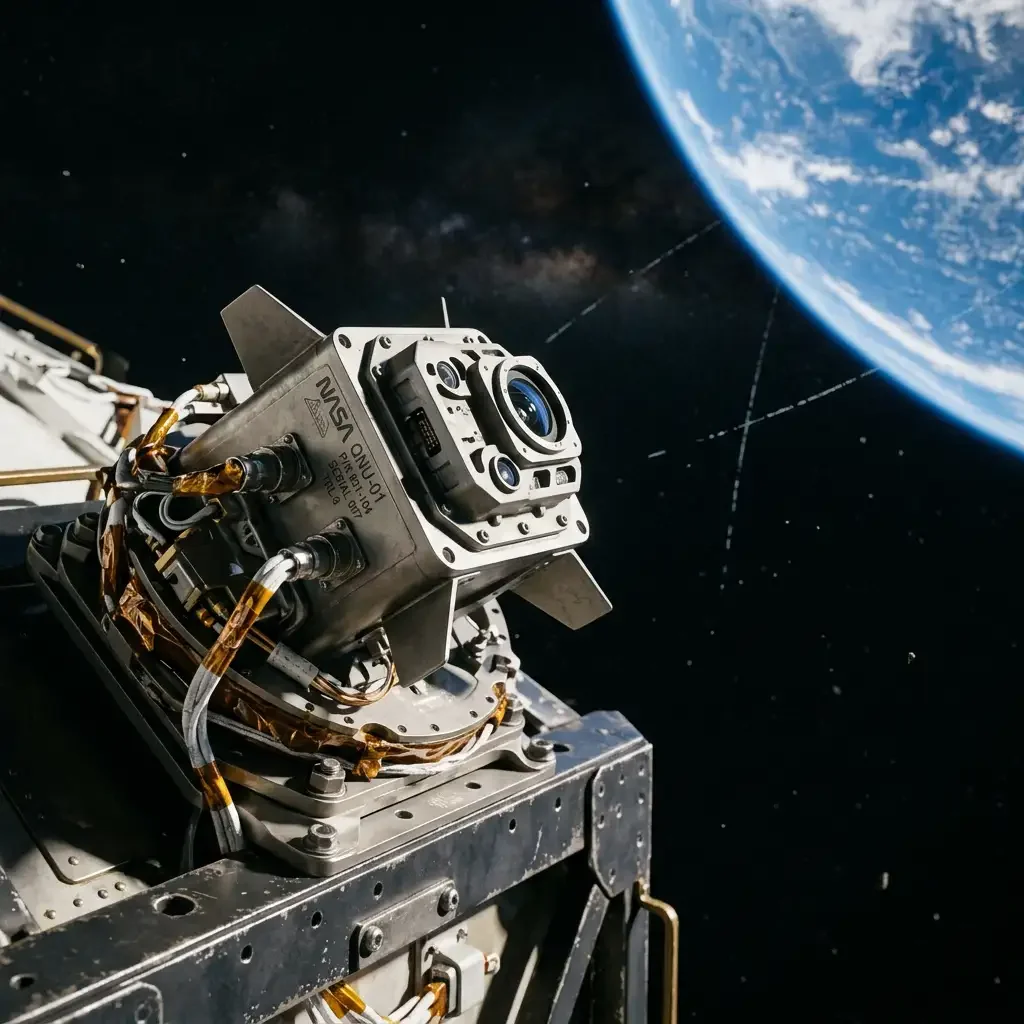
A tray of lettuce floats a few inches off a wall inside the International Space Station, and its roots have no idea which way is down. That confusion is a preview of the real problem behind space farming: growing food somewhere Earth never designed plants for. Every pound of food launched from Earth costs thousands of dollars and burns fuel that could otherwise carry equipment or people. For missions lasting months instead of days, hauling meals from Earth stops being a logistics headache and becomes a hard ceiling on how far humans can travel.
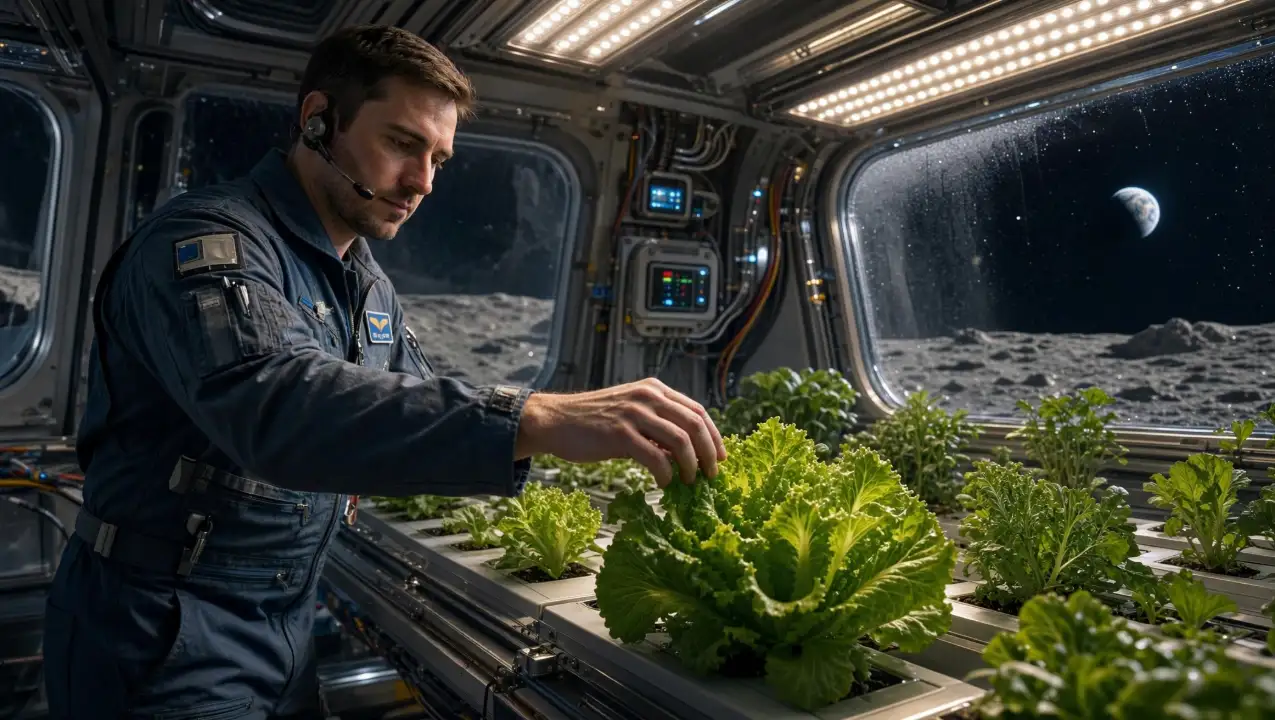
AI Generated Illustration
NASA and the European Space Agency are both planning permanent footholds on the Moon this decade, with Mars sitting on the horizon as the next big leap. A crew orbiting for a week can survive on prepackaged meals. A crew living on the Moon for a year, or spending seven months in transit to Mars, cannot. At some point the supply chain runs out, and there is no truck, no ship, no next-day delivery once you are hundreds of thousands of miles from the nearest grocery store.
Growing plants is something humans have managed for twelve thousand years, so it is fair to ask why this should be so complicated. The truth is that almost everything a plant depends on, gravity, air pressure, soil microbes, a day night cycle, either vanishes or has to be rebuilt from scratch once you leave Earth.
What Scientists Have Built and Why It Matters
Recent growing systems built for the space station and for upcoming lunar missions are not just another plant experiment bolted onto a research schedule. They represent a step toward habitats that can, in theory, keep themselves fed without a resupply rocket. NASA's Veggie and Advanced Plant Habitat systems, along with newer prototypes being tested for lunar and Martian conditions, are built for that longer goal: reliable, repeatable harvests rather than a single successful batch of greens.
Each of these systems packs a lot into a small footprint. Enclosed growing chambers keep humidity and temperature in a narrow band, LED panels tuned to the wavelengths plants actually use replace sunlight, and sensors track everything from carbon dioxide levels to root moisture in real time. Nutrients get delivered through misted or liquid hydroponic systems instead of soil, since hauling dirt to space is neither practical nor useful once every variable needs to be controlled precisely.
Building a greenhouse that works once is one kind of achievement. Building one that keeps working, unattended, for years without a technician nearby to fix a clogged nutrient line is a different problem entirely, and it is the one that decides whether any of this scales beyond a science experiment.
Why Growing Crops Beyond Earth Is Far More Difficult Than It Sounds
On Earth, gravity tells a root which way to grow and pulls water down through soil in a predictable direction. Remove gravity and that signal disappears. Roots in microgravity can grow in loops, water clings to surfaces instead of draining, and pollen, which usually relies on wind or insects, has to be moved by hand or by fans instead. Plants evolved these behaviors over hundreds of millions of years on a planet with consistent gravity, and none of that evolutionary shortcut applies once you leave it.
Radiation adds another layer of difficulty, since cosmic rays and solar particles can damage plant DNA in ways Earth's atmosphere and magnetic field normally block. Water has to be recycled almost perfectly, because there is no well to dig and no rain to catch. Every watt used to run lights and pumps is a watt not available for life support or communications, and without the microbial life found in ordinary soil, disease can spread through a sealed growing chamber with nothing to slow it down.
The question everyone eventually asks is simple: how well do these systems actually perform over the long haul? The honest answer is that nobody fully knows yet. Most published results describe successful individual grows lasting weeks, not the repeated, dependable harvest cycles that would need to run for years on the Moon or during a Mars mission. That gap between a good demo and a dependable system is where most of the real uncertainty lives.
The Bigger Challenge Is Building a Complete Living Ecosystem
Getting one plant to grow successfully is a research result. Getting enough food to reliably feed a crew, cycle after cycle, without a single missed harvest is an engineering and biological problem on an entirely different scale. Astronauts on a Mars mission cannot treat a failed lettuce crop as an interesting setback. It has to be treated as a supply chain failure, because in a closed system, that is exactly what it is.
That means future space farms cannot just grow plants, they have to function as miniature versions of Earth's own ecosystem. Water needs to be captured from humidity and reused. Oxygen produced by plants has to be balanced against the carbon dioxide astronauts exhale. Leftover plant matter, roots, stems, and inedible leaves, has to be composted or processed rather than thrown away, since nothing gets thrown away on a spacecraft. And if one grow module fails, whether from a broken pump or a fungal outbreak, the system needs enough redundancy to keep the crew fed while it gets fixed.
The hardest part is not growing lettuce in space. It is keeping an artificial ecosystem alive for years without Earth.
Why This Research Could Transform Farming on Earth Too
None of this technology stays in orbit. Closed loop systems built to squeeze every drop of water and every photon of light out of a sealed chamber are, functionally, an extreme version of vertical farming, and several agricultural companies already draw on space agency research when designing indoor growing facilities. Precision nutrient delivery, tuned LED lighting, and automated environmental monitoring were all pushed forward, at least in part, by the demands of growing food somewhere far less forgiving than a farm.
That matters well beyond the space program. Regions facing water scarcity, cities trying to grow food closer to where people live, and communities recovering from floods or drought could all use systems built to produce reliable harvests with minimal water and no dependence on local soil quality. A greenhouse designed to survive a six month trip to Mars is, by necessity, also a greenhouse that can survive a lot of what climate change is already throwing at farmers on Earth.
It is a strange trade. Astronauts need this technology to stay alive on the Moon and Mars, and in solving that problem, researchers may end up handing Earth a tool for feeding people in places farming was never supposed to work either.
What Experts Still Need to Prove Before Space Farms Become Routine
A lot still has to be proven before any of this counts as a solved problem. Long duration crop reliability is largely untested, since no mission has run a closed agricultural system continuously for the years a Mars trip would require. Energy consumption is another open question, given that lighting and climate control both draw power that competes directly with everything else a spacecraft or lunar base needs to run. Maintenance may be the biggest unknown of all: a clogged nutrient line or a contaminated growing tray is a minor annoyance in a lab on Earth and a genuine crisis a hundred million miles from the nearest replacement part.
Before space farming becomes a routine part of any mission plan rather than an experimental add on, engineers need to see repeated harvest cycles running under conditions that actually resemble a lunar base or a Mars transit vehicle, not a controlled lab on Earth or a short stay aboard the space station. That distinction, between what works once and what works reliably, is where the entire field currently sits.
NASA and other agencies are already planning the next generation of lunar habitats with agriculture built into the design from the start, rather than added as an afterthought. Whether any of it holds up on the Moon, let alone on the seven month journey to Mars, remains an open question. What is becoming clear is that the timeline for living beyond Earth may depend less on rocket engines than on something far less glamorous: whether a tray of lettuce can survive, unattended, for three years in a place that was never built to grow anything at all.