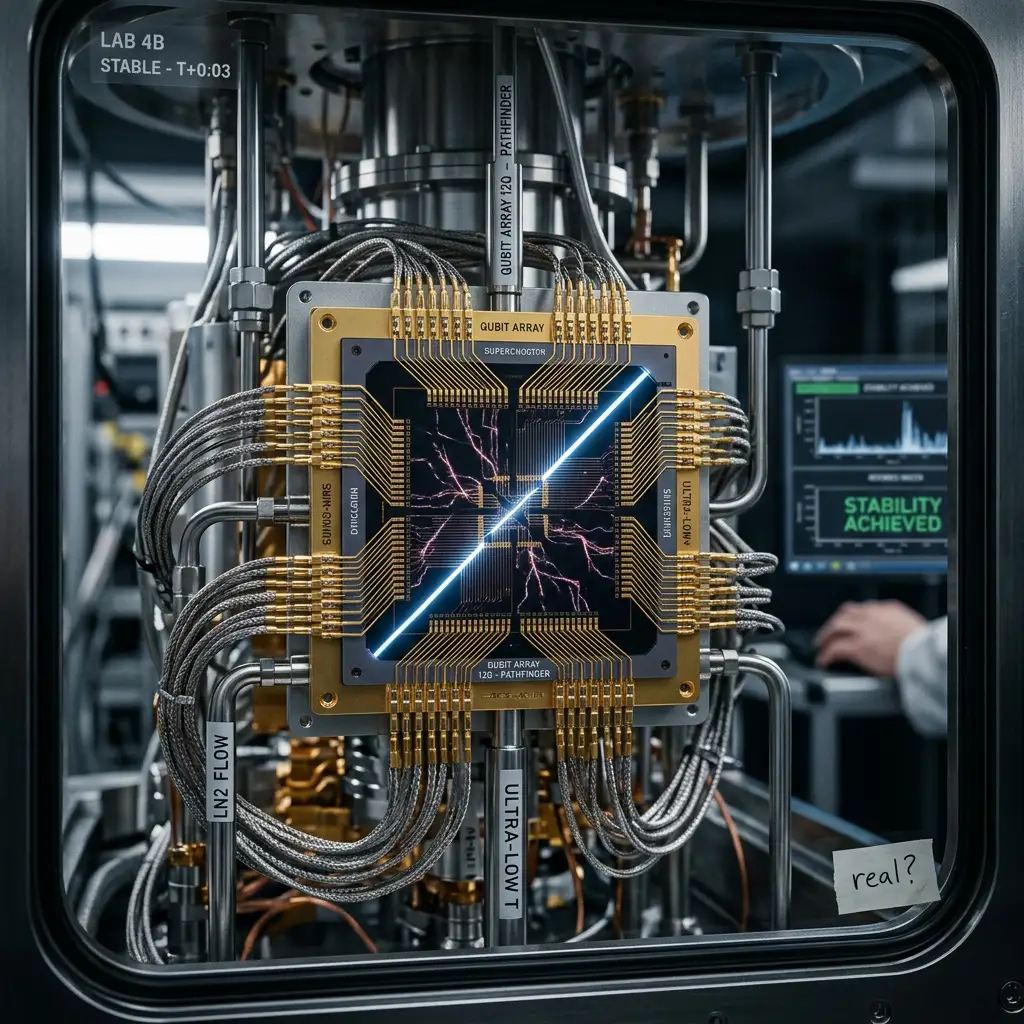
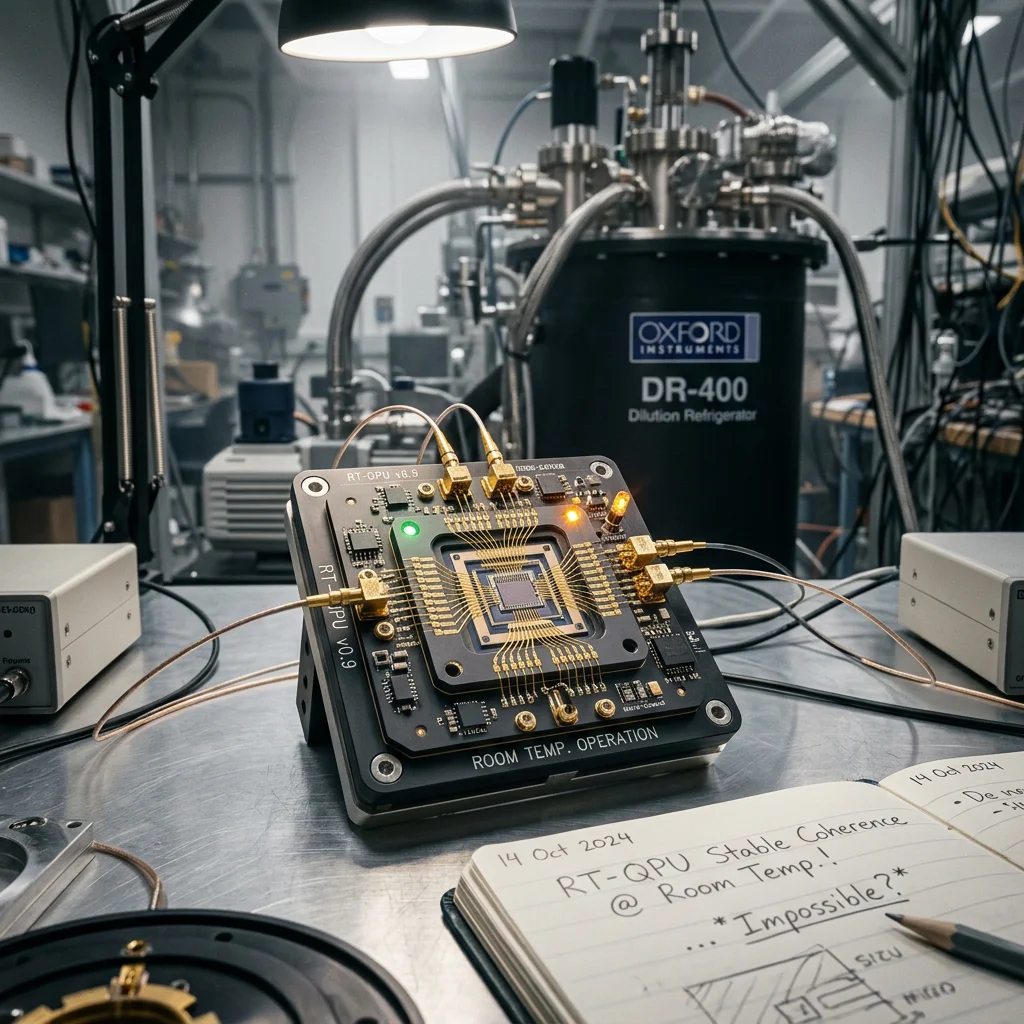
Most quantum computers still look like something out of an oil refinery. Tangles of gold wiring, a steel cylinder the size of a wine barrel, and a cooling rig that hums louder than the machine itself. So when researchers start talking about a coin-sized quantum computer, the gap between what exists and what is being proposed is almost comic. Today's systems fill rooms. The devices being described in new materials research would fit in a coat pocket.
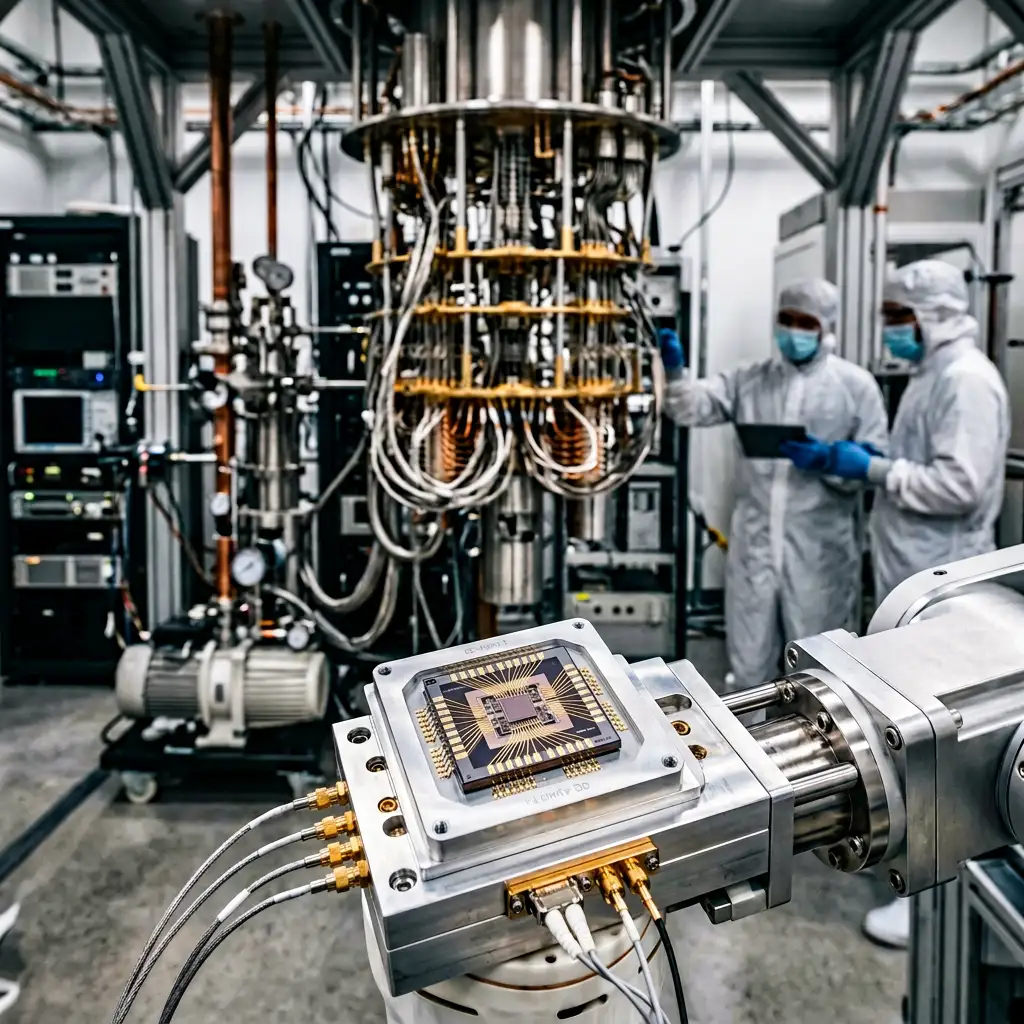
AI Generated Illustration
That gap is exactly why a new materials science advance is getting attention it would not normally receive outside physics journals. The breakthrough is not another qubit count announcement. It targets the physical substance qubits are built on, using a new class of two dimensional materials to construct smaller, more efficient qubit components. Scientists working on this see it as a way to remove a bottleneck that has nothing to do with algorithms and everything to do with plumbing, wiring, and raw material limits.
The Hidden Problem Was Never Just the Qubits
Ask most people why quantum computers are still enormous and they will mention qubit count, as if adding more processing units is the whole story. It is not. Every qubit needs to be paired with control electronics, shielding, and often a component called a capacitor that helps store and manage the delicate quantum state. Multiply that by hundreds of qubits and you get cabinets full of hardware just to support a chip smaller than a fingernail.
Materials are the quiet variable behind almost every limitation in this field. The wrong material introduces electrical noise, and noise is the natural enemy of a qubit's coherence, the length of time it can hold useful quantum information before collapsing into randomness. Coherence and stability remain the real scoreboard in quantum computing, even though exact performance numbers for this particular material have not been made public yet.
That is what makes this update different from the usual quantum headline. If a material problem gets solved at the component level, the fix does not just help one chip design. It potentially helps every architecture built on top of it.
How the New Material Could Shrink Quantum Hardware
The material in question belongs to a family known as van der Waals materials, ultra thin layered substances that can be stacked almost like sheets of paper. Researchers are using them to build smaller, more efficient qubit capacitors, the tiny components responsible for storing and controlling quantum states. Think of a capacitor as a miniature reservoir that holds a very fragile signal steady. A better reservoir means less surrounding equipment is needed to keep that signal from leaking away.
Because these materials are thinner and more efficient at the component level, they open a path toward chips that need less supporting infrastructure. That does not mean quantum computers are about to shed their cryogenic refrigerators. Most designs still require extreme cold to function. But a material that reduces electrical noise and improves integration could ease how demanding that cooling needs to be as the technology matures.
Here is the idea worth sitting with for a second: the biggest breakthrough in quantum computing may not be a better quantum computer. It may be a simpler one.
Why the Entire Quantum Industry Is Paying Attention
Quantum hardware development is not a two horse race. Universities, government labs, startups, and companies pursuing superconducting circuits, trapped ions, and photonic approaches are all chasing the same finish line from different directions. A materials advance like this one does not just help whoever discovered it. Better qubit capacitors and photonic integrated circuits could feed into multiple platforms at once, since the underlying physics of controlling noise and coherence cuts across architectures.
That cross-platform relevance is exactly why smaller, cheaper quantum chips matter beyond the lab. Lower manufacturing costs and improved reliability would make commercialization feel less like a moonshot and more like an engineering roadmap. The eventual payoff people cite includes faster drug discovery simulations, new materials design, financial modeling, cybersecurity research, and optimization problems too complex for classical machines to touch in reasonable time.
None of that happens on lab timelines, though. A material that behaves beautifully on a bench in a university cleanroom still has to survive the far less forgiving world of industrial manufacturing.
The Biggest Questions Scientists Still Need to Answer
Manufacturing quantum materials at scale is a different challenge than making a handful of prototype devices. Van der Waals materials need to be stacked and aligned with precision that is difficult even in controlled lab settings. Whether that process can be replicated across thousands of chips, with consistent yields and long-term stability, remains an open question nobody has fully answered yet.
Coherence times, error rates, fabrication yields, and operational lifetimes are the numbers that would actually tell us how big this is. Right now those figures are either incomplete or simply not public. Critics point out that materials science history is full of promising lab results that stalled the moment they hit a production line, and there is no guarantee this material avoids the same fate. What remains unclear is whether the properties that make it attractive on a small scale will hold up when engineers try to reproduce them a million times over.
That uncertainty is not a weakness in the story. It is the story. Every serious materials breakthrough enters an uncomfortable middle stage before anyone knows if it becomes infrastructure or a footnote.
What This Could Mean for the Future of Computing
Computing history keeps repeating a pattern people forget until it happens again. Classical computing did not shrink because engineers got cleverer with vacuum tubes. It shrank because silicon replaced them. Materials, not just clever design, tend to set the pace of hardware revolutions, and quantum computing appears to be entering that same phase.
If van der Waals materials and similar innovations keep proving out, the long-term possibility is quantum hardware that is smaller, cheaper to run, and realistically accessible to universities and mid-sized companies instead of only a handful of well-funded labs. That outcome depends on far more than one material working out. It needs manufacturing solutions, error correction advances, and years of engineering most people will never read about.
Still, the direction is worth noticing. The race toward a coin-sized quantum computer is turning into a materials science race as much as a computing one, which means the next real leap forward might not come from inside a processor at all. It might come from the atoms sitting underneath it.