On the evening of August 12, 2026, people standing on hillsides in northern Spain will watch the sun vanish just a few degrees above the horizon, low enough that the sky at the edges of their vision stays lit even as the sky overhead goes dark. It is not a normal sunset. It is a total solar eclipse arriving at the exact moment the sun is already on its way down, and that timing is about to turn an ordinary summer evening into the most talked about sky event Europe has had in almost three decades.
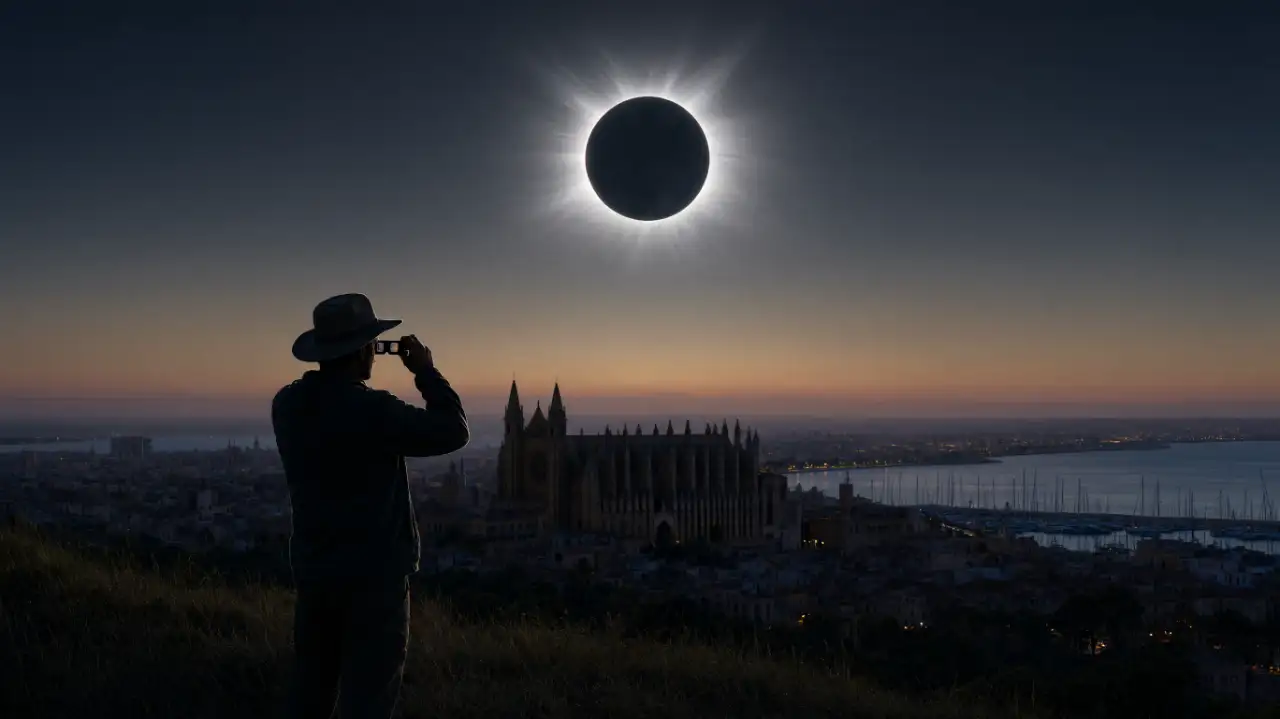
AI Generated Illustration
This is the first total solar eclipse to reach mainland Europe since 1999. The path of totality sweeps down from the Arctic, crosses Greenland and Iceland, then arcs over the Atlantic before touching northern Spain and a sliver of Portugal near the Balearic Islands. Tens of millions across the wider region will see at least a partial eclipse. A much smaller number, standing inside a narrow band roughly 180 miles wide, will get the full experience: a sky that goes dark in daylight.
Why the August 12, 2026 Eclipse Is Unlike Any Europe Has Seen in Decades
Total solar eclipses happen somewhere on Earth every year or two, but most cross open ocean or land with almost nobody on it. This one is different because it ends its run over a stretch of Europe that people actually live in and can drive to. The last time that happened was 1999, when the path cut through parts of the UK, France, Germany and central Europe.
What makes this event stand out isn't just its rarity, it's the mix of geography and timing. The eclipse begins near the North Pole, in a region so far north the sun technically never sets there in August, then travels south across Greenland's ice sheet, clips the west coast of Iceland, and finishes low over the Spanish and Portuguese coastline right before local sunset. That detail is drawing eclipse chasers from around the world, and it raises an obvious question: what does a total eclipse look like this close to sunset instead of high in the sky at midday?
How a Sunset Total Solar Eclipse Creates an Extraordinary Sky
A total solar eclipse happens when the moon passes directly between the Earth and the sun. The moon is about 400 times smaller than the sun but also sits roughly 400 times closer to us, so from Earth the two objects appear almost exactly the same size. That coincidence is the only reason totality is possible at all.
Near sunset, that alignment changes how the sky looks. The sun is already low and dim, filtered through more atmosphere, so the light around it takes on the orange and red tones of any sunset. As the moon finishes covering it, that warm light doesn't fade so much as get swallowed from a strange, low angle instead of overhead.
The result is something close to two sunsets happening at once, the normal glow of dusk on one side of the sky and a second, sudden darkening where the eclipsed sun sits just above the horizon. The effect lasts only a couple of minutes before the sky rights itself, but it's the kind of sight photographs struggle to capture. Where you're standing when it happens matters enormously, which is why this eclipse has become a planning exercise years in the making.
Where Totality Will Be Visible and Why Location Changes Everything
There's a real difference between watching a partial eclipse and standing inside the path of totality, and it isn't a matter of degree. A partial eclipse, even one that covers 95 percent of the sun, still leaves enough direct sunlight that the sky stays bright and the temperature barely drops. Totality is a different event entirely: full darkness, visible stars, and a corona around the blacked out sun that doesn't appear any other way.
The path runs through eastern Greenland, the western edge of Iceland, and a band of northern Spain covering parts of Castile and León, La Rioja, and Aragón before reaching the Balearic Islands. Step outside that band, even by a few dozen miles, and the sun never fully disappears. Much of the rest of Europe, along with northwestern Africa and parts of eastern North America, will see a partial eclipse instead, the fraction covered dropping the farther you are from the centerline. That gap between 90-something percent and full totality is why serious eclipse chasers don't just step into their backyards.
Why Totality Is More Than Just a Dark Sky
The corona is the reason people fly across the planet for two minutes of darkness. It's the sun's outer atmosphere, a wispy halo of superheated plasma normally invisible because the sun's surface is millions of times brighter. Only when the moon blocks that surface completely does the corona show up to the naked eye, stretching out in pale streamers that shift with each eclipse. During the darkest moments, bright planets and a handful of stars can appear in what is otherwise the middle of the day.
Scientists still study these brief windows even though space telescopes watch the sun constantly now. Orbiting instruments can block the sun's disk artificially, but they can't fully replicate what a natural eclipse shows near the sun's edge. NASA and other research groups use total eclipses to feed models of solar wind and coronal heating, chasing one stubborn question: the corona runs over a million degrees, hundreds of times hotter than the sun's visible surface just beneath it, and nobody has a full explanation for why a star's outer layer would run hotter than the layer producing its light.
The Hidden Challenge That Could Decide the Entire Experience
Here's the part that no amount of planning fixes. Eclipses run on orbital mechanics, which are close to perfectly predictable, but the weather on any given afternoon is not. A thick bank of clouds over northern Spain on August 12 would leave people standing in the dark without ever seeing the corona they traveled for, and there's no way to reschedule a total solar eclipse. This exact alignment, at this exact location, won't happen again for generations.
That uncertainty hasn't slowed anyone down. Hotels along the Spanish path have been booking out for months, rental cars in Iceland are hard to find that week, and regional tourism offices are bracing for crowds far beyond what these areas typically see in August. The timing overlaps with the Perseid meteor shower, so northern Spain is expecting visitors who came for the eclipse and stayed for the shooting stars, and roads built for local traffic will need to absorb a surge that could turn two minutes of astronomy into a much longer day.
Why Safe Viewing Rules Change During Different Stages of the Eclipse
Eye safety around a solar eclipse gets misunderstood constantly, and the confusion usually comes down to one detail: the rules change depending on the exact moment. During every partial phase, whether the moon covers 10 percent of the sun or 99 percent, looking directly at it without protection can damage the retina, and that damage doesn't come with pain, which is part of why people underestimate it.
Certified eclipse glasses, meeting the ISO 12312-2 safety standard, are required for the entire partial phase, before and after totality. The one exception is the short window when the sun is completely blocked. Only then is it safe to look without filters, the one chance to see the corona with the naked eye. The instant any sliver of the sun reappears, glasses go back on.
Get the timing right and the eclipse is one of the safest, most spectacular things a person can watch happen in the sky. Get it wrong, even briefly, and it's the kind of mistake that costs someone their vision permanently.
Why This Eclipse Will Be Remembered Long After the Sky Turns Bright Again
Total solar eclipses have a way of sticking with people that few other natural events manage. Part of it is the rarity, part of it is standing in a crowd of strangers who all gasp at the same second, and part of it is how strange it feels for the sky to contradict everything a person has known since childhood. Europe has waited 27 years for this one.
Nothing about that day is fully settled yet. The orbital mechanics are locked in with extraordinary precision, but cloud cover and what each observer happens to notice mean no two accounts of this eclipse will be identical. Some will remember the color of the horizon. Others will remember the corona, or the sudden chill in the air, or the two minutes when a summer evening in Spain briefly stopped behaving like one.
What's certain is that somewhere along that narrow strip from Greenland to the Balearics, millions of people will look up at the same moment and watch the sky do something it hasn't done over this part of the world in almost thirty years. Whether they get the clear skies to see it is the one variable nobody, not NASA, not any observatory, can promise in advance.

![Solar Storm Prediction and Sun's Hidden Signals [Technical Analysis]](https://techtonic-times.github.io/img/q326/the-sun-switches-off-before-the-storm.webp)