For over sixty years, radio telescopes aimed at the sky have picked up pulsars, quasars, and stray signals from our own satellites, never once a confirmed transmission from anyone else. That silence sits inside a question the physicist Enrico Fermi reportedly asked over lunch in 1950: where is everybody. With an estimated 100 billion stars in the Milky Way and thousands of confirmed exoplanets, the odds favor company. The universe has stayed quiet anyway, and that mismatch is the Fermi paradox.
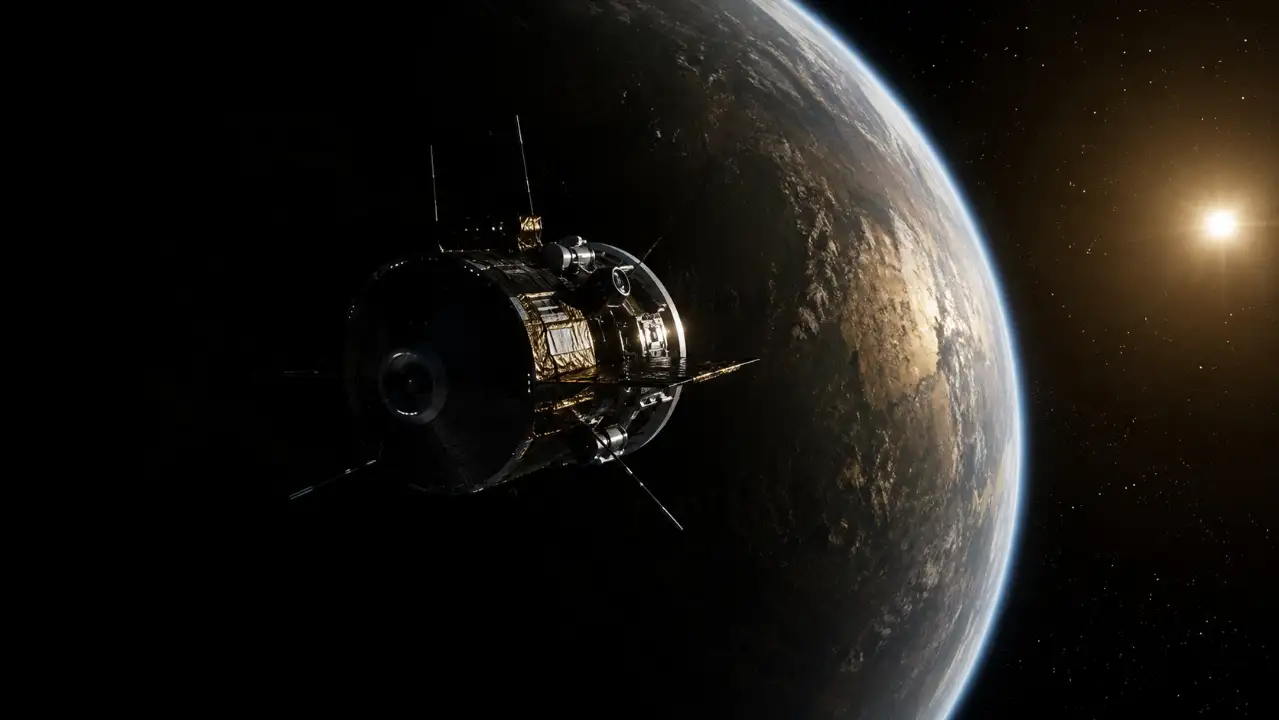
AI Generated Illustration
One idea complicates that silence further. What if the explorers were never biological at all. This is the AI Fermi paradox, the possibility that advanced civilizations send out machines instead of crews, machines built to think and adapt long after the beings who built them are gone. A probe does not get bored on a five hundred year flight. It does not need food, air, or a reason to come home.
That shift changes what we should even be looking for. A galaxy could be humming with autonomous activity, probes replicating, mapping, mining, relaying data between stars, and still look, from a small blue planet in one spiral arm, like absolutely nothing is out there.
Autonomous Probes Could Explore Without Alien Starships
A self-directed probe does not need to phone home before making a decision. Give it a general goal, a way to gather energy, and enough onboard intelligence to handle the unexpected, and it can travel, observe, and replicate without a single new instruction from its creators. It is closer to a self-driving car than a piloted spacecraft: point it at a destination and let it handle whatever the road throws at it along the way.
The idea has a real scientific lineage. Mathematician John von Neumann described machines capable of building copies of themselves back in the 1940s, a concept engineers still call a von Neumann probe. In 1960, Stanford radio astronomer Ronald Bracewell suggested that a civilization looking to make contact might send a probe rather than a signal, since a Bracewell probe could sit near a target star for millennia in a way no broadcast could. What has changed since then is not the concept. It is how plausible artificial intelligence makes the execution.
That is a very different proposition than sending people. A crewed starship needs food, water, radiation shielding, and a plan for what happens when the original crew dies of old age before arrival. A machine needs none of that. It can run on solar or nuclear power for centuries, take damage without panic, and simply keep going.
Autonomy is not a luxury feature here, it is close to a requirement. A probe sent ten light years away takes ten years for a message to arrive, and ten more for a reply. At a hundred light years, a round trip conversation takes two centuries. Nobody is steering a spacecraft in real time under those conditions. The machine has to think for itself, because by the time home base could answer a question, the question is usually irrelevant.
The Galaxy Could Hide an Entire Machine Civilization
A civilization broadcasting from a giant structure or a powerful transmitter would be relatively easy to spot. A swarm of small, quiet, self-sufficient probes scattered across a galaxy is a completely different problem. Instead of one enormous signal, you are looking for the equivalent of a handful of dust specks spread across an ocean, each one doing its job without any reason to call attention to itself.
There is a real difference between technological activity existing and that activity producing something humans can detect. A probe quietly mining an asteroid belt for raw materials is not generating a beacon. It is not trying to be found. It is doing a job, the same way a thermostat in an empty house keeps working without anyone noticing.
A silent galaxy does not necessarily mean an inactive galaxy. That gap between activity and detectability is exactly where artificial intelligence changes the equation, because AI is what would let this kind of quiet, distributed operation run for millions of years without oversight.
AI Could Make Galactic Expansion More Efficient
Sending out a fleet of autonomous machines only works if those machines can handle navigation, upkeep, and decision making without a crew micromanaging every step. That is precisely the kind of work AI is suited for: parsing unfamiliar terrain, adjusting a flight path around debris, repairing a damaged component, deciding whether a nearby moon is worth a closer look.
An advanced version of this technology would not need constant guidance from its home civilization. Send it out with a broad mission and a set of priorities, and it could operate for centuries or millennia with only the occasional check-in, similar to how a probe like Voyager still transmits data decades after the scientists who designed it have retired.
None of this is guaranteed to be possible, and that matters. The idea depends on capabilities nobody has demonstrated yet: propulsion efficient enough for interstellar distances, energy systems that last for centuries without failure, and reliable self-replication using raw materials found in space rather than a factory on Earth. Every piece of this concept is physically plausible. None of it has been proven.
Why We Might Miss the Signals
Most searches for extraterrestrial intelligence are built around a narrow set of assumptions: a deliberate radio transmission, a laser pulse, a structure so large it blocks starlight. Those are the signals we know how to look for. They are not the only signals a civilization, or its machines, might produce.
A probe designed to run quietly for a very long time has no particular reason to broadcast anything. Weak, intermittent emissions would be almost impossible to separate from ordinary astrophysical noise, the same static and interference that already floods every radio survey ever conducted. An object doing its job efficiently might look, to our instruments, exactly like a rock.
Here is the uncomfortable part. We built our entire search for aliens around the assumption that a civilization wants to be found. Nothing about intelligence, biological or artificial, guarantees that. The Fermi paradox may depend less on where everyone is hiding and more on what we have decided an advanced civilization should look like from a distance.
The Biggest Problem With This Idea
None of this holds up if the underlying technology does not work, and there are real reasons to doubt it does, at least not yet. Interstellar travel times run into the thousands of years even for a nearby star. Energy requirements for propulsion at any meaningful fraction of light speed remain far beyond anything humans have built. And self-replication, an autonomous machine gathering raw material and manufacturing an exact copy of itself in deep space, has never been demonstrated even in a controlled lab on Earth, let alone light years from the nearest engineer. If the manufacturing process drifts even slightly with each generation, errors compound. After a few thousand copies, the machines may no longer resemble their original design, or may simply stop functioning.
There is also a difference worth being honest about. A concept being physically plausible is not the same as evidence that anyone is actually using it. Nothing about this idea proves autonomous alien probes exist. It only explains how they could exist without us noticing, which is a much weaker claim.
The absence of a detected probe is evidence of absence only within the limits of what we have actually searched. Humanity has scanned a tiny fraction of the sky, for a tiny fraction of possible signal types, for less than a century. That is not nothing, but it is not close to everything either.
What AI Means for the Search for Alien Life
If any of this is even partly right, it changes what astronomers should be hunting for. Instead of scanning only for deliberate transmissions, some researchers have started paying closer attention to objects with unusual trajectories, unexplained brightness changes, or orbital behavior that does not quite match anything natural. None of that is proof of anything. It is the kind of anomaly worth a second look.
There is also a mirror here worth sitting with. Humanity is already building an early version of exactly what this idea describes. Robotic spacecraft like Voyager and Perseverance already operate with growing degrees of independence, and the artificial intelligence guiding them keeps improving every year. If we eventually send autonomous, self-directed machines to other star systems instead of people, we would be doing precisely what this hypothesis suggests someone else may have already done.
Finding nothing, after decades of looking, was supposed to be a disappointing answer. It might turn out to be the wrong question. The next phase of the search for extraterrestrial life may not be about where everyone is. It may be about learning to recognize a civilization that never intended to look like one.