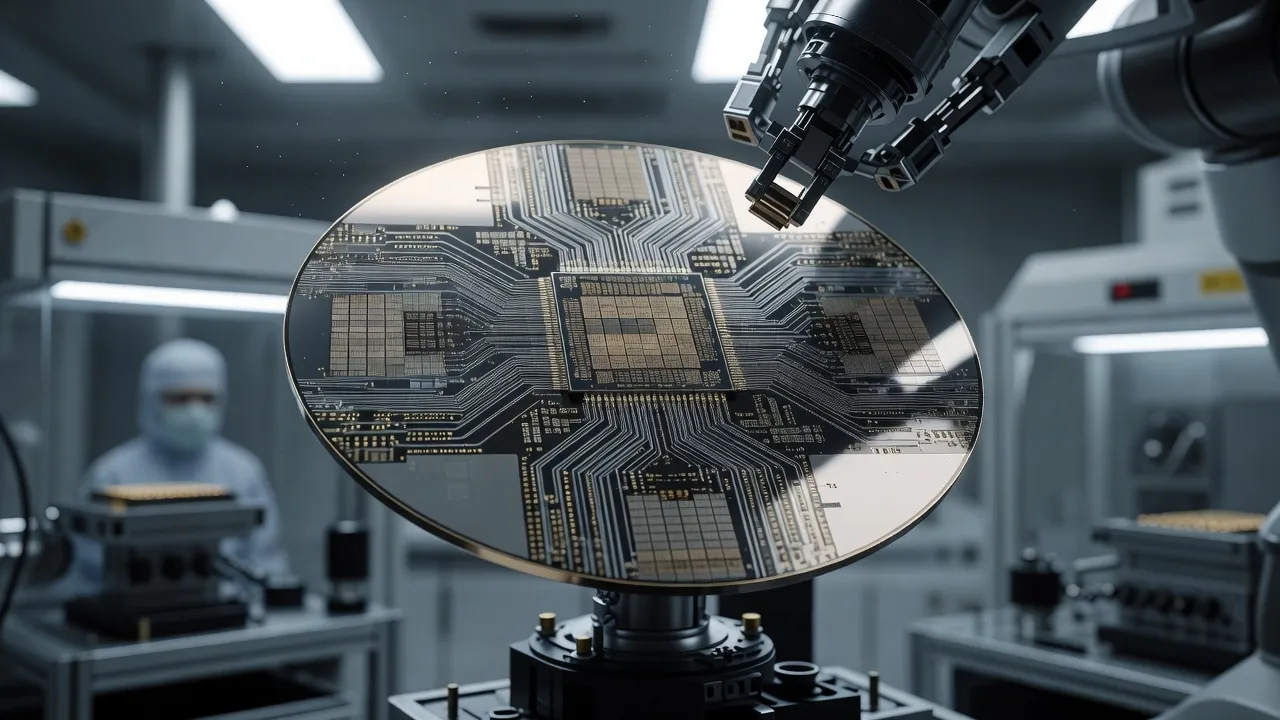
Point a laser at a mirror on a motor and watch what happens. The mirror has to physically rotate before the beam goes anywhere new. That small mechanical delay, measured in milliseconds or microseconds, is the hidden bottleneck behind almost every optical device you own, from a barcode scanner to a fiber-optic router. Researchers at Caltech just found a way around it entirely, using one beam of light to steer another in 74 femtoseconds, with no moving parts at all.
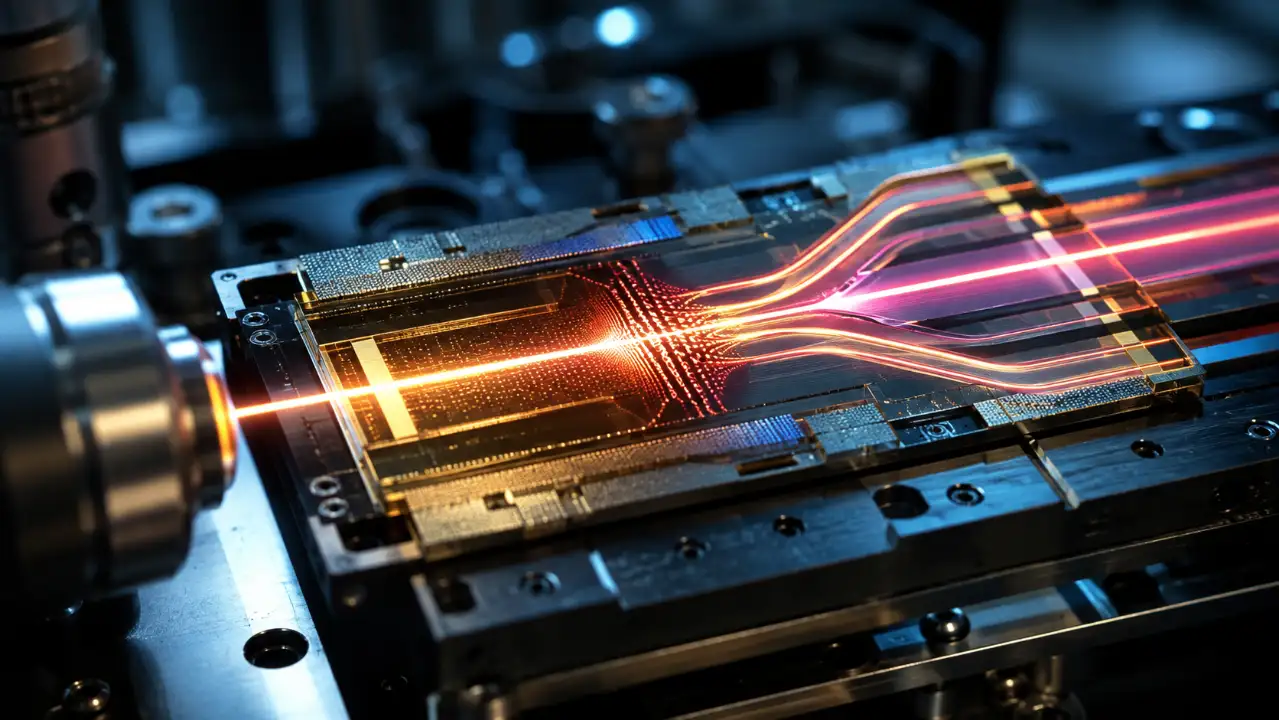
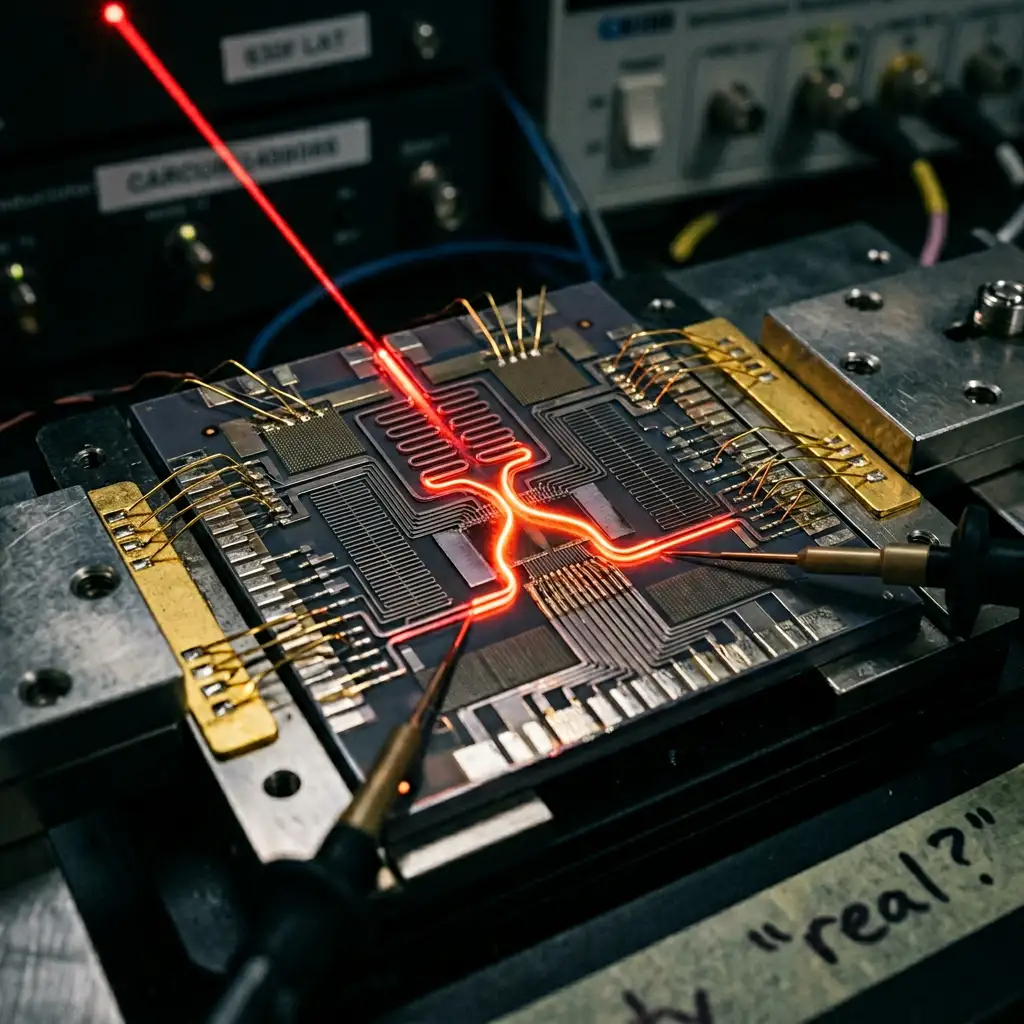
AI Generated Illustration
Seventy-four femtoseconds is 74 quadrillionths of a second. It's roughly the time it takes a pulse of light to cross the width of a human hair. At that speed, the usual language of fast electronics, nanoseconds, microseconds, barely applies. This is light-based computing territory, where the switching happens faster than any transistor could ever hope to react.
The result raises a question that sounds almost absurd until you look at the physics: if a beam of light can be redirected this quickly, does information processing itself have to keep relying on electrons at all?
How Light Controls Light
The device at the center of this work is a metasurface, a sheet of amorphous silicon thinner than a human hair is wide, patterned with nanoscale pillars far smaller than the wavelength of light passing through them. Individually, each pillar is unremarkable. Arranged together in a precise geometric pattern, they force incoming light to linger and circulate inside the structure instead of passing straight through, which is what makes the whole trick possible.
That lingering matters because of the optical Kerr effect, the physical mechanism doing the actual work here. Shine a strong control pulse onto the silicon and its refractive index, essentially how much it bends light, shifts for a fleeting instant. Think of it like briefly changing the shape of a lens while a second beam is already traveling through it, except the lens reshapes itself and then snaps back before the light even finishes crossing the material. There's no waiting around for electrons to settle into a new energy state, which is the slow step in almost every electronic switch.
Using this setup, the Caltech team, led by Harry Atwater's group, steered a probe beam by as much as 13 degrees and demonstrated arbitrary two-dimensional spatial light modulation, meaning they could reshape the light's pattern, not just bend its direction. Change the pattern on the control beam, and the output changes to match, on a timescale that leaves conventional beam-steering hardware looking almost stationary by comparison.
The Real Breakthrough Is the Speed
Conventional electronic switches, even fast ones, are bound by carrier dynamics: electrons and holes have to move, collide, and settle before a signal fully changes state. That process typically takes picoseconds at best. Seventy-four femtoseconds is thousands of times faster, and it was achieved without a single electron changing its energy level in the traditional sense.
What makes this more than a speed record is the shift in what light is being asked to do. In this experiment, light is not just the messenger carrying a signal generated somewhere else by electronics. It's also the switch controlling that signal. The same physical medium is doing both jobs at once.
The important shift here isn't simply making electronics faster. It's learning to control information without waiting for electrons to move at all. That distinction sounds subtle, but it's the entire point. A faster mirror is still a mirror. A material that reconfigures itself using nothing but light is a different category of device, and it raises an obvious follow-up question: can something this fast actually become useful hardware, or does it stay a laboratory curiosity?
Could Photonics Push Computing Beyond Electronics?
The most direct path forward runs through optical signal processing rather than general computing. Ultrafast beam steering could feed into photonic computing architectures, pulse shaping for laser systems, high-bandwidth communications, and high-speed imaging, all of which need to redirect or reshape light faster than a mechanical or liquid-crystal device ever could.
The reason this matters goes beyond raw speed. Modern data centers move staggering amounts of information between electronic components, and every conversion between light and electrical signal costs time and energy. A device that can manipulate light directly, without routing it through electronics first, chips away at that bottleneck rather than just outrunning it.
None of this replaces a CPU or GPU today, and it won't next year either. What the Caltech team built is a building block: proof that light can be steered and reshaped at femtosecond speed using an all-optical mechanism. Whether that block ends up inside a hybrid photonic-electronic chip or something closer to a fully optical processor is still an open question, not a settled one.
What the 74-Femtosecond Number Hides
Here's the detail that gets lost in the more dramatic framing: the 74-femtosecond figure isn't a measure of how fast the metasurface itself can respond. It's the duration of the pump laser pulse used to drive it. The researchers were explicit about this. Their modulation speed matched their pump pulse length almost exactly, which means the material's true ceiling hasn't actually been tested yet.
That leaves a stack of unresolved engineering problems standing between this result and any real device. The control pulses used in the experiment require precise, expensive laser equipment, not something you could shrink into a phone or a data center rack without serious redesign. Optical losses through the metasurface, the difficulty of integrating this kind of structure at scale, and the energy cost of generating femtosecond control pulses in the first place are all real constraints that the current paper doesn't resolve.
It's worth being blunt about what was actually demonstrated: beam steering and spatial light modulation on a single metasurface, in a controlled lab setup. That is not an optical computer, and it is not a drop-in replacement for the transistor. Critics of the broader photonic computing push have made this point for years, that impressive switching speeds on a lab bench have a long, expensive road to travel before they become manufacturable, power-efficient components.
The Next Test Is Turning Speed Into a System
The obvious next step is shortening the control pulses further to find out where the metasurface's actual speed limit sits, since the current number describes the tool, not the material. Better nanostructure designs, larger-scale fabrication, and lower-energy operation all sit on the to-do list before this becomes anything closer to practical hardware.
There's also a broader research current this work connects to. Scientists working on time-varying photonic materials and concepts like optical time crystals are chasing a similar goal: materials whose properties change on ultrafast timescales in controllable, useful ways. This Caltech result sits alongside that effort rather than ahead of it, a demonstrated data point in a field that is still mostly theoretical promise.
The question worth sitting with isn't whether light can be steered this fast anymore. That's been shown. The real question is whether anyone can turn a 74-femtosecond lab result into something reliable enough, cheap enough, and scalable enough to process useful information at a size that matters. Nobody has answered that yet, and the answer probably won't arrive quickly.